
ACOUSTIC SENSING / ENGINEERING AND PROCUREMENT
Acoustic Security System for Drones: Keep Security Alerts Separate from Automatic Enforcement
An acoustic security system for drones can be useful when a site needs an early indication that deserves attention. Microphone arrays and signal processing may identify a sound pattern consistent with an aircraft, but that observation is not the same as proving the aircraft's identity, intent, authorization, or legal status. The safest procurement question is therefore not whether the system can trigger an action by itself. It is whether the system can produce a clear, time-stamped, reviewable alert that helps an authorized person decide what to do next.
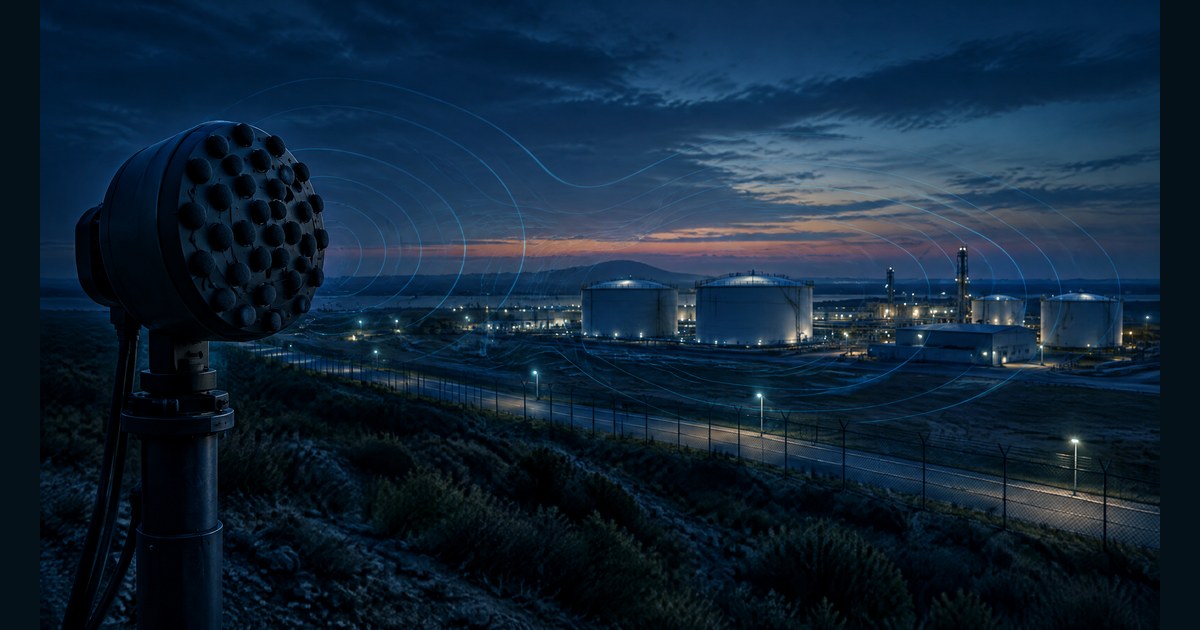
A civil acoustic security system should help teams notice and review a possible drone event. It should not turn an uncertain sound into an automatic enforcement decision.
What an acoustic alert actually means
Acoustic sensing listens for observable sound. A resulting alert may describe a candidate event, a direction, a confidence value, or a classification produced by the system. Those outputs should be named separately in the interface and in the project documentation. Treating them as interchangeable is how a useful observation becomes an overconfident conclusion.
Detection is not identification
A sound consistent with drone propulsion can support detection, but it does not by itself provide a registration number, operator location, aircraft model, permission status, or proof of a violation. The U.S. Department of Homeland Security describes acoustic methods as one detection modality among several. The Federal Aviation Administration describes Remote ID as a separate broadcast source that can provide identification and location information when applicable. A civil workflow should preserve that distinction rather than label every acoustic alert as an identified drone.
Confidence is a review aid, not authority
A confidence score can help an operator sort events, especially when background machinery, wind, birds, vehicles, or construction create competing sounds. It does not grant permission to escalate. The display should show what was observed, when it was observed, which sensor or sensors contributed, and what remains unknown. A low-confidence event may need observation; a high-confidence event may still need independent confirmation and an authorized response path.
Design the alert-to-decision boundary
The most important architecture decision is where sensing ends and accountable decision-making begins. The sensor layer can collect sound, calculate an indication, and pass structured data to a platform. The next layer should support human review, correlation with approved sources, and an explicit record of the decision. Automatic enforcement should not be treated as the default consequence of a sensor threshold.
Use staged alert states
A practical civil workflow can use states such as candidate acoustic event, operator review, corroborated observation, and referred incident. The exact labels should match the site's procedures. Each transition should have a defined owner and evidence requirement. For example, a candidate event might open an observation record, while a corroborated observation might notify a designated safety or security role. This structure keeps notification useful without implying that the system has made a legal finding.
Keep enforcement outside the sensing claim
The FAA's public guidance tells law-enforcement responders to assess the underlying activity, locate or identify the operator where appropriate, determine the type of operation, and decide what level of action is required. That is a human and institutional process. A supplier or integrator can help define alert interfaces and data handoffs, but should not promise that an acoustic sensor itself establishes an unauthorized operation or authorizes intervention.
Build a civil review record
Separating alerts from enforcement is easier when every event leaves an understandable record. The record should help a later reviewer reconstruct what the system heard, what other evidence was available, who reviewed it, and why the event was closed, monitored, or referred.
Capture the observation, not just the alarm
Useful fields may include timestamp, sensor identity, health state, estimated direction if available, confidence or classification output, relevant environmental notes, and links to other approved observations. Store the raw or derived evidence only according to the site's privacy and retention policy. Avoid collecting more audio or personal information than the use case requires.
Record uncertainty and alternative explanations
A reviewer should be able to mark an event as unconfirmed, explained by a known source, awaiting corroboration, or referred for further assessment. This prevents a dashboard from turning a provisional label into a permanent incident narrative. It also gives procurement teams a measurable requirement: the system must support correction, annotation, export, and audit of alert status rather than only displaying a red icon.
Procurement questions for a governed system
Buyers should evaluate governance functions alongside acoustic performance. The goal is not to weaken security response. It is to ensure that a response is proportionate, documented, and assigned to the organization that actually has authority to make it.
Ask what the output means
Request a plain-language definition for each output: presence indication, bearing, track, classification, confidence, and event priority. Ask what test conditions support those outputs and which environmental conditions can reduce reliability. Do not accept a single range or accuracy figure as a substitute for a site-specific acceptance plan.
Ask who can approve the next step
Document the roles for monitoring, escalation, airspace coordination, safety notification, law-enforcement referral, and incident closure. Confirm that software permissions reflect those roles. If an integration can send commands to another system, require a written description of the command path, approval gates, fail-safe behaviour, and records produced. A detection interface should not silently become an enforcement interface.
Ask how authorised flights are handled
A civil site may have inspections, filming, emergency response, or other approved operations. Define how those missions are represented in the review workflow and how an alert is compared with the site's authorisation record. Remote ID, visual confirmation, access-control information, and operator communication may be relevant depending on jurisdiction and site procedures; none should be assumed to be universally available.
A safer operating principle
The strongest civil use case is not automatic enforcement. It is a reliable path from observation to accountable action. An acoustic layer can reduce the time needed to notice a possible event and can give other approved systems a time and direction to investigate. Its value increases when uncertainty is visible and when the resulting record supports a calm, evidence-led decision.
Illustrative example: a restricted industrial site
Illustrative example only, not a SonicVast specification or customer result: a microphone array reports a candidate event near a perimeter. The operator checks sensor health and environmental context, compares the time with an approved flight schedule, and requests a second observation from an authorised source. If the event remains unexplained, the designated site role follows its incident procedure and contacts the appropriate authority. The acoustic alert starts the review; it does not decide the legal response.
Turn the principle into acceptance criteria
During a pilot or acceptance review, test whether users can distinguish detection from classification, see confidence and uncertainty, correlate an event with approved evidence, assign a reviewer, record the disposition, and export an auditable event history. Also test ordinary background conditions and known authorised flights. These checks evaluate the complete decision boundary, not merely whether a sound crosses a threshold.
Specify the handoff before specifying the alarm
Before selecting an acoustic system, draw the event path from sensor output to review, corroboration, referral, and closure. Then ask vendors to map their data fields, permissions, integrations, and audit records to that path. Confirm legal, privacy, and operational requirements for the actual jurisdiction and site.
Discuss your projectAcoustic sensing does not detect literally silent targets or establish a unique aircraft identity, flight permission, or automatic response authority. Legal powers and procedures vary by jurisdiction. Confirm sensor outputs, integration behaviour, privacy controls, and any enforcement workflow in writing for the specific project.