
ACOUSTIC SENSING / ENGINEERING AND PROCUREMENT
Acoustic UAV Detection Equipment: Why a Bench Check Is Not Outdoor Qualification
For buyers, acoustic UAV detection equipment can pass a controlled bench check and still need substantial outdoor qualification. The bench can show that a microphone channel, processor, power path and software build behave as expected under repeatable conditions. It cannot by itself show how the complete installation behaves with wind, reflections, changing background sound, weather exposure, cable runs, mounting structures or site communications. Buyers should therefore treat bench evidence as one gate and outdoor qualification as a separate, site-relevant gate.
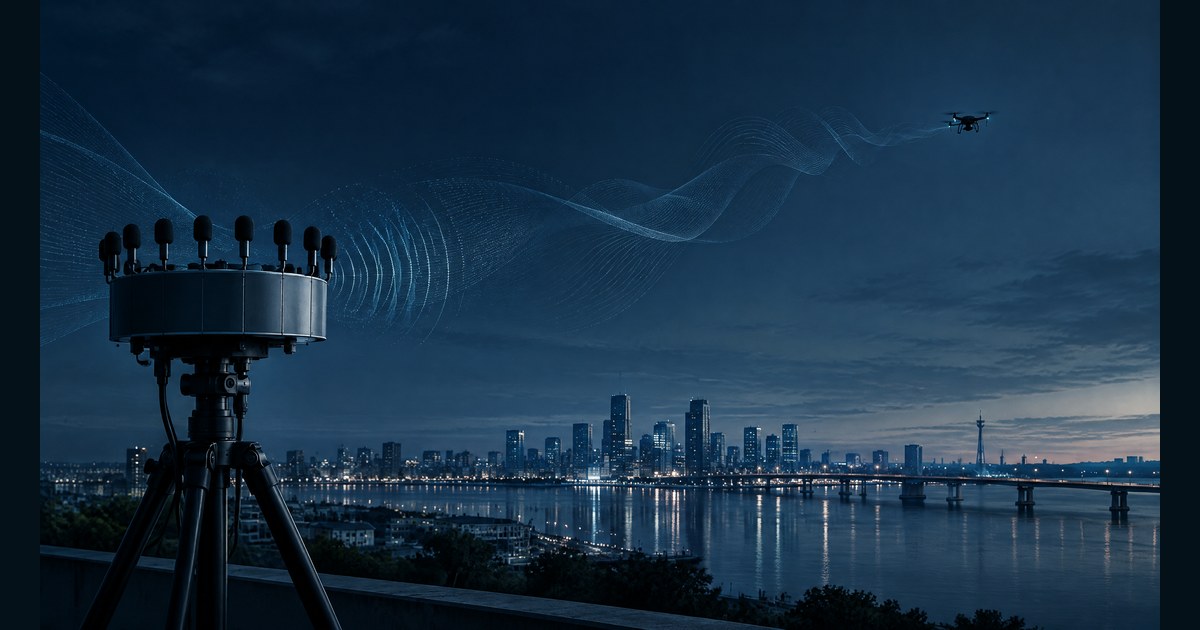
A procurement guide for separating controlled bench verification from outdoor qualification of acoustic UAV detection equipment, with evidence questions for integrators and civil infrastructure buyers.
Start by separating the two questions
The most useful distinction is not indoor versus outdoor location. It is the question each test is designed to answer. A bench check asks whether the supplied equipment is internally functioning and producing a repeatable, interpretable output. Outdoor qualification asks whether the installed equipment and its operating procedure remain suitable in the intended environment. Confusing these questions is a common way to overread a test report.
What a bench check can establish
A controlled check can verify identity and revision, power-up behavior, channel continuity, communications, configuration loading, diagnostic messages and response to a known acoustic input. It can also compare repeated runs against an agreed reference and record the relevant software, firmware, cabling and accessories. These checks are valuable because they isolate faults before a site visit. They are most persuasive when the setup, input, pass criteria and measurement uncertainty are recorded rather than reduced to a statement that the unit passed.
What it cannot establish alone
A bench result does not prove a particular outdoor detection distance, classification confidence, track continuity or false-alarm rate. It does not reproduce every reflection, obstruction, wind condition, temperature change, rain event or background source at a civil site. Nor does a calibrated instrument automatically make the resulting field conclusion fit for purpose. NIST explains that traceability belongs to a documented measurement result and that traceability alone does not guarantee fitness for purpose.
Build a defensible bench-check record
The bench stage should create a clean baseline for later comparison. It is not merely a power-on demonstration. The record should allow another reviewer to understand what was connected, what stimulus was applied, what the system reported and what limits were used to decide pass or fail.
Control the configuration before measuring
Record the equipment identifier, hardware revision, firmware and software versions, microphone or array configuration, power supply, interface settings, cables and any processing profile. If an integrator supplies a host computer, network switch or time source, identify those items too. A later outdoor result is difficult to interpret if the tested configuration cannot be reconstructed.
Use reference inputs and repeatable checks
Where the project permits, use a known acoustic source or approved electrical test input to check the signal path without presenting it as a field performance result. Repeat the same check after reconnecting channels or replacing a cable. Capture raw or suitably time-stamped diagnostic evidence alongside the displayed result. For measurement work, ask what reference was used, what uncertainty was considered and whether the chain of calibration is documented.
Define the bench pass condition narrowly
A sensible bench pass statement might say that all channels produced the expected response within the agreed laboratory limits and that communications and configuration checks completed successfully. It should not silently become a claim that the system will detect every aircraft or operate reliably at a site. Keep functional acceptance, acoustic measurement verification and algorithm evaluation as separate conclusions when they use different evidence.
Design outdoor qualification around the real installation
Outdoor qualification changes the object being tested. The object is now the sensor, enclosure, mount, cable path, power arrangement, network link, processing configuration and operating procedure as a working chain. ISO 1996-2 notes that outdoor sound measurements depend on the selected measurement effort and reported uncertainty, and that operating or propagation conditions may require correction or calculation. That principle is directly relevant to a site test: document the conditions instead of treating one reading as universal.
Document acoustic and physical site conditions
Record sensor height and orientation, nearby surfaces, buildings, barriers, vegetation, access roads and other likely reflectors or noise sources. Note the background sound during each run and whether the source or operating condition was stable. FHWA field guidance illustrates why microphone orientation, extension cables, windscreen use, wind, temperature, humidity and barometric pressure matter to acoustic measurements. The exact limits for a project must be agreed with the measurement and engineering teams rather than copied from an unrelated test.
Test the complete installed chain
Check startup after the intended power arrangement, time synchronization, data transfer, remote health status, local storage or forwarding, alert handoff and recovery after a communications interruption. Inspect connectors, sealing interfaces, strain relief, grounding and mounting stability. A sensor that works on a workbench but loses packets or changes orientation after installation has not completed qualification of the equipment as deployed.
Use representative, controlled observations
A field protocol should state what observation is being made, how it is identified for the test, who authorizes it, which background periods are sampled and what constitutes a valid run. Keep approved test activity, ordinary site activity and unrelated noise events distinguishable in the record. The aim is not to manufacture a favorable result. It is to learn whether the equipment and procedure produce interpretable evidence under the conditions the buyer actually needs to manage.
Use two calibration moments, not one certificate
Calibration evidence has different roles at the bench and in the field. A laboratory certificate can establish information about an instrument or reference under specified conditions. A pre-test and post-test field check helps show whether the measurement chain remained stable during the actual sequence. One should not be used as a substitute for the other.
Before the outdoor sequence
Confirm the condition of the microphone or array, windscreen, cables, front end, reference source and logging system. Perform the agreed field acoustical check and record time, environmental conditions, equipment identifiers and the observed result. FHWA guidance gives a concrete example of performing field acoustical calibration immediately before and after each test sequence; a project may adopt a different protocol, but any deviation should be explicit.
After the outdoor sequence
Repeat the check before dismantling or changing the chain. If the result has shifted, quarantine the affected sequence for engineering review rather than averaging it into an apparently clean outcome. A pre/post comparison does not explain every field error, but it can reveal drift, handling damage, cable problems or an unstable setup that a pre-test certificate could not reveal.
Turn test results into procurement evidence
The buyer should ask for evidence that matches the decision being made. If the decision is whether a delivered unit powers up and communicates, a bench acceptance record may be sufficient for that gate. If the decision is whether an installed acoustic layer is suitable for a particular perimeter or facility workflow, outdoor evidence and site-specific limitations are essential.
Questions for the supplier or integrator
Ask which claims are supported by bench data and which require field data. Request the tested configuration, input or observation method, pass criteria, raw or reviewable records, calibration status, uncertainty treatment, weather and background conditions, installation drawings, software revisions and any excluded conditions. Also ask whether the result concerns detection, bearing, position, classification or another output. These are different outputs and should not be collapsed into a single accuracy label.
Questions for the acceptance plan
Define who witnesses each gate, how an invalid run is handled, what happens after a failed post-test check, which environmental conditions require a repeat, and what documents are delivered at handover. Include a change-control rule for replacing a microphone, mount, cable, firmware build or processing profile. Written project confirmation should govern compatibility, interfaces, service terms and any claimed environmental rating.
Keep the conclusion proportional to the evidence
A good report may conclude that a configuration passed a specified bench check and that a defined outdoor sequence was completed under recorded conditions. It should preserve uncertainty and exclusions. It should not convert a limited demonstration into a universal coverage, availability, certification or aircraft-identification claim. This discipline makes later comparisons more useful and protects the civil operating team from treating an engineering observation as automatic authority for action.
Ask for a two-gate acceptance plan
For an acoustic UAV detection equipment project, request one acceptance record for configuration and functional bench checks, followed by a separate outdoor qualification protocol tied to the intended site. Ask SonicVast or another qualified project partner to confirm the required sensor configuration, interfaces, evidence package and service boundaries in writing before procurement or deployment decisions.
Discuss your projectAcoustic sensing provides observable sound context; it does not detect literally silent targets or by itself establish a unique aircraft identity, flight permission or automatic response authority. Outdoor results depend on the site, test method, environmental conditions and configured system. Any claimed compatibility, environmental rating, certification, accuracy, coverage or service term requires project-specific written confirmation.