
ACOUSTIC SENSING / COMPLIANCE FIRST
Acoustic UAV Detection for Perimeter Security: What Integrators Need to Know
When a low-altitude site needs awareness without turning every sound into an alarm, acoustic sensing deserves a disciplined place in the design conversation. Its value is not a dramatic promise of certainty; it is a contextual observation that can be compared with other authorized sensors and assessed by accountable people.
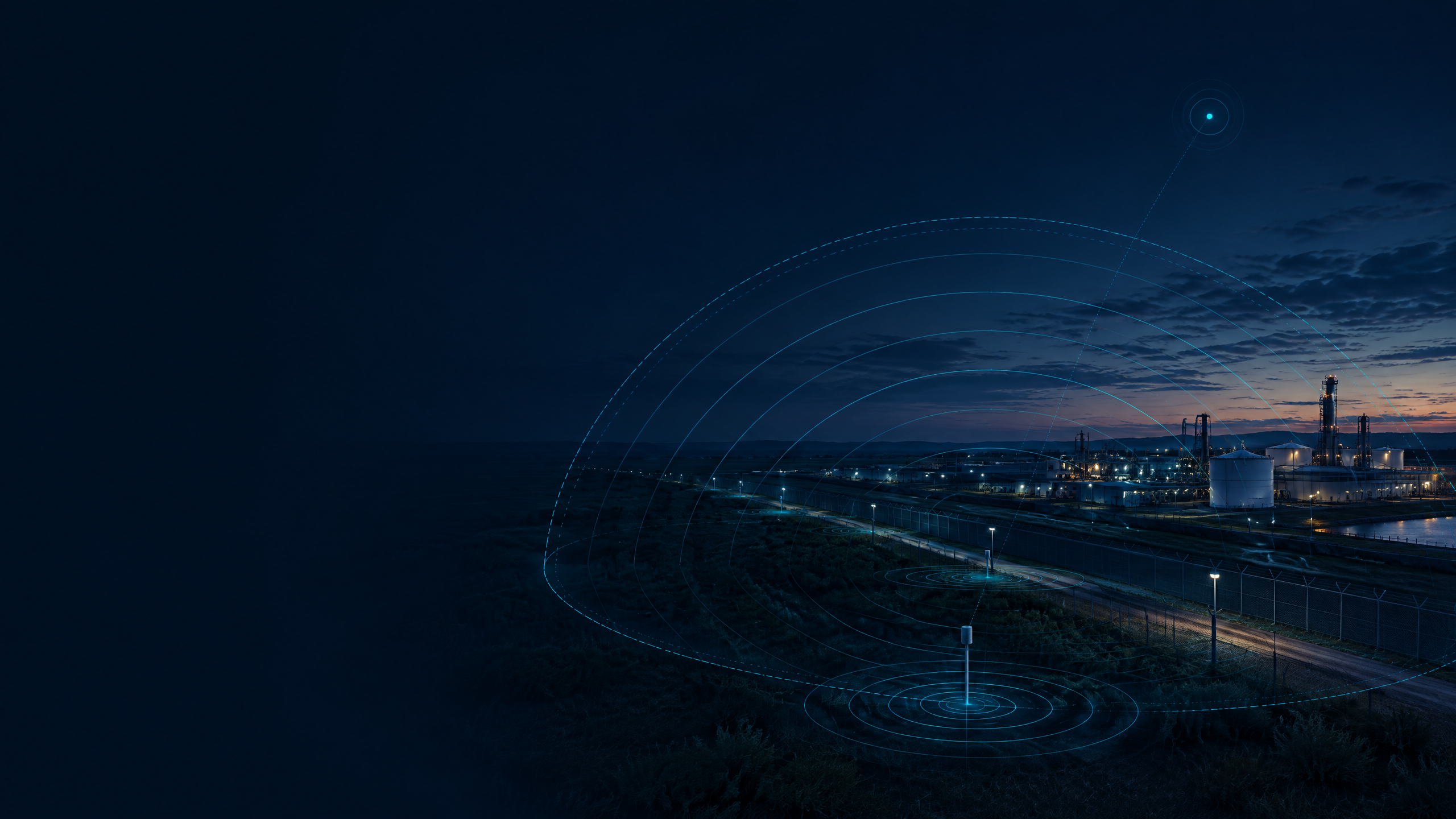
Acoustic sensing can add a useful, reviewable signal to a perimeter-security architecture, but it is not a standalone verdict. Integrators should frame it as one layer in a governed workflow that accounts for site noise, uncertainty, human review, authorization, and data stewardship.
Treat sound as context, not identity
Acoustic detection listens for patterns that may be consistent with an unmanned aircraft, while also encountering vehicles, machinery, weather, birds, construction, and ordinary site activity. A responsible design therefore describes the output as an observation or candidate event. It should preserve confidence and uncertainty in plain language, avoid implying identity, and make clear that classification requires human review and, where authorized, corroboration from other layers such as optical or RF sensing.
Design the handoff before the dashboard
The important integration question is what happens after an acoustic event is raised. Define who may review it, what approved context they can see, how an event is compared with authorized EO/IR or other sensor inputs, and how an uncertain result is recorded. Keep review separate from enforcement decisions: the system may support awareness and investigation, but any response must follow the site’s authority, safety policy, and applicable law.
Give every signal a data boundary
Before connecting an acoustic feed to C2, a security platform, or an API, document purpose, retention, access, auditability, and deletion. Minimize collection where possible; restrict live and stored audio to approved roles; protect exports; and record model, configuration, and reviewer changes. Governance should also address bystander privacy, workplace policy, vendor access, incident handling, and the conditions for pausing a feed.
Validate in the soundscape you actually have
A laboratory demonstration cannot stand in for a site assessment. Validate with the location’s changing noise, structures, weather, operating schedule, maintenance activity, and privacy constraints. Establish an approved test plan, document what was and was not observed, measure nuisance-alert burden in locally meaningful terms, and revisit assumptions after seasonal or operational change. Do not publish a detection-range or performance claim unless it is authorized, reproducible, and specific to the evaluated configuration.
Where this approach fits
Acoustic sensing may be applicable where a civil site needs an additional awareness layer around a defined perimeter and can support authorized review, privacy controls, and maintenance. It may be unsuitable where the soundscape is too variable to interpret responsibly, where stakeholders cannot agree on data governance, or where no accountable reviewer and escalation policy exist. Suitability should be decided with the asset owner through a documented assessment—not inferred from a generic specification.
Start with a governed discovery workshop: map the perimeter, noise environment, authorized data flows, reviewer roles, privacy obligations, and validation plan before selecting hardware or connecting an API.SonicVast provides civil low-altitude security education. This record does not authorize surveillance, interception, jamming, countermeasures, or any response against an aircraft. Follow applicable law, aviation rules, privacy requirements, workplace policies, and asset-owner procedures. Human authorization and site-specific validation remain required.