
INDUSTRY WATCH / NETWORK SENSING
AT&T and Ericsson network-sensing work points to a broader multi-source awareness direction
AT&T and Ericsson public materials describe using characteristics of 5G network infrastructure and reflected radio energy to explore sensing of airborne objects. Reported activity around Latvia’s DiBaX context also illustrates interest in joining communications, AI and multiple sensing inputs. These are technology-direction records, not proof of universal performance, operational deployment, or a substitute for other lawful observation layers.
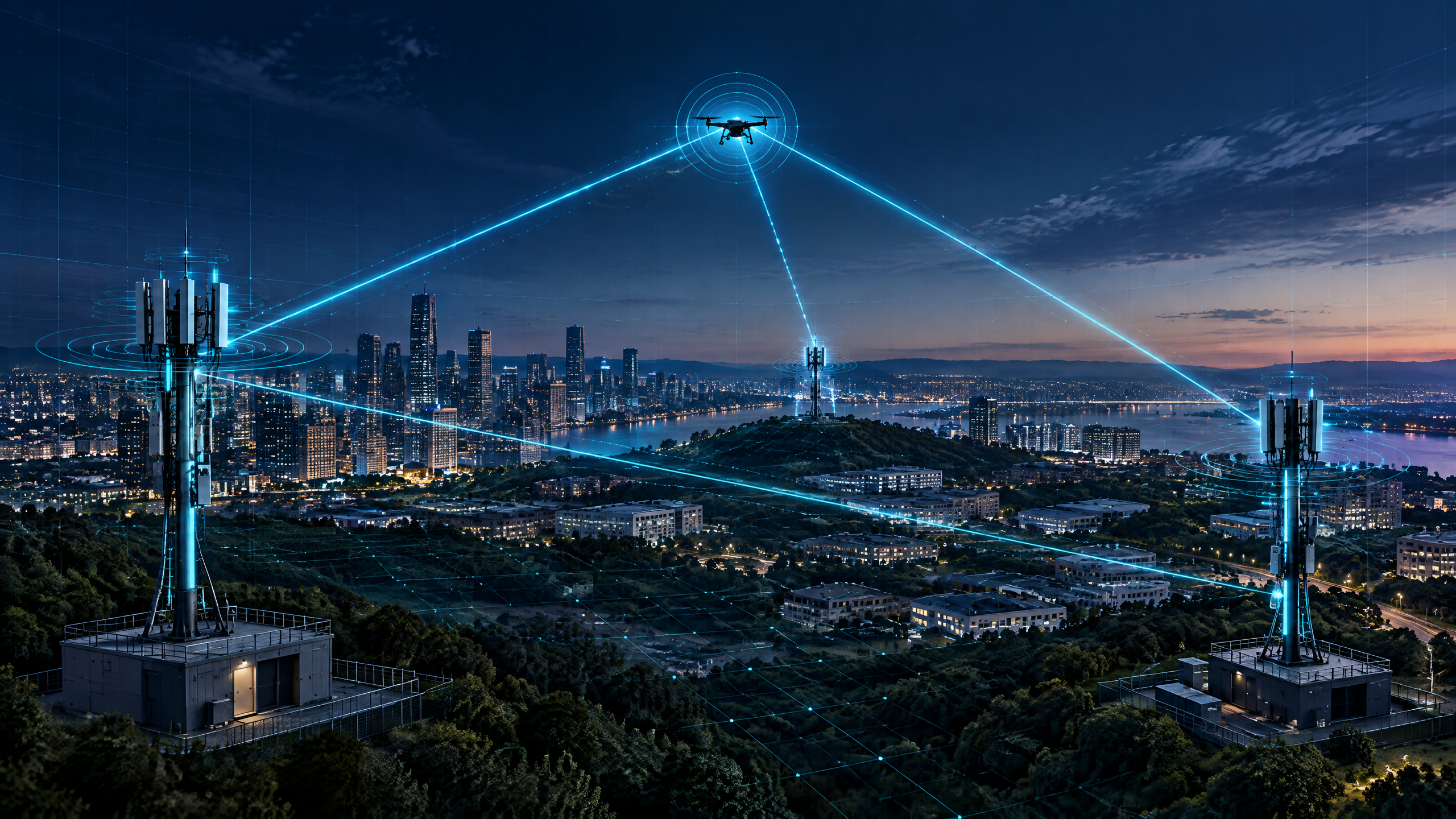
AT&T and Ericsson public material described 5G network-sensing work relevant to drone observation. The reported activity is vendor- and experiment-attributed, and does not establish a mature, general-purpose detection result.
Network sensing examines whether communications infrastructure can contribute an additional observation layer.
Public material describes a direction in which network infrastructure and signal reflections may be analysed for sensing context. That differs from observing a drone’s own control transmission, and it should be understood as a distinct technical approach. The presence of a reflected or modelled signature does not independently establish aircraft identity, operator identity, intent, authorisation or a safety decision.
Communications-derived observations need the same provenance and review discipline as any other source.
A multi-source programme can compare time-aligned observations while keeping the limits of each source visible. Network-derived context may be affected by site geometry, radio conditions, data availability, model assumptions and lawful access controls. A credible integration design records source, timestamp, quality and uncertainty rather than merging every signal into a single unqualified label.
Vendor and event reporting does not establish an operational, airport or SonicVast performance conclusion.
This record does not claim a commercial deployment, C-UAS effectiveness, coverage result, vendor partnership, product interoperability or SonicVast involvement. It does not disclose technical configurations, network parameters or operating methods. Any use of communications-related data requires lawful authority, privacy controls, cyber-security review and accountable human oversight.
A practical integration question for civil stakeholders
The relevant question is whether a site can combine lawful network context with other evidence sources without obscuring uncertainty, increasing unnecessary data collection or weakening accountability. Teams should assess the legal, operational and privacy boundary of each source before introducing it into an awareness workflow.
Discuss Multi-Source AwarenessSource note: AT&T and Ericsson public technology context, Unmanned Airspace reporting and NATO DiBaX 2026 event context. Source names are shown for transparency; no external links are displayed. Statements about network sensing remain vendor- or experiment-attributed. This record does not establish commercial deployment, airport-scale performance, product interoperability, or SonicVast involvement.