
CRITICAL FACILITIES / CIVIL READINESS
How to Build a Civil Low-Altitude Awareness Programme for Critical Facilities
A credible critical-facility programme is not a list of devices. It is a documented operating model for observing changing conditions, deciding when a qualified person should review more information, preserving privacy and coordinating with relevant authorities. Airports, ports and energy facilities have different operational constraints, yet each needs clear authority, safety ownership, data boundaries, supplier accountability and a maintainable lifecycle. This brief intentionally stays non-operational and does not recommend response tools or deployment patterns.
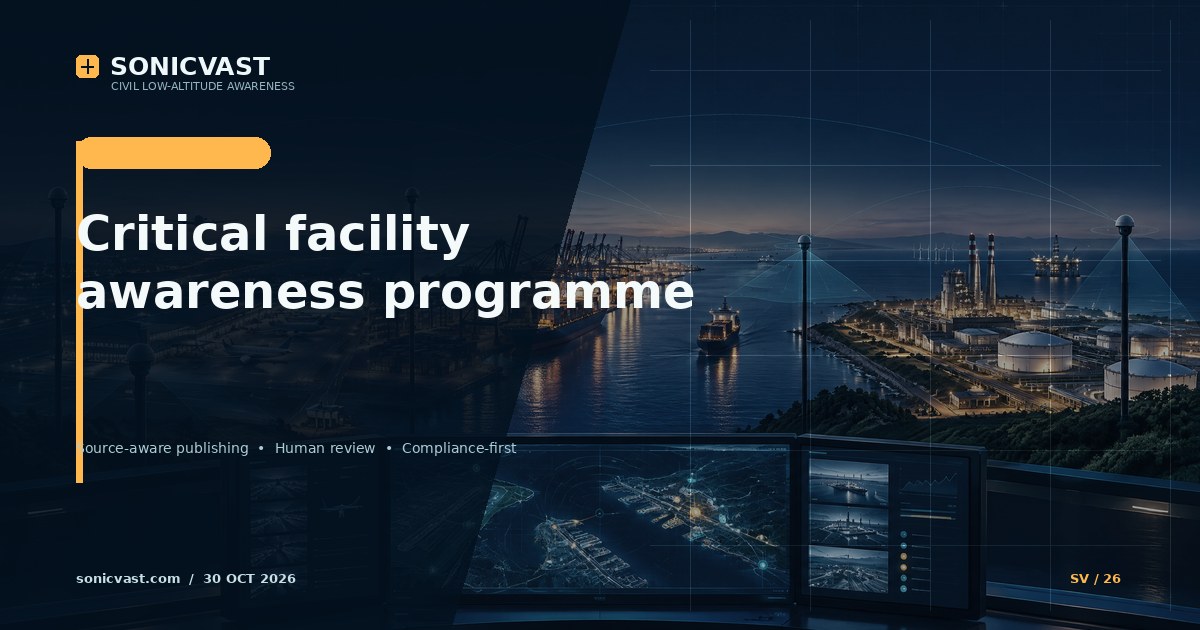
A governance-first framework for airports, ports and energy facilities that begins with lawful questions, proportionate evidence and human responsibility.
Different facilities need different questions and safeguards.
An airport may prioritise aviation coordination; a port may need to align with maritime traffic; an energy facility may focus on process safety and contractor activity. Map decision ownership, applicable authorities, approved escalation and the evidence needed for a proportional human review.
The operating view should make limits legible.
A common view can carry approved sensor or data inputs, but it must show source, timestamp, precision, confidence and health. Preserve the original context rather than flattening it into an unsupported label. Use access controls and retention policies that meet privacy and cybersecurity obligations.
Readiness comes from a maintained programme, not one installation.
Keep commissioning evidence, update control, health checks, supplier support records, training, data-governance review and correction paths current. Reassess as the site, law and authorised mission evolve. Human reviewers retain responsibility for conclusions and coordination.
Create a facility-owned evidence programme
Keep decision logs, source health, review thresholds, authority coordination and lifecycle responsibilities visible to accountable people.
Discuss a civil, compliance-first systems-integration review with SonicVast.Editorial boundary: this civil technical brief covers compliance-first awareness, human review, evidence governance, privacy, cybersecurity and lifecycle assurance. It does not provide tactical deployment, sensitive specifications, interference, interception, targeting, response procedures or performance guarantees. Every site requires qualified local legal, aviation, safety, privacy, cybersecurity and engineering review.