
ACOUSTIC SENSING / ENGINEERING AND PROCUREMENT
Counter UAS System Integration Starts With a Shared Sensor Vocabulary
For buyers, counter UAS system integration often fails before the software is connected: different suppliers use the same word for different outputs. A microphone array may report a bearing, an RF receiver may report an observed signal, radar may produce a plot or track, and an optical camera may provide an image for review. These are complementary observations, not interchangeable proof. This guide gives civil infrastructure buyers and integrators a common vocabulary for specifying interfaces, reviewing alerts and documenting what a multi-sensor system actually knows.
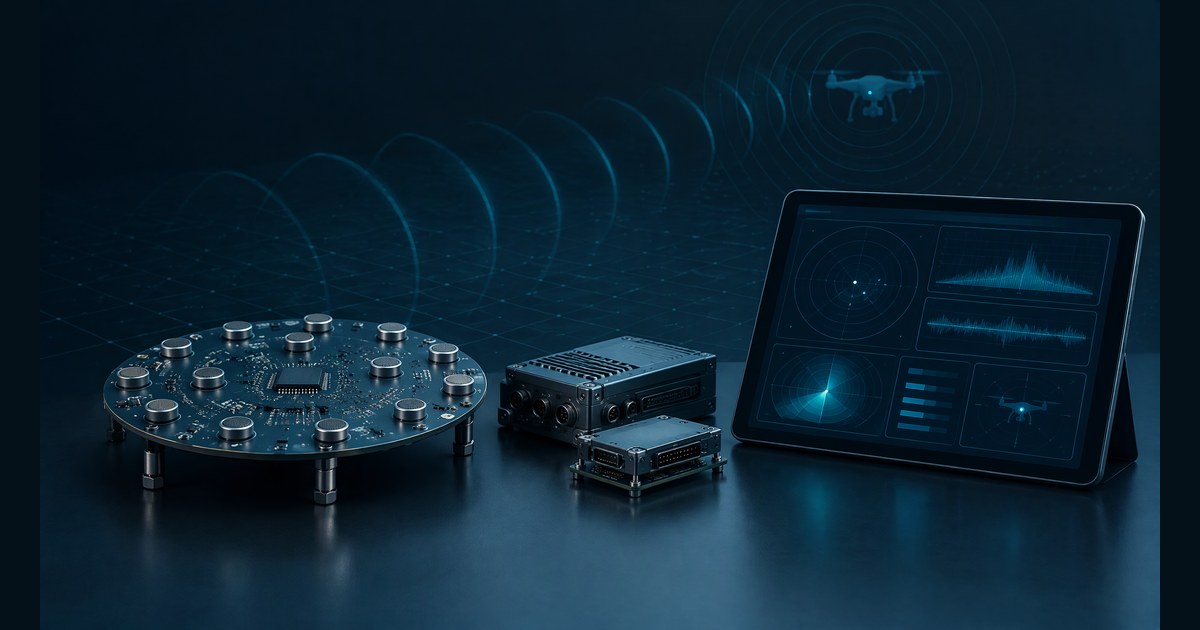
A practical terminology guide for buyers and integrators comparing acoustic, RF, radar and optical sensing without treating unlike outputs as equivalent.
Start by separating the sensing verbs
The first useful distinction is between what a sensor observes and what an application concludes. The FAA describes UAS detection systems as technologies that can detect, monitor or track, and notes that radar, RF, electro-optic and acoustic sensors may operate alone or in combination. It also states that detection systems do not determine intent or the level of threat posed by a UAS. That boundary should appear in requirements, user interfaces and acceptance records.
Detection is an observation, not an identity
Use detection for the system's notice that a signal, object, sound pattern or image feature meets a defined rule. It does not automatically mean the target is a drone, a particular model or an unauthorised flight. A buyer should ask what constitutes a detection, what evidence is retained and whether the event can be reviewed later. Avoid writing a requirement that silently turns an alert into an identification claim.
Monitoring, tracking and classification are different outputs
Monitoring usually means continued observation of an area or event stream. Tracking means maintaining an evolving estimate of an object's or event's state, such as position and time, with an explicit uncertainty. Classification assigns a category supported by the available evidence; identification is a stronger claim about what the object or signal is. These words should be separate fields in an interface rather than interchangeable status labels.
Define each sensor by its observable
A sound, radio emission, radar response and image are different physical observables. Integration becomes clearer when every source is described by the evidence it contributes, its timestamp and its limitations. The source name should not be used as a shortcut for a capability that has not been tested at the site.
Acoustic: sound evidence and directional context
An acoustic sensor receives environmental sound. An array can estimate direction from differences in arrival time or related signal-processing features, but a bearing is not the same as a geographic position. Wind, machinery, birds, buildings and other sources can affect the observation. Acoustic output should therefore state the time window, bearing or sector if available, confidence or quality indicator, and the environmental conditions relevant to review. It cannot establish a unique aircraft identity or detect a literally silent target.
RF: observed radio activity, not aircraft presence by default
An RF sensor reports radio-frequency energy or a recognised signal feature within a defined band and processing rule. The result may be a frequency observation, protocol or signal classification, but it is not automatically a position, aircraft identity or proof of control. A system should distinguish signal detected, signal classified and signal correlated with another observation. RF silence is also an absence of an observation, not proof that no aircraft is present.
Radar: measured returns that can support plots and tracks
Radar actively transmits and receives electromagnetic energy to derive information from returns. Integrators commonly distinguish a plot, which is a detection report at a time, from a track, which is a maintained estimate built from multiple observations. A radar track still has uncertainty and may need correlation with other sources. Do not ask an acoustic or RF input to imitate a radar track unless the system defines how that transformation is calculated and labelled.
Optics: image evidence under stated viewing conditions
Electro-optical cameras provide visible-spectrum imagery, while infrared systems provide information in infrared wavelengths. An optical cue can support visual confirmation or classification when the object is within the field of view and image quality is adequate. Lighting, weather, occlusion, focus and line of sight matter. A camera frame is evidence for review; it is not automatically a confirmed identity or a continuous track.
Use one event model across unlike sources
The integration layer should translate sensor-specific outputs into a common event record without erasing their origin. This is the practical meaning of a shared vocabulary: the operator can see what was observed, by which source, when, with what quality, and what later inference was made.
Minimum fields for a trustworthy observation
For each event, define a source identifier, sensor modality, timestamp and time standard, location reference or bearing reference, measurement or reported feature, quality indicator, processing version and retention reference. Add the source's coverage or availability state. These fields let reviewers distinguish a raw observation from a derived alert and compare events without pretending that every modality measures the same thing.
Keep raw evidence, derived tracks and decisions separate
A raw audio segment, RF feature record, radar plot or image should not be overwritten by a fused label. Store the derived track or correlation result as a separate record that points back to its contributing observations. Keep the operator decision separate again. This structure supports troubleshooting when a source is noisy, unavailable or later found to have used a changed algorithm.
Specify fusion without hiding uncertainty
Sensor fusion can mean several things, from displaying events together to mathematically combining measurements into one estimated track. A procurement document should name the level intended. The FAA's airport guidance notes that sensor technologies may be combined for primary and secondary validation, but it also keeps detection separate from intent and threat assessment. A fused screen should preserve that distinction.
Association is not confirmation
Association links observations that may refer to the same object or event. It can use time, location, bearing, motion or signal features, but the rule should be documented. A radar track near an acoustic bearing is a useful correlation candidate; it is not automatically proof that both sensors observed the same aircraft. Show contributing sources and the association status so the operator can challenge a weak link.
Confidence needs a definition and a provenance trail
A confidence value is meaningful only when the system defines what it represents, how it is calibrated or evaluated, and which inputs contributed. Do not compare an acoustic classifier score with a radar tracking quality value as if they shared a scale. Label modality-specific scores, explain fused scores in documentation, and retain the software or model version used to create them.
Turn terminology into an integration acceptance checklist
A terminology review should happen before a demonstration is called successful. The goal is not to force every supplier into one internal design, but to ensure that the buyer can compare outputs, reconstruct an event and understand limitations across the complete workflow.
Questions for supplier and integrator documents
Ask: Is this field a measurement, an estimate, a classification or an operator decision? What is its timestamp and time accuracy? Is location measured, inferred or manually entered? Which raw evidence supports it? What happens when a sensor is degraded or unavailable? Can an alert be acknowledged without being treated as an identification? Which interface version and algorithm version produced the record?
A useful illustrative example
Illustrative example, not a SonicVast specification: an acoustic node reports a candidate sound with a bearing; a radar reports a nearby track; an RF receiver reports no relevant signal; and an optical camera obtains a low-quality frame. A well-governed interface would show four source records, a provisional association and the reasons visual confirmation is limited. It would not label the event as a confirmed aircraft identity merely because several panels changed together.
Request a modality-by-modality data dictionary
For the next project review, ask each supplier to provide a data dictionary covering observables, units, timestamps, quality fields, uncertainty, provenance, degraded states and derived outputs. Then map those fields into one event model before selecting a fusion or command interface. SonicVast can discuss acoustic sensing, PCBA and integration requirements as project-specific engineering questions subject to written confirmation.
Discuss your projectSensor terminology and regulatory conditions vary by project and jurisdiction. Detection, classification or correlation does not by itself establish intent, authorisation, identity or authority to take action. Site testing and written interface definitions are required.