
ACOUSTIC SENSING / ENGINEERING AND PROCUREMENT
Counter UAS System Integration When One Sensor Is Degraded or Unavailable
Counter UAS system integration is easiest to describe when every sensor is online. Real sites are less tidy: an acoustic node may be masked by construction noise, a radar feed may be under maintenance, an RF receiver may have no observable signal, or an optical camera may be unusable in darkness or weather. The integration question is not whether the remaining sensors can produce a reassuring display. It is whether the system can show what changed, limit the conclusions that follow, and preserve a reviewable record.
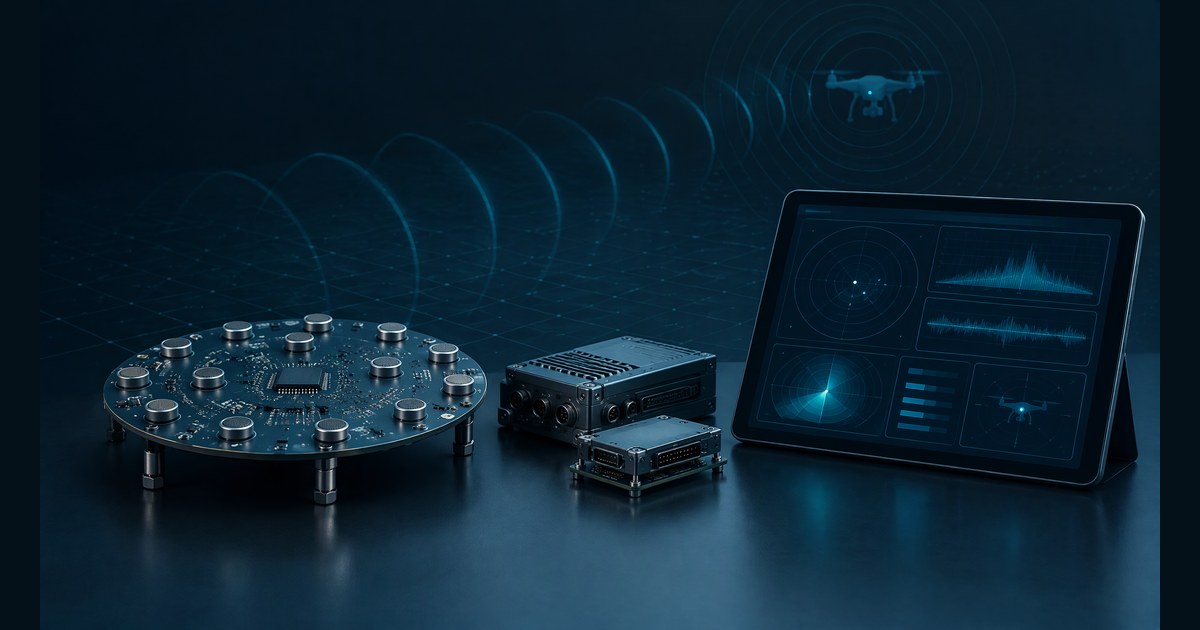
A practical governance guide for keeping a civil multi-sensor awareness workflow honest and usable when acoustic, RF, radar or optical data is missing, stale or unreliable.
Treat degraded operation as a defined system state
A missing sensor should not silently become a missing fact. Before procurement or commissioning, the integrator and site owner should define the states that can affect interpretation: healthy, degraded, unavailable, stale, under maintenance, and restored-but-not-yet-verified. NIST describes resilient systems as continuing essential functions in a degraded or debilitated state after faults or failures. For a civil awareness system, that principle means continuity with narrower claims, not continuity of the same confidence.
Separate availability from usefulness
A feed can be technically connected yet unsuitable for a particular decision. A microphone array may be reporting while its local noise floor is elevated. A camera may be streaming while visibility is inadequate. A radar may be powered while its coverage is constrained by a temporary obstruction. The integration layer should therefore expose both connection status and data-quality status. “Online” is not the same as “fit for every interpretation.”
Write the degraded-mode contract before testing
The project should document which outputs remain available when each source is lost. For example, a remaining source might support an alert for review but not a location estimate; a historical track might remain visible but not be refreshed; or an acoustic observation might retain time and direction while classification is withheld. These are project decisions to validate with the actual architecture, not universal promises about any sensor type.
Make the health of every observation visible
Operators and later reviewers need to see the condition under which an observation was created. The OGC Timeseries Profile describes metadata for correct machine interpretation and supports status, quality, time, and point-level context. A counter-UAS integration does not need to adopt that standard in every project, but it should adopt the underlying discipline: an observation should carry enough context to avoid being mistaken for a current, verified, full-quality measurement.
Minimum fields for a governed event record
A useful event record can include the source identifier, observation time, receipt time, location reference, output type, processing or software version, health state, quality flag, and reason for any missing or withheld value. It should also identify whether the value is raw, derived, correlated, or manually reviewed. The exact schema belongs in the interface-control document. The principle is stable: preserve the conditions around the data, not only the headline track.
Do not turn stale data into live certainty
A last-known position or classification can be useful for context, but its age must remain visible. A simple freshness rule can mark an observation as current, aging, or stale according to the site's operational needs. If the system extrapolates a track during a gap, that extrapolation should be labeled as such. A display that hides the gap may look continuous while creating a false impression of continuous sensing.
Change confidence rules when an input disappears
Multi-sensor correlation is not a license to average away uncertainty. When one input is degraded, the fusion service should apply a documented rule for what can be combined and what must remain separate. UK Dstl's SAPIENT guidance presents shared interfaces and information fusion as ways to combine complementary strengths and mitigate weaknesses, while also acknowledging that edge AI can produce false alarms, inconsistencies and errors. The procurement task is to make those limitations observable and governable.
Use confidence bands, not a single green light
A site can define levels such as corroborated, single-source candidate, context-only, and unknown. The labels should describe evidence status rather than imply aircraft identity or intent. If acoustic data is unavailable, an event supported by another source may remain a candidate observation, but the interface should not preserve a confidence label that depended on acoustic corroboration. Every confidence change needs an explanation that an operator can understand.
Define what must be withheld
Some outputs should disappear or be explicitly marked unavailable when their supporting input is missing. Examples include a classification that requires a particular feature set, a location estimate that depends on synchronized nodes, or a correlation result that has exceeded its allowed time gap. Withholding an unsupported output is a quality feature. It is safer for a review record to say “not determined” than to fill a gap with a plausible-looking value.
Give people a clear handover and escalation path
Degraded-mode governance is partly technical and partly organisational. A site needs a named owner for sensor health, a named reviewer for ambiguous events, and a rule for when a degraded condition becomes a maintenance or operational continuity issue. This is not an instruction to automate a security response. It is a way to ensure that a display change reaches the person who can assess its significance under local policy.
Use a short operator-facing status message
The interface should answer three questions without requiring a diagnostic investigation: which source is affected, since when, and what decision outputs are limited. “Acoustic node 2 unavailable since 14:20; directional acoustic corroboration withheld” is more useful than a generic red icon. The message should link to the event and maintenance record so a later reviewer can reconstruct the timeline.
Test recovery as a separate state
A sensor that reconnects is not automatically a trusted sensor. The recovery workflow can include time synchronization, health checks, calibration or self-test results, and a controlled return to service. Until those checks pass, the source can be marked restored-pending-verification. This prevents a short reconnect from silently changing the interpretation of events collected during the fault.
Turn degraded-mode requirements into acceptance evidence
A live demonstration with every feed operating does not prove resilient integration. Acceptance should include controlled interruptions and the records they produce. The aim is not to publish a universal performance number. It is to verify that the agreed behavior is visible, bounded, and repeatable in the buyer's environment.
Ask for scenario-based test cases
Useful cases include one sensor going offline, delayed messages, bad timestamps, a high-noise acoustic interval, loss of network connectivity, a stale track, and a sensor returning after maintenance. For each case, the test script should state expected status labels, allowed outputs, prohibited inferences, operator notification, audit fields, and restoration steps. The buyer can then compare the delivered behavior with the interface-control document rather than relying on a general claim of interoperability.
Review the record, not only the screen
After each test, export the event history and inspect whether it preserves source identity, times, health changes, quality flags, decisions and acknowledgements. Check whether a later reader can distinguish a sensor absence from an absence of an aircraft. This evidence is also valuable when the site adds an acoustic layer, changes a camera, upgrades a fusion service, or changes its operating policy.
Ask the integrator to demonstrate one-sensor loss
For the next project review, choose one acoustic, RF, radar or optical source and ask for a controlled outage demonstration. Require the team to show the resulting status, confidence change, withheld outputs, operator message, audit record and verified recovery. Then confirm which interface fields, SDK or API behaviors, and support responsibilities will be delivered in writing for the actual project.
Discuss your projectSensor behavior depends on site conditions, architecture, timing, maintenance and the approved data model. Acoustic observation does not establish unique aircraft identity or flight authorization, and a missing RF observation does not prove that an aircraft is absent. Any response or intervention remains subject to applicable law, site safety procedures and authorised human decision-making.