
ACOUSTIC SENSING / ENGINEERING AND PROCUREMENT
Drone Acoustic Detection System: Why Measuring Sound Is Not the Same as Detecting a Drone
A drone acoustic detection system does more than report how loud a site is. It evaluates sound observations against a detection logic, which may include time windows, frequency features, array relationships, and contextual rules. Confusing the two functions can produce a specification that asks a sound-level instrument to make an aircraft judgment, or a detection platform to provide metrology evidence it was never designed to produce.
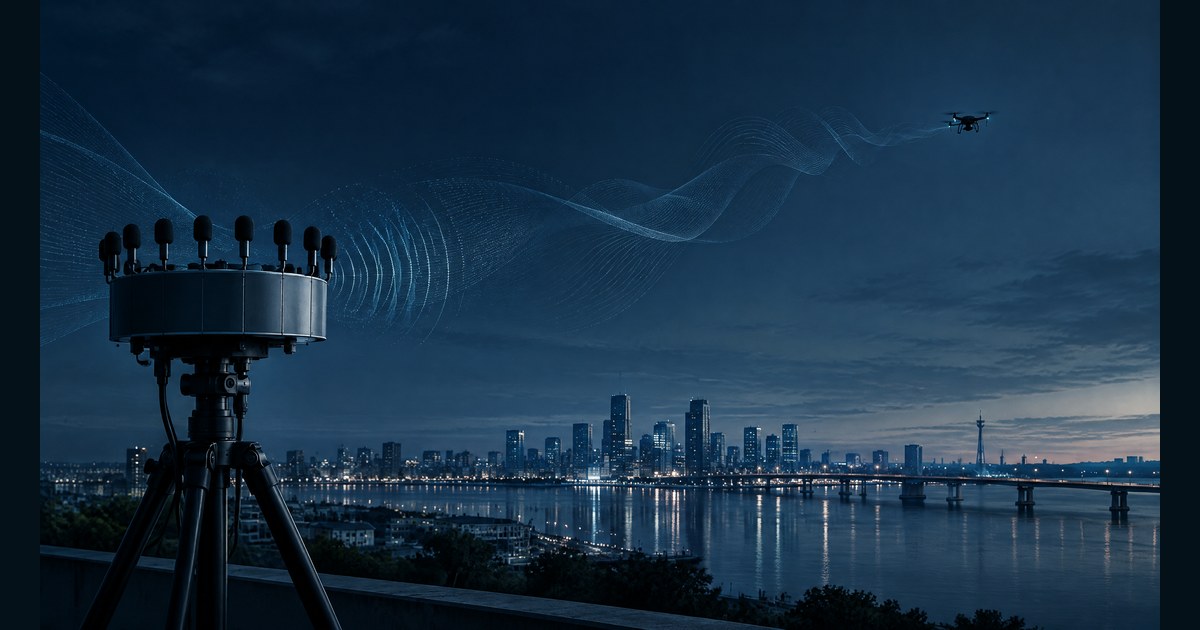
A practical guide for separating calibrated sound measurement from event detection, acoustic classification, and directional review when specifying a civil low-altitude sensing project.
What sound measurement actually tells you
Sound measurement turns an acoustic signal into a defined quantity under a stated method. A sound-level meter may report a time-weighted level, a time-averaged level, or sound exposure level. These outputs are useful for comparing environmental conditions, checking a measurement procedure, and documenting how the acoustic field changed over time. They are not, by themselves, a declaration that a drone is present.
A level is a quantity, not an identity
A measured sound-pressure level can rise because of many sources. Rotating equipment, vehicles, birds, wind effects, construction, and aircraft can all change the observed level. Even a strong level excursion does not establish which source caused it. IEC 61672-1 describes sound-level instruments through their measurement outputs and performance categories; it does not turn a level reading into an aircraft classification.
Calibration answers a different question
Calibration concerns the relationship between a microphone's electrical output and the sound-pressure quantity it represents. NIST explains that microphone calibration establishes sensitivity for sound-pressure measurements and supports traceability for other acoustic measurement equipment. This is essential evidence for measurement quality, but calibration alone does not validate a drone-detection model, an alert rule, or a location estimate.
What detection adds to the measurement
Detection is a decision process built on observations. A detection function asks whether the available signal and context meet a defined condition for a candidate event. In an acoustic project, that condition may involve a changing spectrum, a duration pattern, repeated features, energy across several microphones, or agreement with an approved secondary source. The output should be named precisely: candidate acoustic event, drone-like acoustic event, alert, or another term defined in the specification.
Detection is not automatic identification
An acoustic alert is evidence for review, not proof of an aircraft identity, operator, authorization status, intent, or threat level. The FAA describes acoustic sensors as one possible UAS detection technology and explicitly notes that detection systems do not determine intent or the level of threat posed by a UAS. A project specification should therefore keep detection, classification, identification, and response as separate outputs and responsibilities.
Classification needs a stated evidence basis
If a system uses a classifier, the buyer should ask what input data it uses, what classes it distinguishes, and how uncertain or ambiguous observations are represented. A label such as drone detected is stronger than a measured spectral feature, so the documentation should show the decision path between them. Avoid treating a model label as a universally valid identity claim across every site and aircraft type.
Why arrays can support directional detection
A single microphone primarily provides a local acoustic observation. Multiple synchronized microphones provide relationships that can be processed for directional or source-localization information. This is a different analytical layer from measuring the level at one point. It can help a review team understand where a candidate sound appears to originate, while still leaving uncertainty caused by reflections, obstructions, changing propagation, and overlapping sources.
Localization uses relationships between channels
NASA Glenn explains that microphones arranged in one-, two-, or three-dimensional arrays can be processed to pinpoint noise sources. In procurement language, this means the buyer should specify whether the desired output is per-channel level, a bearing estimate, a position estimate, a track, or only a zone indication. These outputs should not be collapsed into one vague word such as accuracy.
A directional result still needs site evidence
An array-derived direction is an estimate from the received signals. Buildings, terrain, machinery, wind, and reverberation can affect the result. Recorded test data can show that a processing chain behaves consistently under selected conditions, but it does not automatically prove field performance at another site. Field observations and recorded observations should therefore be traceable to their conditions, timestamps, sensor state, and review outcome.
How to write the distinction into a specification
A good specification separates the sensing chain from the decision chain. It states what is measured, what is calculated, what is classified, and what is shown to an operator. This prevents a supplier from answering a detection question with a decibel figure or answering a measurement question with an unexplained confidence score.
Name the output before asking for performance
Start by naming the required output: calibrated sound level, waveform or feature record, acoustic event, bearing, location estimate, track, or operator alert. Then define the evidence and review conditions for that output. A measurement requirement may need units, weighting, time response, calibration records, and uncertainty. A detection requirement may need event criteria, alert latency, logging, false-alert review, and a procedure for ambiguous observations.
Keep test evidence comparable
For each test, record the acoustic scene, source condition, sensor configuration, software or model version, weather or environmental notes where relevant, and the ground-truth method. Compare like with like: a controlled recording is not the same evidence as a live field observation, and a source-localization result is not the same metric as a sound-level result. This vocabulary makes acceptance discussions more reproducible without inventing a universal performance number.
A buyer’s review questions
Before comparing suppliers, ask questions that reveal whether the proposed system is a measuring instrument, a detection analytic, or a combination of both. The answers should be written into the project record rather than inferred from marketing labels.
Questions about the acoustic measurement layer
Ask which acoustic quantities are reported, whether microphone sensitivity is calibrated, how timestamps are maintained, what data is retained, and which environmental conditions can invalidate or complicate a measurement. Also ask whether the measurement path is intended for metrology-style reporting, analytic feature extraction, or both.
Questions about the detection and review layer
Ask what event causes an alert, how the system represents uncertainty, whether the output is a candidate event or a confirmed class, how an operator can inspect supporting evidence, and how the system behaves when the sound is masked or ambiguous. If integration with other approved sensors is planned, define whether acoustic data is primary evidence, secondary validation, or contextual information.
Define the required output before choosing the sensing architecture
For a civil project, begin with an output register that distinguishes measurement, event detection, classification, localization, and operator review. Then ask SonicVast or another qualified integrator to confirm which sensor data, interfaces, records, and project tests support each output. Treat compatibility, software behavior, and acceptance criteria as items for written project confirmation.
Discuss your projectAcoustic sensing can provide useful sound context but cannot detect a literally silent target or, by itself, establish a unique aircraft identity, flight authorization, intent, or automatic response authority. Actual results depend on the site, acoustic environment, sensor configuration, processing, and documented test conditions.