
ACOUSTIC SENSING / ENGINEERING AND PROCUREMENT
Drone Acoustic Detection System Testing: How to Compare Recorded and Field Observations
A drone acoustic detection system can appear consistent on a fixed collection of audio files and behave differently when microphones, weather, background sound, aircraft type, or operating procedure changes. The procurement question is therefore not simply whether a model detected a sound once. It is whether the same test definition can be repeated, whether changed conditions are documented, and whether recorded results provide a defensible bridge to field observation.
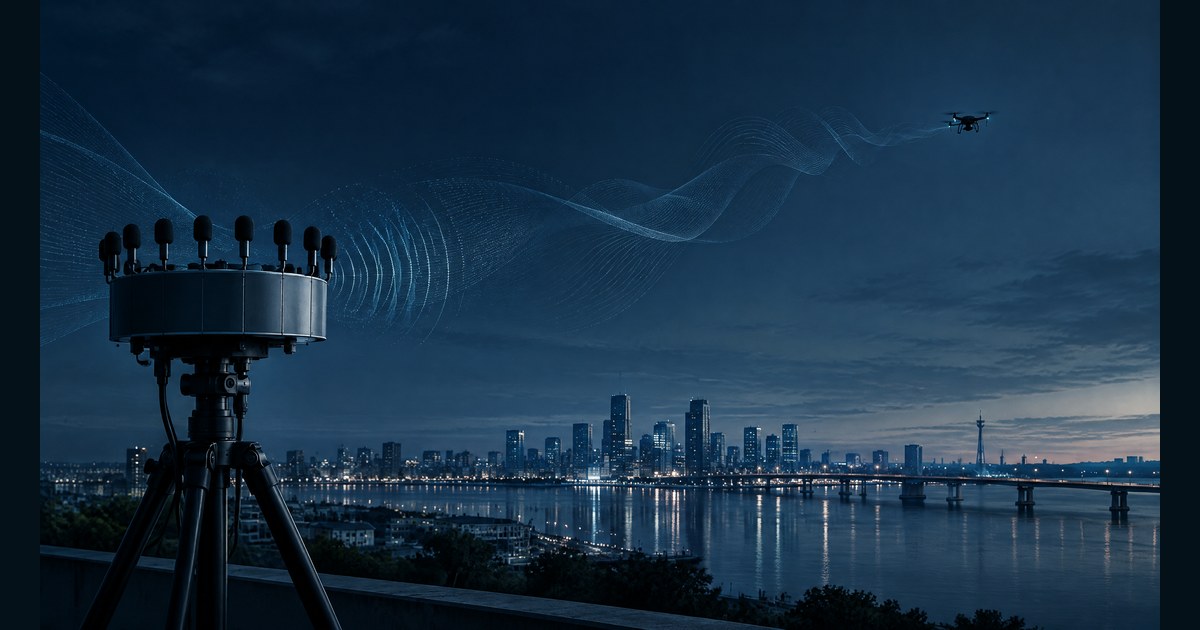
A practical evidence framework for checking whether acoustic detection results remain comparable when a controlled recording set becomes a changing real-world observation.
Start by separating repeatability from reproducibility
These terms are often used as if they mean the same thing. They do not. NIST defines repeatability as agreement between successive measurements of the same measurand under the same conditions. Reproducibility concerns agreement when conditions change, and a valid reproducibility statement must specify what changed. ISO 5725-2 likewise frames precision experiments around estimating repeatability and reproducibility rather than treating one test result as universal evidence.
Repeatability asks whether the test can be run consistently
For an acoustic detector, a repeatability test might hold the audio files, preprocessing, software version, threshold, and evaluation rule constant. The team can then rerun the same files or replay a defined signal and check whether the output category, timestamp, confidence field, or alert decision is stable. The test report should name the fixed conditions instead of using a vague label such as reliable.
Reproducibility asks what survives a controlled change
A reproducibility test changes one or more stated conditions, such as a different recording session, microphone unit, site position, time of day, background-noise state, drone model, or operator workflow. The result is not a single universal score. It is evidence about the system under those specified changes. If several conditions change at once, the report should acknowledge that the causes of any difference cannot be isolated cleanly.
Make the recorded dataset a documented test instrument
Recorded audio is valuable because it can be replayed, inspected, and shared under controlled rules. It becomes weak evidence when the provenance and labels are unclear. A buyer or project team should ask for a dataset description that makes each result auditable without assuming that a recording represents every future site.
Record provenance, labels, and exclusions
For each clip or segment, document the intended target condition, whether the clip is positive or negative, recording date and location class, microphone and channel identity, sampling and file settings, relevant background sources, and the rule used to mark the target interval. Keep exclusions visible. Removing difficult clips after seeing the result can make a dataset look cleaner while reducing its value for procurement review.
Prevent leakage between development and evaluation
If near-duplicate clips from the same flight, session, or background event appear in both development and evaluation sets, the reported result may reflect memorisation of a recording context rather than generalisation. A practical control is to split by session or collection event, not only by short audio window. The split rule and any tuning performed after evaluation should be retained in the test record.
Use field observations to test changed conditions
Field work is not merely a louder version of a laboratory test. UK government guidance notes that acoustic sensor range depends on microphone sensitivity, how noisy the drone is, and whether motor sound rises above wind, engines, or other noise. It also notes that different drones can have substantially different sound signatures. Those variables are exactly why a recorded benchmark and a field observation should be related but not conflated.
Define the field condition before collecting results
A field test plan should state the observation window, target aircraft or target class, permitted flight and safety arrangements, microphone configuration, approximate environmental state, background activity, and the reference used to establish whether the target was present. The purpose is not to prescribe a universal flight geometry. It is to ensure that a later reader knows what the detector was actually asked to observe.
Pair positive and negative evidence
A field record needs more than successful target passes. Collecting approved negative periods helps reveal alerts caused by ordinary site sound, wind, vehicles, machinery, birds, or other recurring sources. The comparison should preserve the same reporting rule for both classes. Detection, classification, bearing, and position are different outputs, so each must be evaluated against its own reference when it is in scope.
Bridge recordings and field data without overstating equivalence
The most useful comparison is a traceable chain, not a forced one-to-one match. Use recordings to check repeatable processing and controlled cases. Use field observations to examine how specified changes affect the output. Then explain which differences come from the detector, which come from the acoustic scene, and which remain unresolved.
Compare like-for-like outputs
Use the same event definition, decision threshold, time window, and reporting vocabulary wherever the comparison is valid. For example, compare target-present detection events with target-present detection events rather than comparing a recorded clip classification with a field bearing estimate. If a field system produces a track or direction while the archive contains only labels, report the mismatch instead of manufacturing a combined metric.
Report uncertainty and missing comparators
NIST cautions that accuracy is qualitative and that numerical statements should be tied to uncertainty or an appropriate dispersion measure. For a project report, that means showing sample counts, the evaluation rule, the spread of results where meaningful, and the conditions that were not tested. A field observation without an independent reference may support an observation record, but it does not automatically prove identity or location accuracy.
Turn the evidence into an acceptance conversation
An acceptance discussion should specify what evidence is required before the system is considered suitable for the intended civil workflow. It should not reduce the decision to a headline accuracy number detached from site conditions.
Ask the supplier for a reproducibility matrix
A useful matrix lists each changed factor, the fixed factors, the reference or ground-truth method, the output being judged, the number of observations, and the treatment of inconclusive cases. Ask which results came from replayed recordings, which came from live field observations, and whether the software, model, configuration, and library version were held constant.
Keep measurement compliance separate from detection validation
IEC 61672-1 specifies performance requirements for sound level meters and describes classes of sound-measuring instruments. Conformance of a sound-measurement instrument does not by itself validate a drone detector's classification or alert logic. If a project needs acoustic level measurements, detector outputs, or both, specify each measurement object and its acceptance evidence separately.
Ask for the test conditions before comparing detector results
For a project review, request the dataset provenance, session-level split rule, field-condition log, positive and negative evidence, output definitions, software and library versions, and uncertainty or dispersion reporting. Then decide which remaining conditions require a controlled pilot or written limitation rather than assuming that a recorded result transfers unchanged to the site.
Discuss your projectAcoustic observations depend on the target, sensor chain, background sound, environment, and test design. They do not by themselves establish a unique aircraft identity, flight authorisation, or automatic response authority. Any field activity must follow applicable aviation, privacy, safety, and site rules.