
FROM SOUND DETECTION TO PRECISE LOCALIZATION
Drone Acoustic Positioning: From Sound Detection to Precise Localization
For a critical-infrastructure team, acoustic positioning is not a promise that every sound can be identified or placed exactly. It is a governed chain of observations: microphones capture an acoustic event, algorithms estimate where it may have originated, and trained reviewers decide what the evidence supports. The value is disciplined context, not false certainty.
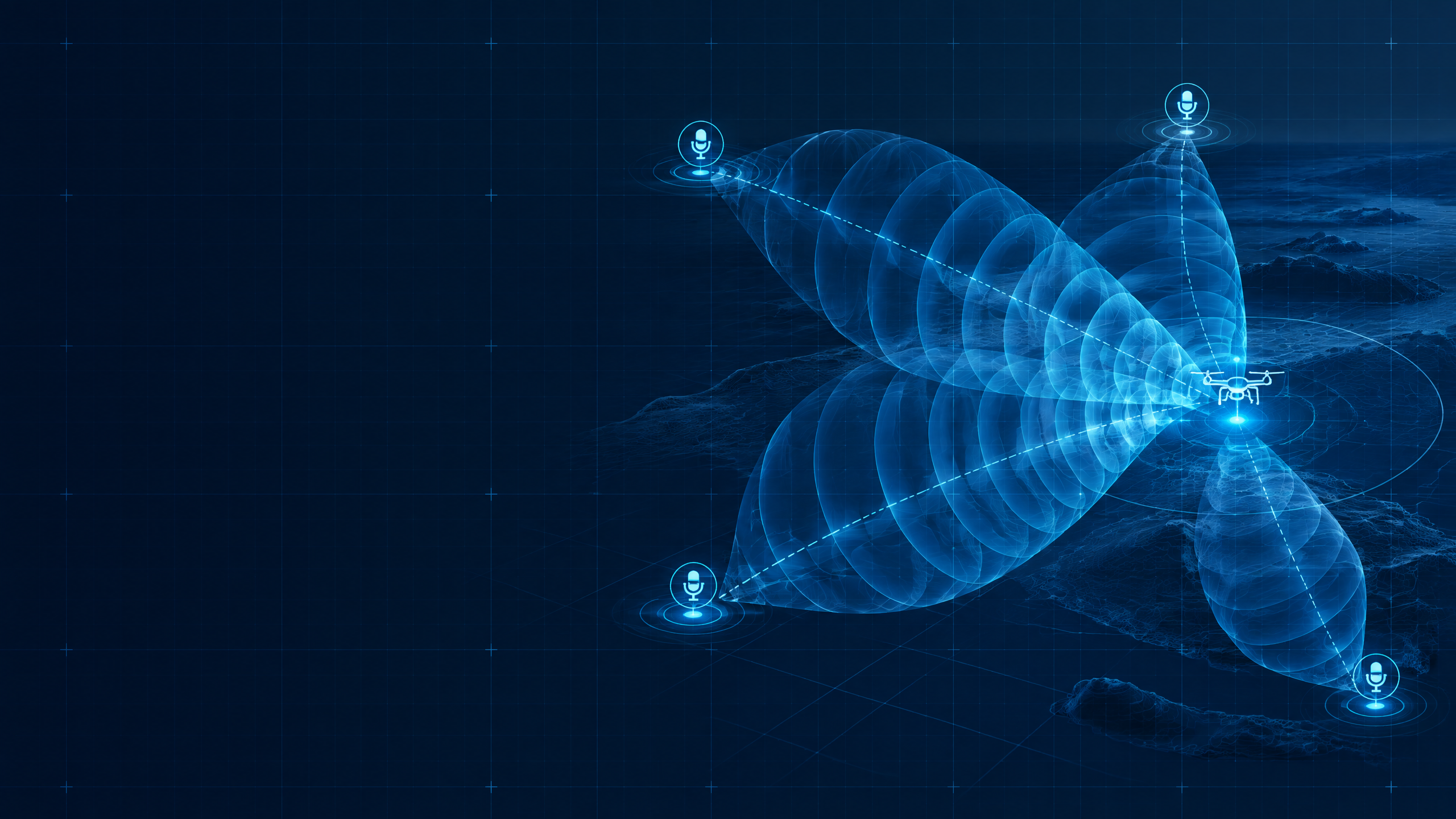
A compliance-first guide to turning drone acoustic observations into carefully qualified location estimates—without confusing an alert with proof, or a model output with authorization to act.
Start with an auditable acoustic observation
A microphone array can record sound pressure patterns and timing differences across sensors. A processing layer may then flag features consistent with a rotorcraft-like acoustic event. Integrators should preserve the original sample or approved derivative, clock and sensor-health context, processing version, and access history. Noise from weather, construction, traffic, ventilation, wildlife, and facility equipment can overlap with the signal of interest. The first record should therefore say what was observed, when, and with what confidence—not what the object was.
Convert timing differences into a qualified location
Localization models compare how an acoustic pattern reaches separated sensors to estimate a direction or candidate area. Reflections from buildings, terrain, fences, and hard surfaces can create misleading paths; wind and changing background noise can also shift the result. A responsible interface should show an uncertainty region, quality indicators, and competing hypotheses rather than a single pin that implies precision. Optical or other approved context can help a reviewer correlate observations, but correlation is not automatic identification.
Build a multi-sensor case without overclaiming
Acoustic data may be reviewed alongside authorized EO/IR, RF, weather, airspace, or facility-system context when those sources are lawfully available and governed for the purpose. Each source has different blind spots, retention rules, and confidence semantics. Fusion should preserve source provenance and make disagreement visible. A matching timestamp or track does not by itself establish identity, intent, ownership, or a policy violation. Human review remains responsible for deciding whether the combined evidence merits escalation, documentation, or closure.
Design the workflow around authorization and review
Before deployment, define who may view, export, annotate, retain, or delete acoustic data; which events require a second reviewer; and how corrections are recorded. Map alerts to an approved incident taxonomy and a clear escalation owner. Access should follow least privilege, and interfaces should resist automation bias by exposing uncertainty and review status. Any action beyond observation—such as contacting authorities or activating a safety procedure—must follow site policy, applicable law, and documented authorization. The system should support a decision, never silently make one.
Where this approach fits
Acoustic positioning can be considered as one layer in a broader civil security architecture for facilities where low-altitude awareness, privacy-aware observation, or redundancy matters. It is most useful when the site can characterize its soundscape, maintain sensor health, provide a defined review process, and coordinate with authorized optical, RF, or facility data. It is not a substitute for airspace governance, physical safety procedures, lawful authority, or site-specific validation. Begin with a bounded pilot, document failure modes, and reassess as the environment changes.
Want a defensible starting point? Ask SonicVast for a site-readiness workshop covering soundscape mapping, data governance, human-review design, and validation criteria.SonicVast publishes this educational material for civil security planning. It is not legal, regulatory, aviation, privacy, safety, or operational advice; it does not authorize intervention or response. Requirements vary by jurisdiction and site. Obtain qualified professional review and written authorization before collecting or connecting data, and validate any implementation under the policies that govern your facility.