
SIGNAL CLASSIFICATION · C-UAS DETECTION
Drone Signal Classification: An Important Layer of C-UAS Detection
A detection record is not a verdict. Classifying an observed drone-related signal structures review—it does not identify an operator, infer intent, or trigger action on its own.
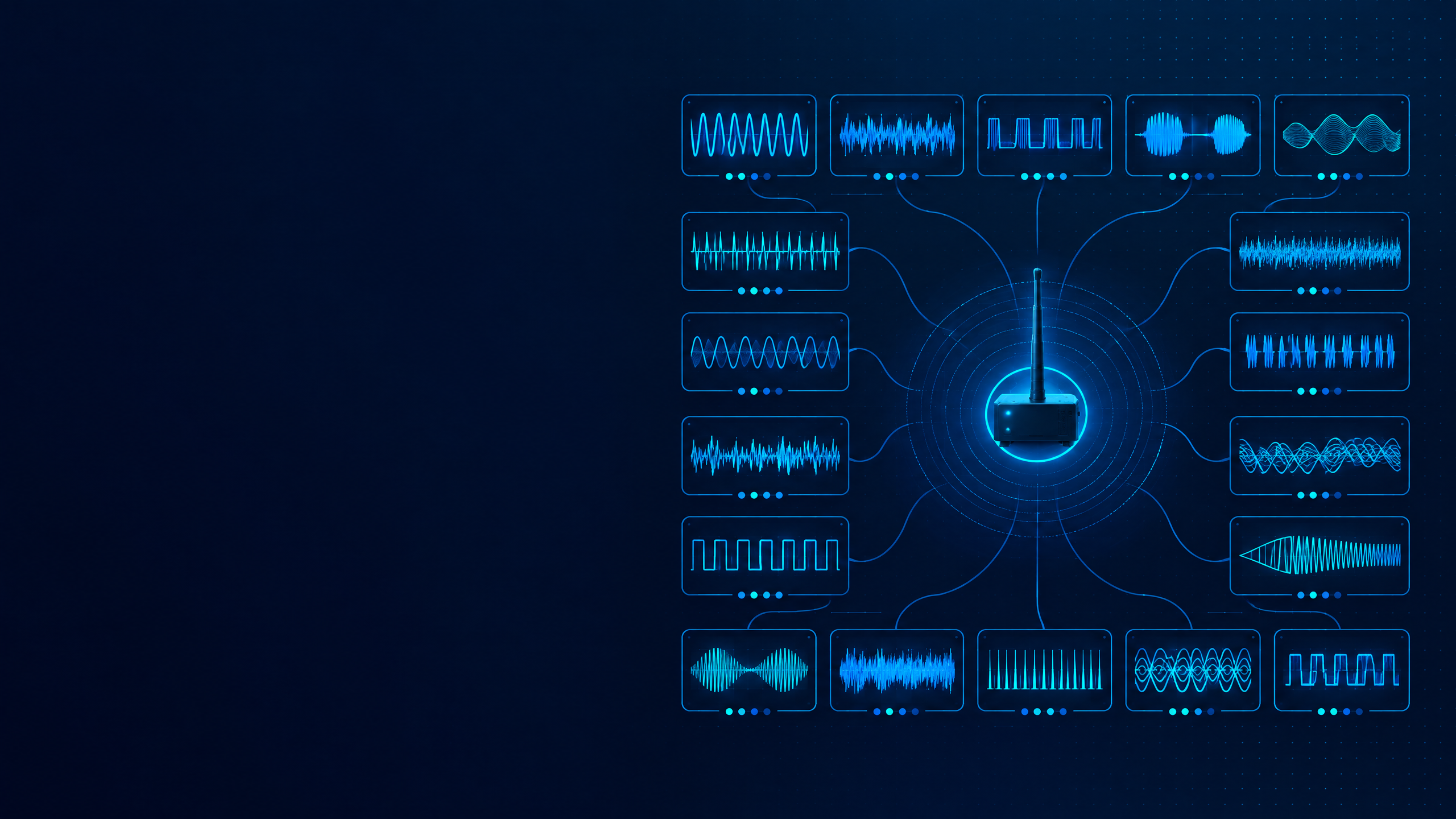
Signal classification helps a low-altitude security program organize observations before any response is considered. This compliance-first guide explains how to treat RF evidence as one contextual layer, preserve uncertainty, and keep people, authorization, and governance in the loop.
What classification can—and cannot—say
RF classification groups observations by signal characteristics and confidence so a team can compare them with other site information. It may answer what a reviewer should examine next, but it does not establish an aircraft’s identity, ownership, intent, legality, or location. Treat every label as a bounded hypothesis with timestamp, collection context, and uncertainty.
Use independent context, not a single sensor
An RF observation is more useful when reviewed alongside authorized records and independent site context, such as an EO/IR observation, access-control event, approved flight notice, weather, or known interference. Correlation should expose disagreement. Reviewers should be able to mark a record unresolved, request more observation, or separate possible explanations.
Validate the model where the system will operate
Buildings, terrain, lawful emitters, construction, and changing airspace activity shape what a classifier sees. The site owner and integrator should define representative conditions, document blind spots, test false-alarm handling, and revisit assumptions after environmental or software changes. A laboratory demonstration is not evidence of suitability for every facility.
Make the record accountable from intake to retention
A defensible workflow records who may access signal data, why it was collected, which configuration produced an assessment, and who approved downstream decisions. Apply data minimization, retention limits, access controls, audit trails, and a correction path. Make uncertainty and human approval visible in the C2 or API experience.
Where this approach fits
This guidance applies to authorized monitoring programs at airports, utilities, campuses, logistics sites, public venues, and other critical-infrastructure environments that need a documented way to triage low-altitude observations. It is useful for requirements definition, integrator design reviews, acceptance testing, operator training, and governance audits. Suitability remains site-specific; consult qualified legal, privacy, spectrum, and safety professionals.
Build a reviewable signal-classification workflow with SonicVast: define the evidence boundary, map human approvals, and validate the record against your site’s real conditions.Educational content only. This article does not provide legal, aviation, spectrum, privacy, safety, or security advice, and does not authorize detection, identification, tracking, interception, or response activity. Obtain appropriate approvals and conduct site-specific validation before using any system.