
TECHNICAL BLOG / ACOUSTIC INTEGRATION
How Acoustic Detection Complements Radar and RF Drone Detection
An acoustic indication, a radar track and a radio-frequency report are not three versions of the same measurement. A microphone receives sound. Radar observes radio energy reflected by an object. Radio-frequency emission detection observes relevant transmissions. Acoustic detection can add another way to examine a suspected event, but its value comes from the evidence it contributes—not from replacing radar, proving identity or deciding whether a flight is permitted.
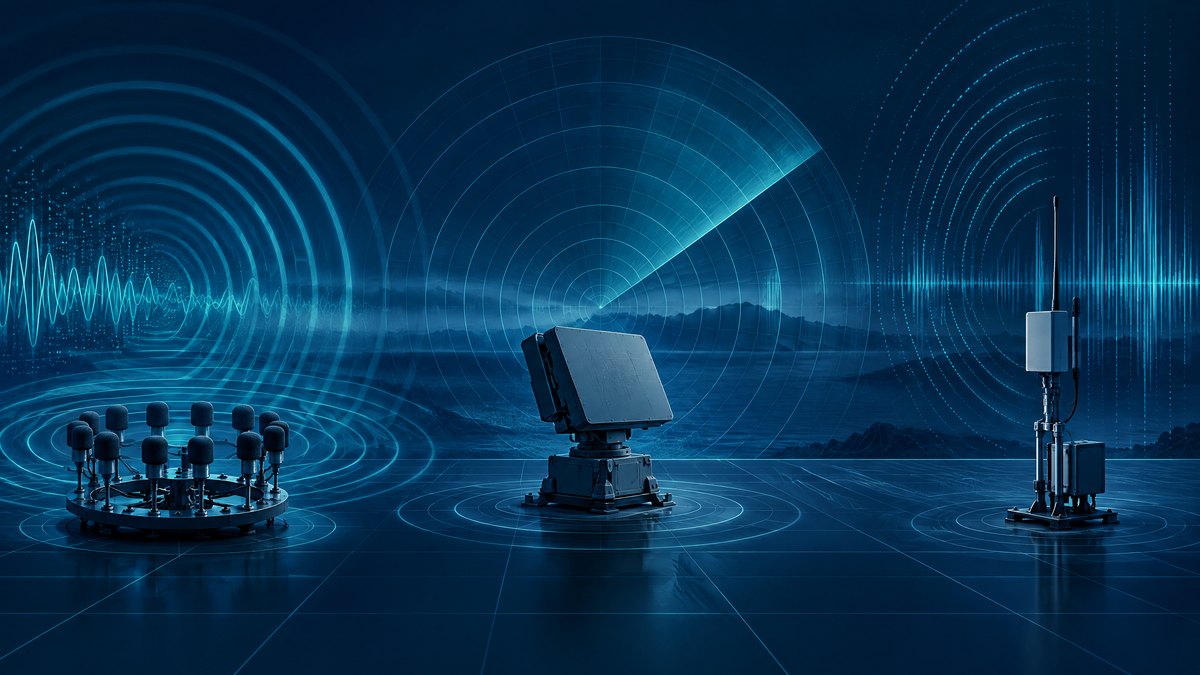
Sound, reflected radio energy and aircraft-related transmissions support different claims. A civil operator needs to understand those claims before treating several observations as one drone event.
First identify what the sensor actually observed
The November 2025 detection guidance from the U.S. Cybersecurity and Infrastructure Security Agency, or CISA, describes acoustic, radar and radio-frequency sensing as different mechanisms. Its descriptions are earlier technical background for this guide, not a new November 2026 development. The practical distinction is what entered the sensor before software assigned a label.
Acoustic reception establishes a sound observation
A microphone responds to pressure changes in air. Aircraft motors and propellers can produce sound patterns that analysis software compares with learned examples or signature libraries. The September 2019 U.S. Department of Homeland Security, or DHS, technology guide describes this reception-and-analysis approach. A reported drone-like pattern is therefore an interpretation of received sound, not a direct reading of an aircraft's registration or purpose.
The distinction matters when the interface uses a confident label. A classifier score concerns the model's treatment of its input under a particular method. Unless the supplier defines and validates a wider interpretation, it should not be read as the probability that a particular aircraft is present, identified or unauthorised. The sound observation and the classification claim should remain distinguishable.
Radar reflection establishes evidence about an object
CISA describes radar processing radio waves reflected by an object. Conventional active radar transmits the signals used for that observation. The result may support motion or position estimates, depending on the system, without requiring a communication message from the aircraft.
A reflecting object is not automatically a drone. An object track and a drone classification are separate claims, and a radar result does not identify the source of a nearby sound merely because both appear on the same screen. hensec's announcement also names passive radar; the reflection principle remains distinct from listening for an aircraft's own transmissions, without implying that every radar architecture is identical.
Radio-frequency emission observation establishes signal evidence
In this article, radio-frequency, or RF, detection means observing relevant emitted communication signals, rather than reflection sensing. CISA describes receivers listening for and interpreting signals between an aircraft and its ground control station. The DHS guide notes that classification may rely on comparison with known radio signatures.
A signal observation supports a claim about received radio activity. It does not, by itself, prove that the associated aircraft is airborne, that a neighbouring radar object is that aircraft, or that its operation is approved. Signal characteristics and any decoded message content are also different information; the latter must not be assumed to be available or legally accessible.
Acoustic evidence can test a claim that radar or RF leaves open
The useful reason to consider acoustics is that sound reception does not depend on the same physical observation as a radio receiver or radar. CISA notes that acoustic sensing can detect aircraft without relevant RF emissions, while also identifying ambient noise and extreme weather as limitations. That supports a complementary role, not a claim that microphones will always fill another sensor's gaps.
A sound pattern can add context without supplying identity
Consider a hypothetical civil monitoring record containing a moving-object report and a drone-like sound classification. If the observations can reasonably be associated, the sound may provide additional support for a propulsion-related interpretation of that object. It still does not establish make, ownership or permission. If the association is uncertain, the accurate record contains two observations and an unresolved relationship—not a confirmed identity.
A different hypothetical record might contain aircraft-related RF activity but no established airborne object. A compatible acoustic observation could add physical context. The contribution is conditional: the sound must be relevant to the same event, rather than unrelated machinery or another aircraft. Neither example is a reported incident or a claimed feature of any cited platform.
No acoustic cue is not a verdict on the other evidence
A missing sound report can reflect the received sound, the analysis method or an unavailable input. CISA's noise and weather cautions mean that no cue cannot be treated as proof that a radar object is harmless or that an RF observation is mistaken. Equally, an acoustic label without supporting radio evidence is not automatically false.
Sound that resembles a target pattern may still have another source. Keep the explanation narrow: acoustics supplies another observation to assess, not a universal veto or confirmation channel. Radar and RF evidence retain their own value when acoustic evidence is absent or ambiguous.
Read hensec's sensor expansion as an allocation of evidence roles
A company announcement carried by Drones magazine's press portal on 10 November 2026 describes Sonidio acoustic sensing and Sentinex Robotics artificial-intelligence cameras being added to hensec's civil monitoring platform. It names existing radio detection, passive radar and radio telemetry inputs. DroneNews reported the same announcement that day and cited Drones magazine. This is an attributed integration announcement, not independent verification of its performance.
A shared picture should not erase the origin of an observation
The announcement describes acoustic detection and classification alongside optical verification and tracking roles. Those stated roles illustrate why a platform may combine information with different meanings. A sound category, a radio observation and an image are not interchangeable confirmations simply because they enter one digital airspace picture.
For civil interpretation, the important question is whether the record makes the origin of each claim intelligible. A label could come from acoustic analysis, an image-based inference or a later combined assessment. That is an editorial requirement to discuss, not a verified description of hensec's interface or a SonicVast capability claim.
The announcement date does not establish completed integration
10 November is the verified publication date of the attributable announcement. It does not establish when an agreement was signed, when an installation became operational or whether a specific combination passed acceptance testing. The reviewed reporting supplies no independent combined-system test or acoustic-specific false-alert dataset.
The example is useful because it assigns different information roles within a civil concept. It cannot establish a detection range, a sensitivity improvement or a result that transfers to another supplier. This article's 14 November 2026 publication date is the editorial date, not a new hensec event.
Place Ericsson's ISAC on the reflection side of the distinction
Ericsson's earlier 2 November 2026 announcement describes Integrated Sensing and Communication, or ISAC, using reflections of transmitted radio signals to observe objects, including drones not connected to the network. Its system page expressly positions sensing as complementary to radar, cameras and acoustic sensors. Although wireless signals are involved, this is not the RF-emission observation defined above.
The observed aircraft need not provide a radio message
With reflection sensing, the relevant evidence is how transmitted wireless signals interact with an object. The object need not send a control or telemetry message for that physical interaction to occur. Calling ISAC a receiver for drone emissions would therefore misstate the mechanism.
This correction does not imply universal detection of objects without an observable radio link. A possible reflection is not a guaranteed usable detection, and a commercial mobile-service footprint is not a validated sensing footprint. The transmitted-signal mechanism also means the complete arrangement should not be described as passive merely because an acoustic component listens passively.
The Polish demonstration is earlier context, not an acoustic benchmark
Ericsson and Play published accounts on 22 October 2026 of a demonstration held on 15 October 2026 in Kraków. They describe acoustic detection and radio sensing integrated and visualised through Asseco's PUSZCZYK platform. The event and reporting belong to October; neither is a new demonstration on this article's publication date.
The accounts show an example of presenting different evidence together. They do not supply an acoustic-specific detection probability, a false-alert rate or a controlled numerical benefit for that combined configuration. A reported radio-sensing result cannot be repurposed as validation of the acoustic component or of another company's system.
Correlation should explain the relationship, not count agreeing labels
Once the measurement types are clear, the next interpretive question is whether the observations concern the same event. This is an inference in its own right. Several positive labels may describe one aircraft, several unrelated sources or repeated reports derived from a single input. Counting labels does not resolve that distinction.
Match the meaning and timing of the records
A sound analysis window, a radar track update and a received radio message may refer to different intervals. A dashboard arrival time is not necessarily the time of the underlying observation. Sound propagation and processing can also make the acoustic report later than a radio observation. Civil interpretation benefits from knowing which time a record represents and whether its age is visible, rather than treating simultaneous display as simultaneous measurement.
Not every output has the same spatial meaning either. A directional indication is not a full position, and a radio-source estimate is not automatically an aircraft position. Correlation should retain those distinctions and any stated uncertainty. A relationship that cannot be supported should remain unresolved rather than acquiring certainty from a shared event identifier.
Distinguish new evidence from a repeated inference
If a combined platform repeats an acoustic classifier's label in an event summary, the summary is not a second acoustic observation. If a later assessment uses the same radar track as an earlier one, the two assessments are not independent measurements. Provenance helps a reviewer understand whether information has genuinely been added or simply republished.
Disagreement can be informative when its reason is visible. In a hypothetical record, a radar object with an uncertain sound match should stay different from a radar object with a well-supported sound association. A missing RF input should stay different from an affirmative RF observation that conflicts with the proposed association. These distinctions describe evidence quality, not a prescribed operational response.
Keep flight permission outside the sensor classification
Detection addresses what may have been observed. Classification addresses what the observation may represent. Correlation addresses whether separate records belong together. None of those measurements or inferences establishes whether an operator holds the approvals required for a particular flight. A civil evidence view should keep that administrative question separate.
An approval record needs its own supported association
A sound pattern cannot contain the scope or validity of a site's flight approval. A received identifier may offer a possible link to an administrative record, but the link still needs assessment; it does not make every nearby sound or reflecting object part of the approved activity. The provenance and current relevance of the approval record matter independently of the sensor label.
The inverse is equally important. A known sound category is not an authorisation whitelist, and no acoustic cue is not an exemption from permission review. Acoustic presence and acoustic absence therefore cannot decide permission in either direction. This distinction also prevents a correctly detected approved flight from being confused with a false detection.
Judge the acoustic addition by the uncertainty it actually reduces
An acoustic contribution is useful when it supports a better-evidenced interpretation of the agreed civil observation task. That might mean a previously ambiguous object has additional, properly associated sound evidence. It might instead reveal that a proposed association remains weak. Both are more informative than an unexplained rise in the number of alerts.
Any claimed benefit still needs evidence for the proposed configuration and relevant conditions, including ambiguous and unavailable observations. Earlier CISA and DHS guidance supports considering complementary sensors and reviewing actual functions with qualified legal advice; it does not approve a supplier or guarantee an outcome. The appropriate enquiry is what additional evidence acoustics could contribute here—not whether adding microphones automatically makes the system complete.
Bring an evidence question to a civil project enquiry
If your organisation is considering acoustic input for a civil monitoring project, a SonicVast enquiry could begin with the evidence you need to interpret and the records your existing platform can provide. Any proposed scope, access to integration materials or partner involvement would remain subject to technical, safety, privacy and compliance review. This guide does not establish that a particular SonicVast interface, feature or configuration is available or suitable.
Discuss a civil sensing projectThis technical editorial concerns lawful civil observation and interpretation, not deployment design, operational response or legal advice. The cited organisations' announcements do not establish SonicVast or New Ark affiliation, endorsement, equivalence, customers, features, certification or performance. No universal coverage, acoustic sensitivity, automatic permission or intervention capability is asserted.