
TECHNICAL BLOG / ACOUSTIC INTEGRATION
AI-Based Acoustic Drone Localization for Critical Infrastructure
AI-based acoustic drone localization is not one prediction. A civil infrastructure operator may receive a drone-like sound label, a direction estimate, an associated track and a map position, but each answers a different question. At a utility facility, transport hub or industrial site, the useful assessment asks which outputs were actually checked against independent evidence, under which sound conditions, and with how much human review. A confident classification cannot supply the missing proof for the rest of that chain.
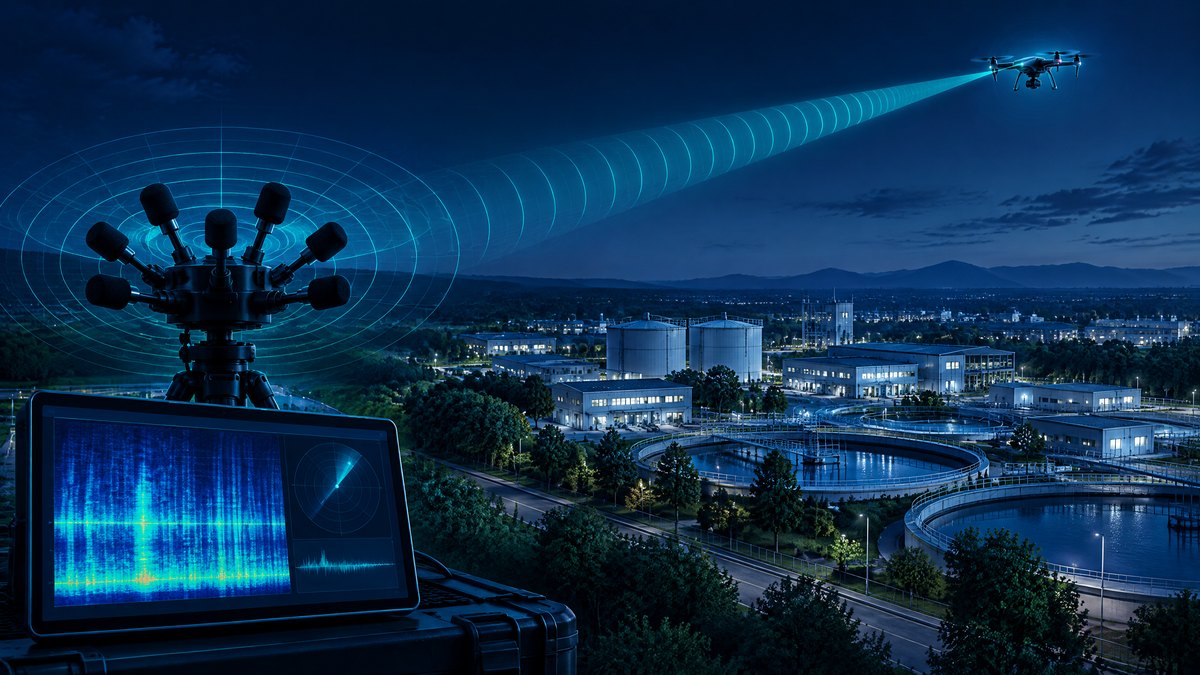
Assess AI acoustic localization through four separate outputs: sound classification, bearing estimation, track association and geographic position. Judge the evidence, data quality and human workload—not a confidence score alone.
Four outputs need four different kinds of evidence
The U.S. Department of Homeland Security's September 2019 technology guide distinguishes acoustic classification, direction finding and geographic location. That older technical background remains useful for interpreting terminology, not for establishing current product capability or legal authority. Track association adds another question: whether successive observations have been correctly assigned to the same source. Calling the whole process AI localization must not erase these distinctions.
Sound classification does not establish a bearing
Sound classification assigns a category to an audio sample or analysis window, such as drone-like sound, another known sound class or an unresolved result. Bearing estimation concerns the direction from which a sound appears to arrive. A classifier can assign the right sound category while the direction estimate is wrong or unavailable. Conversely, a credible sound direction does not prove that the source is a drone. Request category evidence and directional evidence separately, rather than treating either as confirmation of the other.
An associated track is a continuity claim, not an identity
Track association links observations over time, and sometimes across sensing inputs, to a candidate source. Its quality concerns continuity and incorrect linking, not merely the number of classifications produced. A steady track label can conceal a mistaken reassignment, while one real source can appear as several fragmented records. This is a technical continuity question: an acoustic track does not identify a person, establish an aircraft's registration or determine whether its flight is authorized.
Geographic localization needs its own reference and uncertainty
A bearing gives direction, not a complete position. Geographic localization expresses an estimated position in a stated coordinate reference using the information available to the system. A map marker is therefore a reported estimate, not independent evidence that the aircraft was there. Assessment should compare the position with an independent reference at the corresponding observation time and distinguish horizontal position from any separately claimed height. Ask how uncertainty and unavailable position estimates are represented; an exact-looking marker should not imply exact knowledge.
A high classifier score cannot measure system accuracy
A score may represent a probability estimate, a similarity measure or another model-specific output. Its meaning has to be documented before it is interpreted. The National Institute of Standards and Technology's 2023 AI Risk Management Framework describes accuracy in relation to accepted truth and calls for realistic, representative test sets and a stated methodology. A percentage shown beside one sound label is not that evaluation.
Calibration checks the meaning of probabilities
The official scikit-learn documentation explains that a well-calibrated classifier's assigned probabilities should correspond to observed class frequencies across comparable samples. Some models produce poor probability estimates. Calibration therefore asks whether probability statements match outcomes in an evaluated population; it does not make every individual prediction correct. It also needs data independent of the classifier's training data. Even a calibrated sound classifier does not establish bearing error, track continuity or geographic position error.
Classification metrics answer different questions
Google's official machine-learning guidance defines accuracy as the share of classifications that are correct. Recall asks what share of actual positives was correctly classified, while precision asks what share of positive classifications was correct. These distinctions matter when ordinary background sound greatly outnumbers drone-related samples: overall accuracy can look favorable while the useful positive events are missed. A classification false-positive rate uses negative samples as its denominator; nuisance review cases per observation hour measure a different burden. Do not interchange those figures.
Changing a threshold changes the assessed system
A decision threshold controls which scores become positive classifications or review candidates. Google's guidance notes that changing it affects the balance of false positives and false negatives. A quieter console after a threshold change is not sufficient evidence of improvement. The assessment should retain missed events and unresolved cases alongside reductions in nuisance alerts, and identify the threshold and software version used. This is evaluation discipline, not a recommendation for a particular operational setting.
The dataset must represent the civil question being asked
The National Institute of Standards and Technology calls for documented test sets and evidence under conditions similar to the intended setting. For acoustic assessment, the editorial implication is straightforward: a collection of clean drone recordings alone cannot establish usefulness in a facility's ordinary sound environment. Data quality includes trustworthy labels, relevant background recordings and separation between material used to learn and material used to assess.
Document recordings and labels without assuming certainty
Useful dataset documentation explains where recordings came from, what equipment captured them, how their quality was checked and who assigned the labels. A planned flight occurring during a recording does not prove that every audio window contains usable drone sound. Uncertain or mixed examples should remain identifiable rather than receiving a convenient definitive label. Where independent observation supports a label, record that basis; where it does not, preserve the limitation.
Keep related recording sessions out of both sides of the test
Adjacent snippets from the same recording can share background sound and other session-specific features. Distributing those snippets across training and test sets risks measuring familiarity with the recording session rather than generalization. A meaningful assessment should explain separation at the recording-session level and, where the intended claim requires it, across sites or aircraft examples. Separate material used for model training, probability calibration and final evaluation. A held-out file is not automatically an independent held-out situation.
Recording quality and model changes belong in the record
Distortion, missing samples and changed capture conditions can affect what the model receives. Assessment records should identify relevant quality checks and explain excluded recordings instead of silently removing inconvenient cases. Preserve the evaluated model, preprocessing and class definitions with their versions. A smaller onboard model or an expanded comparison library is a development choice; neither proves that the revised output is more reliable. Recheck the claims affected by a material change using evidence that was not consumed during tuning.
Validate the evidence chain in the intended acoustic environment
The Cybersecurity and Infrastructure Security Agency's guidance, dated November 2025 on its cover, identifies ambient noise, extreme weather and obstacles as relevant acoustic limitations. Its buyer questions ask what testing was conducted and in which environments. Those are reasons to examine facility-relevant evidence, not reasons to assume that an AI label removes physical limits. Sound-based analysis needs usable acoustic evidence and cannot promise detection when no usable target sound is present.
Include normal facility activity, not just selected demonstrations
An authorized evaluation should account for ordinary machinery, vehicle movement, maintenance periods and changing weather where relevant to the intended use. Report performance by meaningful condition groups so a favorable pooled result does not hide a weak period. Identify conditions that were not assessed. Noise handling that improves classification does not automatically improve bearing or position estimates; evaluate the effects at the output level rather than describing all results as environmental robustness.
Count missing outputs as well as errors in available outputs
A location-error summary calculated only when the system produced a position can omit the difficult cases. Report when a position was available, when only a bearing or class label was available, and when no usable output was produced. Compare directional and positional results with independent references at matched observation times, and distinguish observation age from message delivery time. Report the spread of errors and important larger errors rather than only a best example or one average. Otherwise a neat geographic result may describe a selectively easy subset.
Review workload is part of localization usefulness
The Cybersecurity and Infrastructure Security Agency warns that false positives can cause alert fatigue and asks buyers about operator involvement and training. For civil infrastructure, the practical burden is not simply the number of audio windows classified. It is the number of cases people must assess, how long those cases remain uncertain and whether the evidence helps them understand the result.
Distinguish model samples from cases on the review queue
One sound event may generate many scored windows but only one review case. Conversely, broken association can turn one source into repeated cases. Evaluation should state how observations are grouped and retain both the sample-level results and the case-level workload. Record review effort over defined observation periods, including uncertain cases, rather than counting rapid acknowledgement as correct resolution. This connects technical performance to available staff without claiming that a particular alert rate is acceptable everywhere.
Show reviewers the limits of the conclusion
A proposed interface should distinguish the class label, directional estimate, association status and geographic estimate, with their relevant uncertainty and observation times. If another sensing input or a human supplied confirmation, that contribution should remain distinguishable from the acoustic result. Evaluation can then ask whether reviewers recognize missing or contradictory evidence and can record an unresolved judgment. These are interface assessment questions, not statements that SonicVast provides a particular display or workflow.
Data handling and human decisions need explicit ownership
The National Institute of Standards and Technology treats privacy, transparent interpretation and human oversight as parts of AI risk management. Acoustic assessment must examine the actual data flow: sound may be captured without being permanently retained, but neither passive sensing nor onboard processing establishes privacy compliance. Appropriate legal and privacy review depends on what the proposed system actually does and where it would be used.
Separate evaluation evidence from unrestricted recording
Identify whether the proposal uses transient audio, stored clips, derived features or event metadata, and what may contain incidental speech or other personal information. Agree the lawful purpose, necessary retention, authorized access and deletion responsibilities before data collection. If recordings are later proposed for model improvement or external engineering review, assess that use separately. Evidence preservation should be proportionate to the evaluation; it is not a reason for indefinite recording or unrestricted data sharing.
Do not let a sound label decide permission or intent
Human reviewers need an accountable role in interpreting uncertain observations and documenting conclusions. Flight-authorization information belongs to a separate governance record; an acoustic match does not grant permission or establish hostile intent. An unresolved event should not be converted into a definitive judgment merely because the model prefers one label. This guide addresses civil assessment and decision accountability only, not procedures for responding to aircraft or authority to interfere with them.
Maintain the link between evidence and approved changes
Assign responsibility for approving model updates, changed data uses and revised evaluation criteria. Preserve the connection between a result, its configuration and the person who reviewed it. The National Institute of Standards and Technology's framework calls for monitoring component behavior and tracking risks over time; a site can use that principle to identify when earlier evidence no longer supports the intended use. It does not confer certification or establish compliance with a particular jurisdiction's law.
Read recent AI sensing reports at the level they actually support
Recent reporting shows why these distinctions are necessary. A published model-development account can explain how a team refined classification. A demonstration can show that outputs were brought into one platform. Neither automatically establishes independent geographic accuracy, manageable review workload or suitability for another civil facility.
The Army's model-development report is not an accuracy benchmark
The U.S. Army's November 13, 2026 account of Project MANOWAR describes custom machine learning and a smaller onboard model refined using sensor recordings and personnel-created labels. Its stated window-level confidence is not a measured overall detection-accuracy rate. The reviewed official account supplies no independent protocol, dataset, false-alert measurements or localization-error results. Its May and September test narrative is earlier experimental background; those passages do not separately establish the test years or exact days. This November 14 editorial does not assign missing dates or transfer that research to SonicVast.
The Polish demonstration is integration background, not acoustic proof
Ericsson and Play's October 22, 2026 accounts describe the October 15 demonstration in Kraków, where Asseco's PUSZCZYK platform integrated and visualized acoustic detection alongside radio sensing. Play provided mobile-network data transport. Ericsson's November 2 announcement is a later publication, not a new date for that demonstration. These are earlier background accounts for this guide. They do not provide acoustic-specific controlled measurements that validate a civil configuration, and radio-sensing results cannot fill that gap. Model adoption, shared visualization and source-reported tests do not validate SonicVast or establish an affiliation.
Bring an evidence question to a civil enquiry
If discussing a project with SonicVast, describe the civil assessment need, the outputs requiring evidence and the site's review and privacy constraints. Any proposed scope, available documentation or integration arrangement would need technical, safety, legal and privacy review. An enquiry does not imply that a capability, test result or delivery commitment is available.
Discuss a civil sensing projectSource-attributed technical editorial, not legal advice, an operational response procedure, certification or product validation. No SonicVast or New Ark affiliation, endorsement, equivalence, customer relationship, feature, deployment or performance guarantee is asserted. No deployment geometry, localization implementation, evasion or suppression guidance is provided.