
ACOUSTIC SENSING / ENGINEERING AND PROCUREMENT
Industrial Acoustic Drone Detection System: Establishing a Realistic Industrial Sound Baseline
An industrial acoustic drone detection system is only as useful as the sound environment it is asked to interpret. A compressor yard, tank farm, loading area, or utility corridor does not have one permanent background sound. Its acoustic character changes with production state, rotating equipment, traffic, wind, rain, maintenance, and nearby activity. Establishing a realistic industrial sound baseline therefore comes before choosing alert thresholds or discussing detection results.
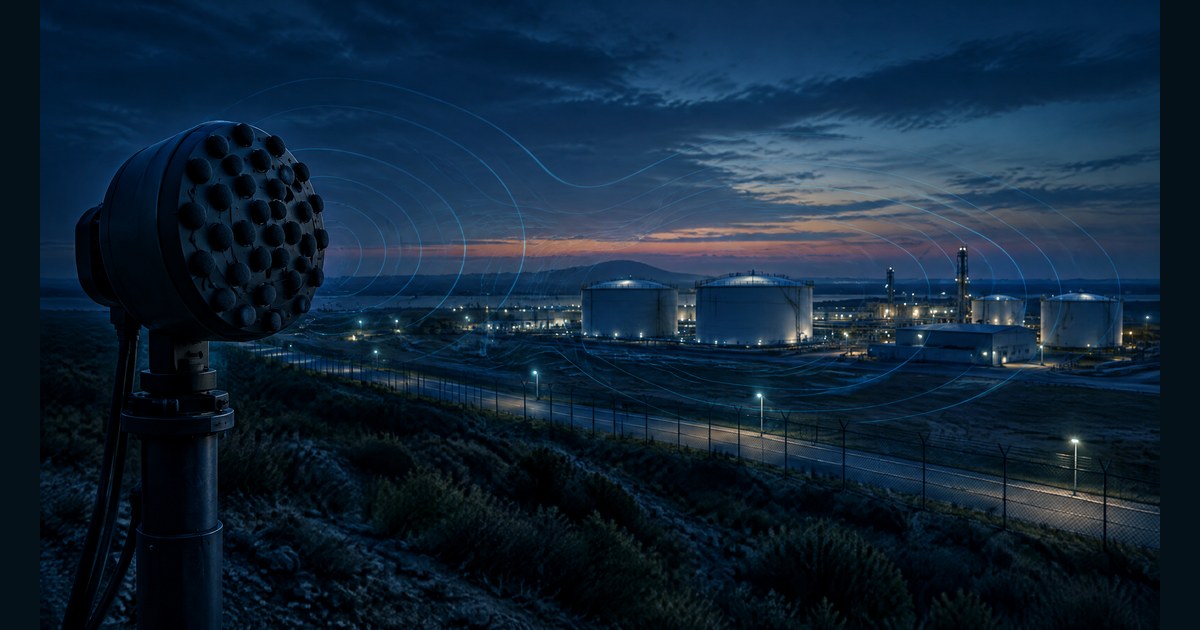
A procurement and validation guide for describing an industrial site's normal acoustic environment before interpreting candidate aerial sounds.
A baseline is a map of operating states, not one quiet recording
A baseline should describe what normal sound looks like at the places and times where the system will operate. It is not simply the lowest level recorded during a site visit. ISO 1996-1 treats environmental noise as a set of physical quantities and assessment procedures, and notes that the same level can be perceived differently depending on characteristics such as tonality, impulsiveness, and low-frequency content. For an industrial project, that means the baseline must preserve context rather than reduce the site to one number.
Define the operational states that matter
List the states that can materially change the acoustic scene: normal production, start-up and shutdown, shift change, vehicle movement, loading or unloading, planned maintenance, standby equipment, and abnormal but non-emergency conditions. For each state, record which equipment is running, the approximate schedule, and whether the area is open, enclosed, or partially screened. This operating-state register gives the acoustic team a reason for each measurement period and helps reviewers compare like with like.
Describe sound by time, frequency, and character
A sound-level average alone may hide the features that matter to an acoustic classifier. Record the selected descriptor, frequency weighting, time weighting, measurement duration, and representative spectra or audio evidence where governance permits. Note whether the scene is steady, intermittent, tonal, impulsive, broadband, or strongly directional. These labels are not drone identifications; they are a disciplined description of the background against which a later candidate observation will be judged.
Measure under conditions that can be reproduced and explained
A useful baseline is a documented comparison set. ISO 1996-2 explains that environmental sound pressure levels may be determined by direct measurement or calculation, and that measurement effort and uncertainty should be determined and reported for each case. The practical implication is to state what was measured, where, when, under which operating and propagation conditions, and what was not measured.
Treat weather as part of the acoustic record
Wind and precipitation can alter both the measured sound and the microphone environment. Queensland's Noise Measurement Manual instructs field staff to record approximate wind speed, avoid measurements in rain or excessive wind for its stated method, and use appropriate microphone protection. A project baseline should therefore retain weather observations alongside each session, rather than mixing calm, wet, and windy recordings into one undifferentiated reference. Site-specific limits and the applicable local method still require confirmation by the responsible acoustic professional.
Control position, reflections, and calibration evidence
Measurement position affects comparability. Record sensor height, nearby reflective surfaces, mounting, orientation, and the relationship to boundaries, buildings, equipment, and sensitive locations. The Queensland manual calls for calibration before and after sets of measurements, a documented site sketch, and notes on extraneous sound. For an acoustic detection pilot, the equivalent evidence should include sensor identity, firmware or configuration, time synchronisation, calibration status, and any recording gaps.
Separate environmental awareness from equipment-condition monitoring
Industrial buyers often use the word acoustic for two different jobs. An environmental or perimeter awareness layer listens to sound propagating through the site and may help organise candidate aerial observations. Equipment-condition monitoring usually examines machinery or structures for changes associated with a fault or degradation. The two programmes may share microphones, analytics, or data infrastructure, but they do not share the same baseline question.
The reference object is different
For environmental awareness, the reference is the acoustic scene at a defined location and operating state. For condition monitoring, the reference is normally a machine, component, or structure under a defined condition. Acoustic emission guidance from the American Bureau of Shipping describes acoustic emission as a passive nondestructive examination technology used for structural monitoring. That is a different purpose from describing the sound field around an industrial perimeter. Procurement documents should name the reference object explicitly.
Avoid blending alert ownership
A change in a pump, fan, valve, or vehicle pattern may be important to maintenance without being evidence of an aircraft. Conversely, an aerial sound may be relevant to low-altitude awareness without diagnosing equipment health. Keep separate labels, workflows, retention rules, and responsible reviewers unless an approved integration design explains how the data will be correlated. This prevents a maintenance alarm from being treated as a security conclusion, or a security alert from being treated as a maintenance finding.
Turn baseline data into a validation and change-control plan
The baseline becomes valuable when it can be revisited. Before a pilot or acceptance exercise, define which background conditions will be replayed or sampled, which approved test observations will be evaluated, and what evidence will be retained for each review. Do not set a universal threshold from a generic decibel value. A threshold that is sensible at an open boundary may be unsuitable beside a turbine enclosure or during a scheduled truck movement.
Use matched comparisons rather than a single threshold
Compare candidate observations with matched baseline windows: similar production state, weather category, time of day, sensor configuration, and nearby activity. Review both the raw or permitted audio evidence and the derived features used by the system. Ask whether an alert reflects a persistent change, a short transient, a known source, or an unobserved condition. The result should be a confidence and review record, not a claim that sound alone proves an aircraft identity or authorisation status.
Re-baseline after material site changes
Add a revalidation trigger to the project plan. Examples include a new fan or compressor, changed operating speed, building work, altered traffic flow, new acoustic barriers, vegetation changes, sensor relocation, firmware changes, and changes to permitted drone activity. The trigger does not mean every change invalidates the system. It means the team must decide whether the old comparison set still represents the scene and document that decision.
Procurement questions that expose baseline quality
A supplier discussion should test the evidence model before it tests a headline range or classification label. Ask how the proposed system represents operating states, weather, missing data, known industrial sources, and uncertainty. Ask what the customer must provide during site validation and what outputs are available for independent review. These questions keep the project focused on a realistic sound environment rather than an abstract laboratory scenario.
Questions for the acoustic and operations teams
Which areas and operating states are in scope? Who owns the source register? Which descriptors and frequency bands will be retained? How are calibration, time synchronisation, weather, and sensor placement recorded? What is the procedure when a baseline session contains rain, wind, a temporary construction source, or a maintenance event? Which changes require a new validation session?
Questions for the integrator and governance owner
Can baseline labels and evidence travel with an alert into the approved review system? Can reviewers distinguish detection, bearing, track, classification, and identity confidence? How are authorised flights and known site activities represented without treating them as proof of an acoustic match? What human approval is required before an observation is escalated? Written answers make the system easier to procure, test, and operate responsibly.
Start with a site sound register
Before requesting a system quotation, assemble a simple register of zones, equipment states, schedules, weather conditions, known transient sources, measurement positions, and planned site changes. Ask each candidate integrator to show how that register would become validation data and an auditable review workflow. SonicVast project discussions can then focus on the acoustic sensing, integration, and customization questions that the documented site evidence actually supports.
Discuss your projectAcoustic observation cannot detect a literally silent target or by itself establish unique aircraft identity, flight permission, or response authority. Site conditions, applicable measurement methods, privacy requirements, safety controls, and written project confirmation remain necessary.