
ACOUSTIC SENSING / ENGINEERING AND PROCUREMENT
Industrial Acoustic Drone Detection System: Keep Airspace Awareness Separate from Equipment-Condition Monitoring
An industrial acoustic drone detection system listens to sound from the surrounding environment, while equipment-condition monitoring asks whether a machine is changing from its expected operating state. Those activities may share microphones, networks, or an industrial site, but they do not have the same question, label, baseline, or acceptance test. Keeping them separate is essential when a buyer needs a defensible drone-awareness record rather than a machine-health alarm described with a different name.
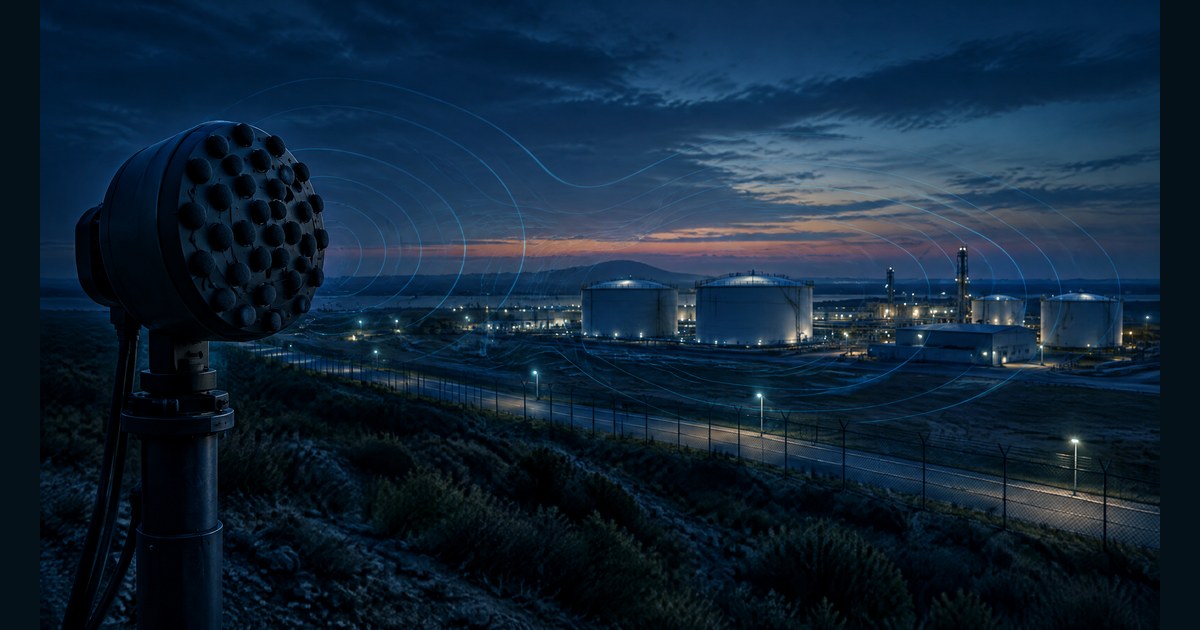
A procurement and validation guide for preventing industrial machinery noise, maintenance changes, and asset-health data from being confused with acoustic drone-awareness outputs.
Two sensing questions that should not be merged
The first design decision is not the sensor brand. It is the decision about what each data stream is allowed to mean. CISA describes acoustic UAS sensors as groups of tuned microphones that use propeller sound signatures to support UAS detection and related location outputs. ISO 17359 addresses the general procedures for a condition-monitoring programme for machines, while ISO 22096 addresses acoustic-emission application to machine condition monitoring. These are adjacent technical fields, not interchangeable output categories.
Drone awareness is an environmental observation
For drone awareness, the question is whether an airborne sound event is present and whether the system can provide a documented indication such as a candidate direction or location within its validated scope. CISA notes that acoustic systems can detect non-RF-emitting UAS, but also states that ambient noise, extreme weather, and obstacles can reduce detection, range, or location accuracy. The output should therefore remain an observation with confidence and conditions attached. It is not, by itself, proof of aircraft identity, permission status, operator identity, or an authorised response.
Condition monitoring is an asset-health workflow
Condition monitoring follows a different logic. It measures selected parameters of a machine or component and interprets changes against an operating reference to support maintenance decisions. The monitored object is the asset, not the open airspace. A bearing, pump, fan, compressor, transformer, or valve may have a condition-monitoring record even when no drone-awareness function exists. Conversely, a drone-awareness record should not be treated as evidence that any item of plant is healthy or failing.
Why one industrial soundscape creates two different risks
Industrial sites are acoustically active. Rotating equipment, vehicles, cooling systems, alarms, construction, process flows, and weather can all change the sound reaching a microphone. CISA specifically identifies loud and persistent noise as a factor that may interfere with acoustic sensors and says that environmental conditions should inform technology selection. That does not make acoustic awareness unsuitable; it makes the sound environment part of the evidence required for a site decision.
A machine change can resemble an airspace event
A maintenance intervention may alter a fan spectrum, exhaust tone, bearing noise, enclosure resonance, or operating schedule. If a drone-awareness classifier is trained or tuned against an old sound picture, the change can create a new false-alarm condition. The reverse error is also possible: a team may dismiss a candidate airborne event as ordinary plant noise because the condition-monitoring dashboard reports that a nearby machine is within its own maintenance limits. The two records need correlation, not substitution.
The same microphone does not create the same measurement
A microphone used for broad environmental awareness is not automatically a suitable sensor for contact acoustic emission, bearing diagnostics, or other asset-specific measurements. Mounting, coupling, frequency response, sampling, enclosure, signal processing, and time windows can differ. A shared hardware platform may be practical, but the project should document which channel, processing chain, and calibration evidence support which claim.
Build separate baselines before interpreting alarms
A baseline is useful only when its scope is explicit. For drone awareness, the baseline should describe the site sound environment across relevant operating states and approved test conditions. For condition monitoring, the baseline should belong to a defined machine, measurement point, operating regime, and maintenance state. ISO 17359 is the appropriate reference for framing a machine condition-monitoring programme; it should not be presented as a drone-detection performance standard.
Record the airspace-awareness baseline
The awareness baseline can include ordinary plant activity, traffic periods, weather notes, scheduled alarms, and known non-drone sound sources. The purpose is not to declare every background sound harmless. It is to give reviewers a traceable comparison and to show when the acoustic scene has changed. CISA recommends considering a facility's location, layout, airspace, environmental factors, and available resources when selecting detection technology. Those same factors belong in the baseline record.
Record the equipment baseline separately
The equipment baseline should identify the asset, sensor position, operating load or state where relevant, measurement units, collection interval, and maintenance history. A new bearing, changed fan speed, repaired duct, altered enclosure, or process-setpoint change may require a new reference period or an explicit annotation. A machine-health trend should not silently overwrite the environmental baseline used for drone awareness.
Control maintenance changes before revalidating acoustic awareness
Industrial maintenance is not background administration for an acoustic project. It can change the very sound field used for awareness. Procurement teams should require a change-notification path between operations, maintenance, security, and the sensing integrator. The objective is not to stop maintenance. It is to ensure that a changed sound environment is recorded, reviewed, and included in the next validation decision.
Use a change log with two impact questions
For each relevant intervention, ask first whether the work changes a machine's own condition-monitoring interpretation. Ask second whether it changes the sound heard by an awareness sensor or alters an expected nuisance source. A yes to either question should trigger an impact review. A yes to both does not mean the system has failed; it means the evidence must identify the new operating state before an alarm rule is trusted again.
Revalidation is not the same as recalibration
Calibration or sensor checks address the measurement chain. Revalidation asks whether the operational claim still holds under the site's changed conditions. After major equipment replacement, layout work, new traffic patterns, or persistent noise changes, a buyer may need controlled recordings, updated background examples, and a repeatable acceptance scenario. The required scope should be agreed in writing rather than assumed from a generic maintenance certificate.
Specify the data boundary in the purchase and integration documents
The clearest way to prevent category confusion is to specify separate data products and owners. A security or low-altitude-awareness workflow may need event time, sensor identity, candidate direction or location, confidence, environmental notes, and reviewer disposition. A maintenance workflow may need asset identity, measurement point, operating state, trend, threshold logic, work order, and maintenance outcome. These records can be correlated by time, but one should not be labelled as the other.
Questions for the acoustic-system supplier
Ask which acoustic observables are delivered, how environmental noise and weather are represented, what evidence supports location or classification outputs, and how non-drone events are documented. Ask whether raw or intermediate data can be retained for review, what timestamps and metadata are available, and how a site can mark maintenance-related sound changes. Confirm each interface, SDK or API field, retention rule, and service responsibility in the project documents rather than inferring them from a product name.
Questions for the maintenance-system owner
Ask which assets have condition-monitoring coverage, which parameters define their baseline, and how maintenance changes are annotated. Establish whether the maintenance platform can expose only the context needed for acoustic review without turning a security event into a maintenance alarm. Where systems are integrated, define the direction of data flow, the authoritative record for each field, access controls, and the person accountable for resolving a disagreement.
Accept the two functions with different evidence
A joint dashboard can be useful, but a shared screen is not a shared acceptance criterion. CISA recommends a site-appropriate approach that considers facility characteristics, organizational factors, and integration into existing security plans. In practice, the acceptance package should show that each function was tested against its own question and that cross-system correlation did not erase uncertainty.
Awareness acceptance evidence
For the drone-awareness function, document the test sound or approved scenario, environmental conditions, sensor configuration, expected output, observed output, time synchronization, and reviewer disposition. State whether the result demonstrates detection, direction, location, classification support, or only an event record. Do not convert a successful scenario into a universal range, accuracy, coverage, or identification guarantee.
Condition-monitoring acceptance evidence
For equipment monitoring, document the asset and measurement point, operating state, baseline or reference period, alarm logic, maintenance annotation, and the response workflow. If acoustic data is used for machine diagnosis, identify the applicable measurement method and its limitations. Passing this test demonstrates an equipment-monitoring workflow; it does not establish drone-awareness performance.
Make separation a line item in the statement of work
Before selecting an industrial acoustic drone detection system, ask the integrator to provide two signal maps: one for low-altitude awareness and one for equipment condition monitoring. Require separate baselines, change logs, acceptance scenarios, data ownership, and escalation paths. Then define the limited, documented ways the records may be correlated. This gives procurement, maintenance, and security teams a common review process without claiming that one sensing function performs the other's job.
Discuss your projectAcoustic sensing observes sound that is present at the sensor and cannot detect a literally silent target. Outputs such as detection, direction, location, classification, and model confidence are different claims. Site noise, weather, terrain, equipment changes, and local evidence affect validation. Any integration, interface, certification, service, or performance commitment should be confirmed in writing for the specific project.