
INDUSTRY WATCH / ACOUSTIC SENSING
Project MANOWAR: U.S. Army Reports Acoustic Classification and Networked Sensor Research
The U.S. Army has published an account of Project MANOWAR, an acoustic-network research effort involving the 532nd Military Intelligence Battalion within the 501st Military Intelligence Brigade. The November 13, 2026 article describes collaboration with the Army Research Laboratory, the 2nd Infantry Division, industry partners and Republic of Korea Army forces. For civil acoustic-sensing readers, the substantive development is the reported combination of sound classification and networked reporting—not a claim that the research establishes commercial readiness or performance for another supplier.
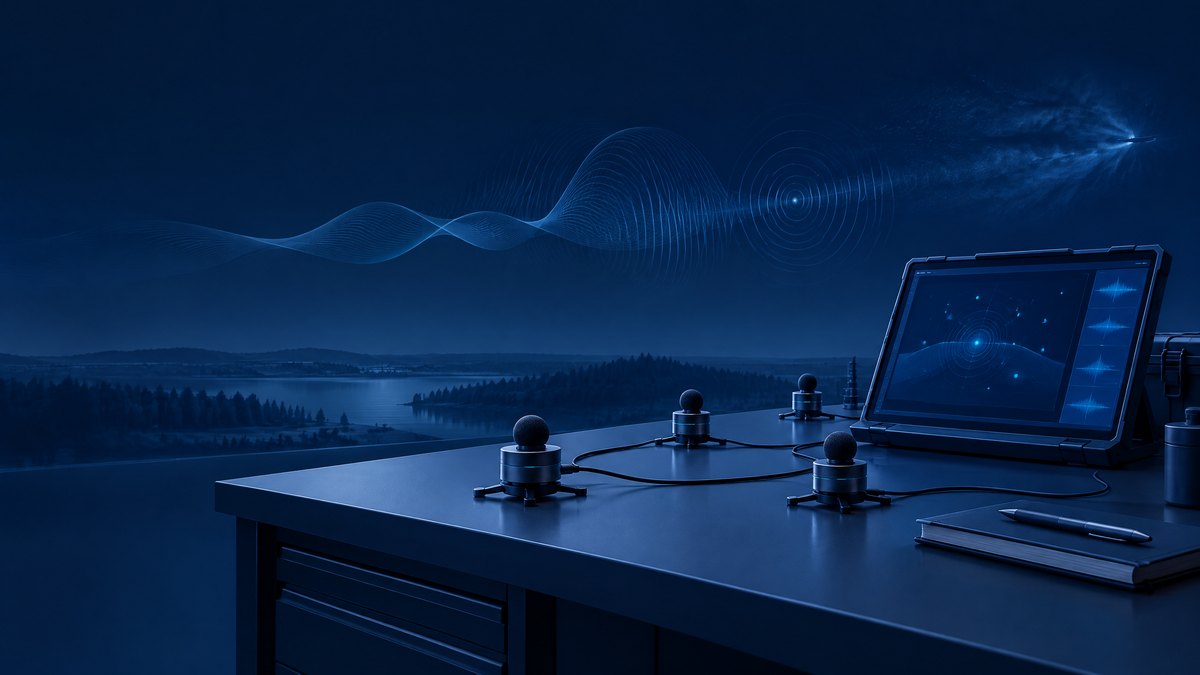
The Army's November 13, 2026 report describes passive acoustic sensing, machine-learning development and networked sensor reporting. It documents an experiment, not an independently validated civil product or a completed production transition.
The Army describes acoustic sensing alongside machine-learning development
The Army identifies MANOWAR as research intended to detect, classify and locate small unmanned aircraft through an acoustic-network approach. Those are stated objectives and reported experimental capabilities, not independently established specifications. The source describes the acoustic sensing as passive; that wording should not be extended to every communication function in the network.
The collaboration links unit-led development with laboratory research
According to the Army article, military intelligence personnel developed a custom machine-learning algorithm in collaboration with scientists from the Army Research Laboratory's Mechanical Sensing Branch. The report places this work within a wider effort involving Republic of Korea Army forces and other partners. It does not identify a SonicVast or New Ark role.
Recorded sound and human-created labels informed model refinement
The article attributes to a project data scientist an account of an initial May sensing baseline and a smaller onboard model developed by September using sensor recordings and personnel-created labels. This supports an attributed account of model refinement. It does not supply the dataset, labeling criteria or independent evaluation needed to judge generalization to a civil environment.
Sensor-report delivery is a distinct part of the experiment
The Army describes a distributed, self-healing mesh network and reports that the team demonstrated delivery of sensor reports to a separate local display. The public account therefore covers both acoustic analysis and the movement of its reported observations. It does not establish continuous service availability, independently measured network resilience or compatibility with a civil monitoring platform.
Keep classification evidence separate from reporting evidence
A report arriving at a display shows that information was communicated during the described demonstration. It does not, by itself, show that the underlying classification or location estimate was correct. The article does not publish a complete test protocol, false-alert measurements or localization-error results that would resolve those separate questions.
The November publication is not the September experiment
The canonical Army page is visibly dated November 13, 2026. This SonicVast editorial is dated November 14, 2026. The source's May and September test narrative is earlier experimental background, not a newly conducted November trial. Its eight-month research chronology provides context, but the test passages do not separately state their years or exact days; this article does not assign unverified test dates.
The official archive mirrors the reporting rather than independently replicating it
The Defense Visual Information Distribution Service news record carries the same account and lists a November 13, 2026 posting date. It reinforces the publication chronology but is not a second independent technical assessment. Archive creation or photograph dates should not be substituted for the May or September experiment dates.
Scaled production and a formal Army program remain stated goals
The Army says the battalion is focused on transitioning the experiment to scaled production and a formal Army program of record. The reviewed account does not establish that either transition has been completed. It also does not establish a production contract, commercial availability or civil certification.
Civil assessment needs evidence for the intended application
MANOWAR is relevant as an officially reported example of acoustic analysis being studied together with networked reporting. A civil purchaser still needs evidence that matches the proposed application. A military research account cannot establish another product's suitability, legal authority or integration readiness.
Request understandable evaluation evidence rather than transferring a headline
For a lawful civil review, useful documentation would distinguish classification outcomes from false alerts and reporting reliability. It would identify the evaluated conditions and explain uncertainty. Any review should also address applicable privacy, data-governance and procurement requirements. These are assessment considerations, not a deployment plan or authorization for any response action.
Use this report as civil research context
Use the article to understand the distinction between sensing research and network-reporting evidence. Any civil application requires its own technical, legal and compliance review; this report supplies no hardware design, deployment geometry or operational response procedures.
Discuss a civil sensing projectThis is source-attributed research reporting, not military operational advice, legal advice, product validation or a procurement recommendation. It asserts no SonicVast or New Ark affiliation, customer relationship, endorsement, equivalence, feature, certification or performance guarantee. No suppression, evasion or automatic response capability is described or recommended.