
ACOUSTIC SENSING / ENGINEERING AND PROCUREMENT
Passive Acoustic UAV Detection: What “Passive” Means for the Sensing Method
In practical terms, passive acoustic UAV detection means the acoustic sensing layer receives and analyses sound already present in the environment rather than transmitting an interrogation signal. That distinction is useful, but it is not a guarantee of silent operation by every component or of automatic aircraft identification. A buyer evaluating this method should ask what is being measured, how the signal is separated from local noise, which output is required, and how the result will be checked against site conditions.
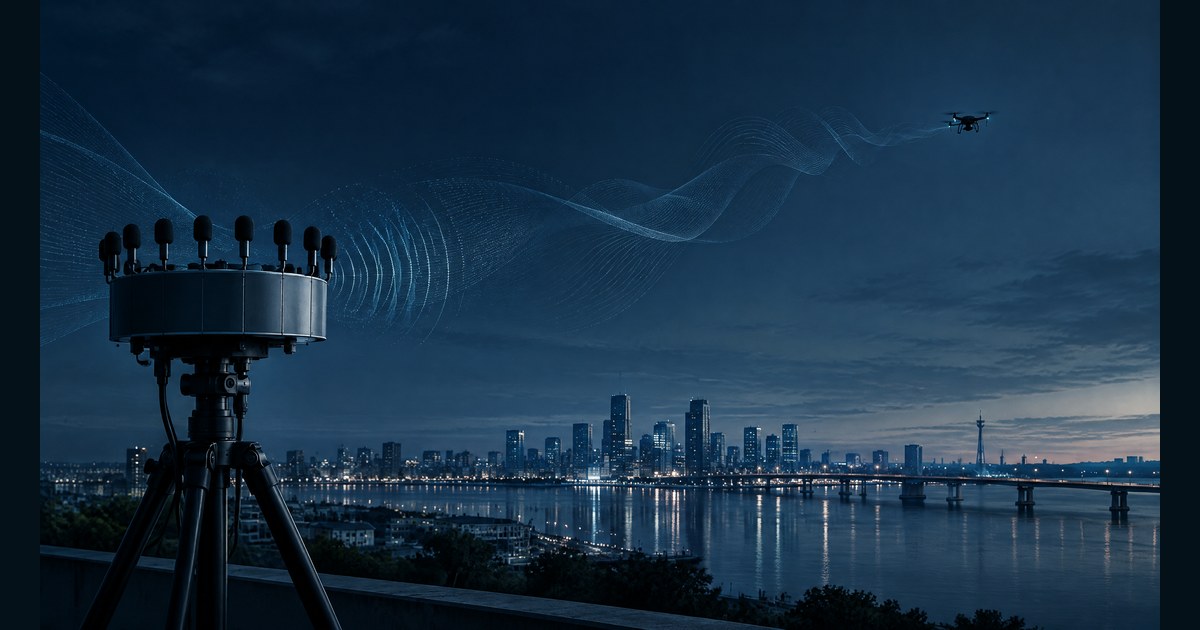
A procurement-oriented explanation of what passive acoustic UAV detection listens for, what its processing chain must do, and why results depend on the site as much as the sensor.
What passive means in an acoustic sensing method
The word passive describes the relationship between the sensor and the observed scene. A microphone is a receiver: it captures pressure variations and the system analyses features such as energy, frequency content and arrival-time differences. The system does not need to illuminate the airspace with a radar waveform or transmit a radio challenge to obtain an acoustic observation.
Passive is about reception, not a complete system promise
A passive acoustic layer can avoid an active RF emission from that sensing layer, but the wider installation may still contain powered processors, wired or wireless communications, network equipment and other sensors. “Passive” therefore should not be read as “the entire installation emits no energy.” It also does not establish explosion-proof approval, privacy compliance, or authority to take action. Those are separate engineering, governance and procurement questions.
The observation is sound evidence, not an identity certificate
Propellers, motors, airframe vibration and operating state can create acoustic patterns that support detection or classification. A sound event can indicate that a candidate source may be present, but it does not by itself prove a unique aircraft model, operator, flight permission or intent. Bearing, position, track, classification and model confidence are different outputs and should be named separately in a requirements document.
The dependencies hidden behind “just listening”
Listening is only the first step. A defensible result depends on the complete chain from acoustic coupling to decision record. The chain should be described in project terms instead of reduced to a claim that a sensor can hear a drone.
Microphones, calibration and array geometry
A single microphone can record sound level and spectral information, but directional review normally needs multiple channels with known relative positions and time alignment. The U.S. Army Research Laboratory report on a small tetrahedral array describes beamforming for direction-of-arrival estimation and notes that triangulation with multiple arrays can support location estimation. It also shows why calibration, array geometry and the chosen output matter: azimuth and elevation did not perform equally in that test. A project specification should therefore state whether it needs an alert, a bearing, a location estimate or a continuing track.
Processing turns a waveform into an operational observation
Filtering, time-frequency features, beamforming, noise estimation and classification can all change the result. Thresholds are not universal because the background distribution changes by site and time. In the Army report, the detection baseline used coherent beamformer energy and tested different passbands; the reported receiver-operating-characteristic results belong to that aircraft, array, processing method and measurement programme, not to every acoustic system. Acceptance evidence should document the tested configuration rather than copy a headline number.
Why the site can determine what passive listening can show
Sound is affected by distance, obstructions, reflections, wind and competing sources before it reaches the microphone. This makes environmental characterization a dependency of the sensing method, not an optional cosmetic improvement.
Noise and propagation can mask the source
Road traffic, machinery, ventilation, birds, construction and other aircraft may overlap the frequencies or timing patterns used by an algorithm. Wind can add microphone noise and alter propagation, while buildings, hard surfaces and terrain can create reflections or multiple arrival paths. The 2026 Acta Acustica study on a MEMS microphone system reports that coastal wind, indoor reverberation and ambient interference affected its experimental results. Its findings are useful as evidence of dependencies, not as a universal range or accuracy promise.
Geometry changes the meaning of a directional result
An array estimates direction from relationships among microphones. The same sound source can be easier to resolve from one direction than another, and reflections can produce competing paths. The Army report found mixed elevation tracking and interference from a helicopter in some flights. A buyer should ask how the proposed system handles overhead or near-vertical sources, reflective structures, moving background sources and simultaneous candidate sounds.
How to specify and validate passive acoustic UAV detection
The most useful procurement question is not “What is the maximum range?” It is “Under which defined conditions does the system produce which observable, with what evidence and uncertainty?” That framing keeps the passive method technically honest and makes comparisons fairer.
Define the required output before choosing the sensor
A civil facility may need an acoustic event log, a direction cue for operator review, a position estimate for correlation, or a candidate track that is explicitly labelled as uncertain. Each output requires different timing, synchronization, geometry and integration. Ask whether the data will be retained, what metadata accompanies an alert, how confidence is expressed, and how an authorised operator distinguishes detection from identification.
Test representative conditions and record the boundaries
A meaningful pilot should include the actual mounting context, representative background recordings, weather and operating schedules, approved test flights, known non-target events and a defined method for scoring false alarms and missed observations. The result should state the scenario, sensor configuration, processing version, test distances or locations, and limitations. It should not convert a controlled demonstration into a guaranteed coverage claim.
Turn “passive” into a written interface requirement
For a project discussion, document the acoustic output, synchronization, environmental assumptions, data-handling path and validation conditions before discussing coverage. SonicVast can review acoustic sensing, PCBA, SDK or integration options for a defined civil project, while compatibility, release scope and performance boundaries should be confirmed in writing for that project.
Discuss your projectAcoustic sensing listens for observable sound and cannot detect a literally silent target through sound alone. Results vary with aircraft acoustics, distance, geometry, weather, structures, background noise, calibration and processing. Any cited study result is specific to its reported test conditions and is not a SonicVast performance guarantee.