
RF detection is a starting point, not a verdict
From RF Detection to Drone Identification: Building a Smarter C-UAS Architecture
A responsible C-UAS program does not treat an RF alert as proof of a drone, an operator, or intent. It treats the alert as one piece of evidence in a governed workflow: observe, correlate, qualify, document, and escalate only when an authorized reviewer has enough context.
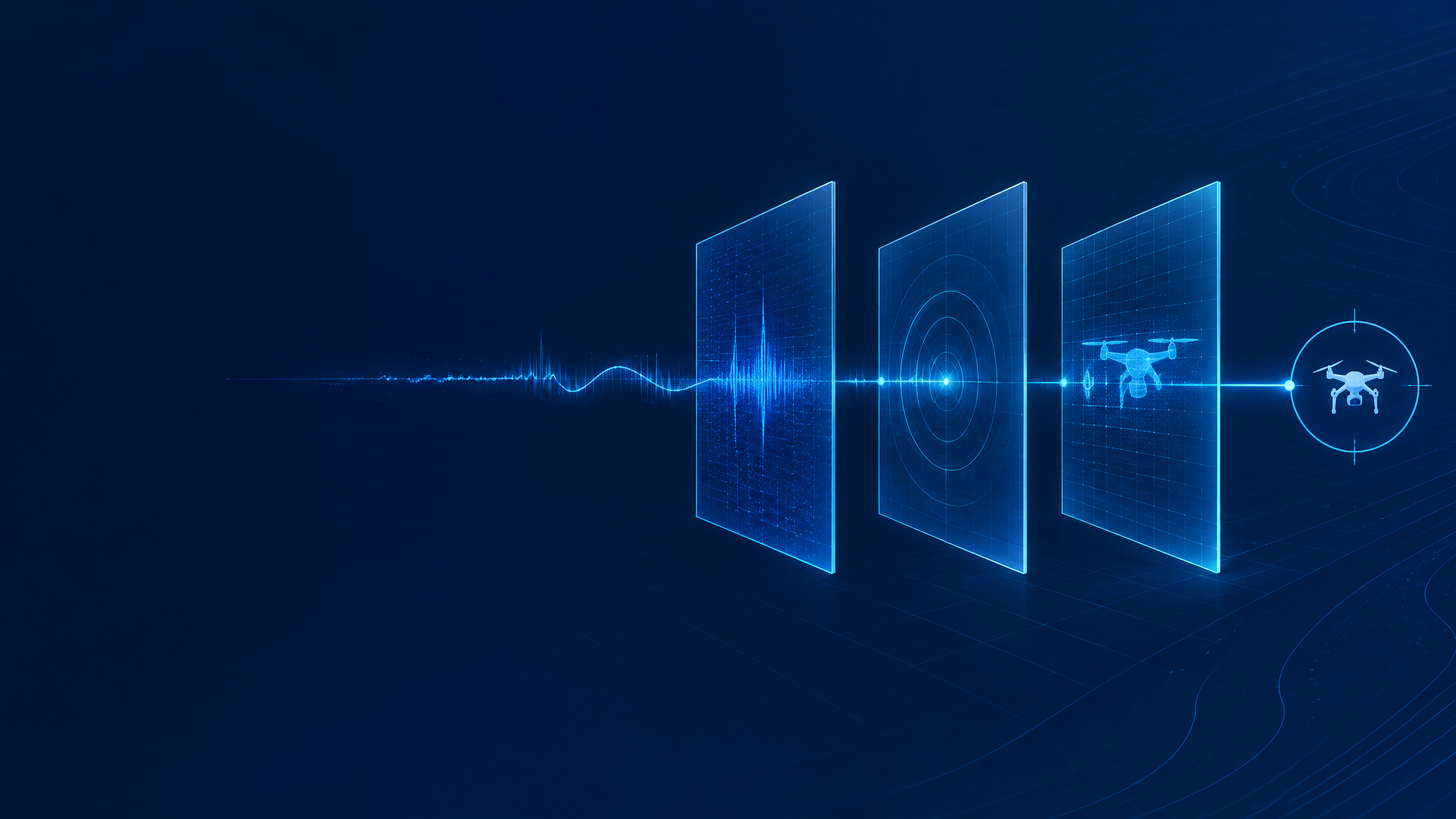
A compliance-first guide to turning RF observations into carefully qualified drone-identification decisions through layered sensing, human review, authorization controls, and site-specific validation.
Start with an observation, not an identity
RF sensing can indicate that energy or a recognizable signal pattern is present in a monitored environment. That observation may be affected by local interference, authorized devices, reflections, changing occupancy, or incomplete reference data. The system should therefore record time, location context, sensor health, confidence, and relevant environmental notes without turning a signal into a named aircraft or person. A clear distinction between detection, classification, and identification keeps dashboards honest and prevents premature action.
Use independent views to narrow uncertainty
Optical or EO/IR review can add visual context when conditions, privacy controls, and authorization permit it. Acoustic sensing may provide another contextual cue, but neither source is automatically definitive. Correlation should align timestamps and site zones, preserve each sensor’s provenance, and show disagreement instead of hiding it. If views conflict, the record should say so and route the case for human assessment rather than forcing a single label.
Design the decision layer around confidence
A useful decision layer expresses what is supported, what is inferred, and what is unknown. It can group observations into review queues, attach evidence snapshots, and apply locally approved rules for benign, ambiguous, or safety-relevant cases. Rules must be versioned, explainable, and tested against the site’s normal RF environment. Identification should remain a qualified assessment with an audit trail, not an automated assertion made solely because a threshold was crossed.
Make C2 the place where accountability lives
The C2 layer should connect alerts to roles, permissions, retention rules, and review outcomes. A reviewer needs to know who authorized monitoring, which data sources contributed, when the record was created, and what uncertainty remains. Integrations through an API should minimize shared data, authenticate services, log changes, and respect separation of duties. The architecture is complete only when it can support an inquiry after the event, including correction, deletion, and incident-review processes required by the organization.
Applicability
The approach is suitable for airports, utilities, ports, campuses, data centers, public venues, and other critical-infrastructure environments that need civil low-altitude awareness. It is most useful during requirements definition, system integration, acceptance testing, and governance review. The architecture must be adapted to local law, spectrum conditions, privacy expectations, existing C2 processes, and the organization’s authorized response boundaries.
Want a more accountable starting point? Map your site’s sensors, review roles, data flows, and uncertainty states before selecting integrations. Then ask SonicVast to help turn that map into a validation-ready architecture conversation.SonicVast provides this article for general civil security education. It is not legal advice, a compliance certification, an identification guarantee, or operational guidance. System owners remain responsible for authorization, lawful use, safety, privacy, cybersecurity, human review, and site-specific validation.