
INTEGRATION NOTE 018
What Makes an RF Drone Detection System Suitable for C-UAS Integration?
An RF drone detection system can add useful context to a civil low-altitude security program, but integration should begin with governance rather than a promise of certainty. The right question is whether the system can support a documented decision process: what it observes, how confident that observation is, who may review it, what happens when signals are ambiguous, and how the record is retained. Site-specific validation and human accountability are the measures of readiness.
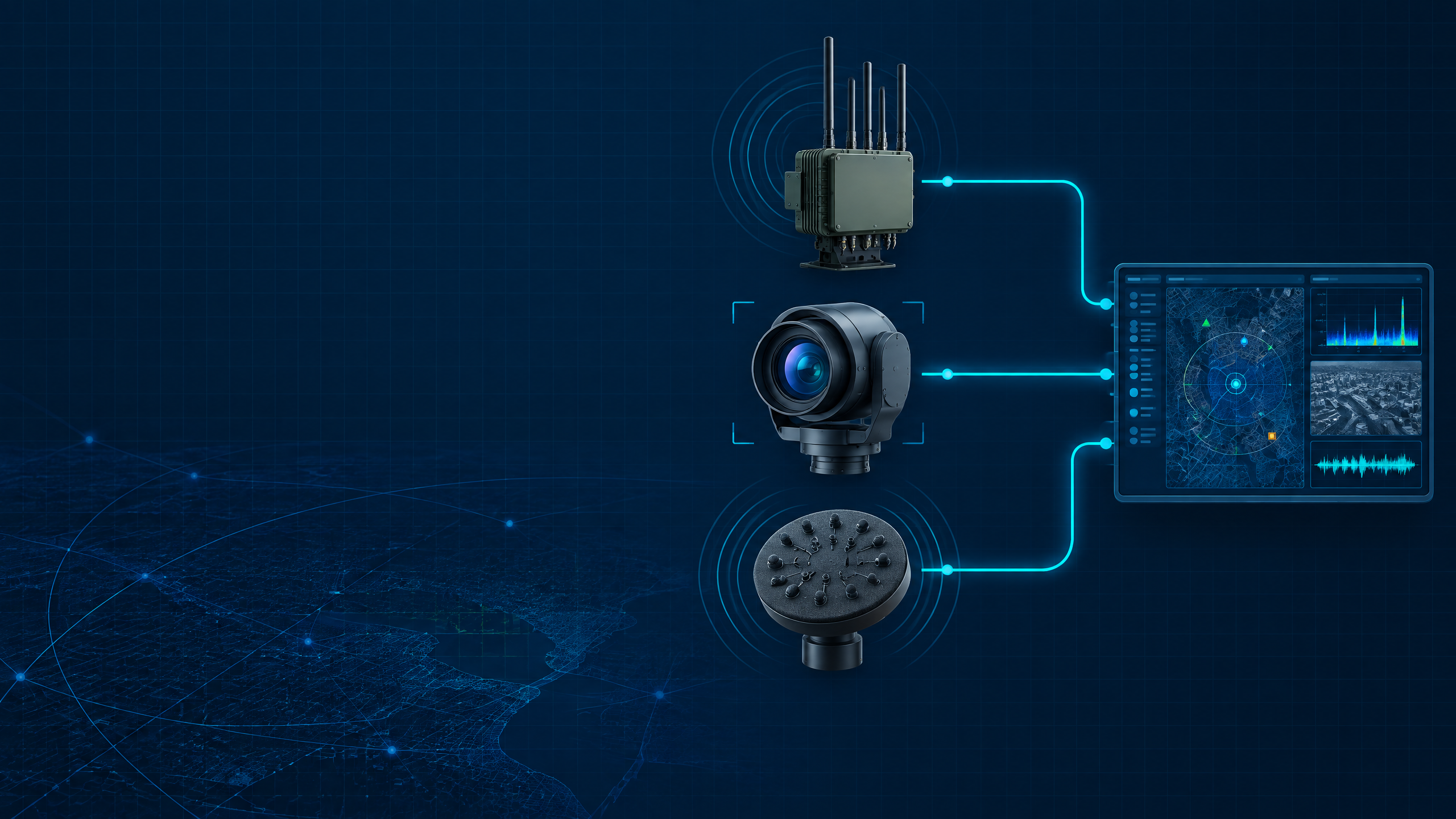
Suitability is not a feature checklist. It is the demonstrated ability to produce reviewable evidence, fit an authorized workflow, protect data, and remain dependable when conditions change.
Start with the decision, not the sensor
Document the legitimate safety or continuity decision the system is meant to support. Define the boundary between detection, classification, alerting, and response authorization. A suitable integration makes those boundaries visible in its interface and procedures, so an alert is treated as an input for review—not as proof of identity, intent, or wrongdoing. Requirements should also state what the system is not permitted to do, including any action outside the organization’s authority.
Make uncertainty legible
RF observations can be affected by local architecture, other emitters, propagation conditions, device behavior, and changes in the environment. The integration should preserve event time, sensor status, relevant context, confidence or quality indicators, and the distinction between an observation and a human-approved assessment. Where data is incomplete or conflicting, the workflow should support a clear unknown state, escalation for review, and correction without silently rewriting the record.
Treat data and access as safety controls
Before connecting an RF system to C2, case management, or other tools, establish data ownership, purpose limitation, retention, deletion, export, and access rules. Use role-based permissions, audit trails, change control, and documented API behavior. Minimize personal or incidental information, protect records in transit and at rest, and define how vendors, maintenance personnel, and integrators handle access. A technically stable connection is not sufficient if the resulting data cannot be governed.
Prove fit at the actual site
Validation should use an authorized, documented test plan that reflects the site’s layout, operating environment, permitted workflows, and foreseeable sources of ambiguity. Test normal operation, degraded connectivity, maintenance states, false or inconclusive alerts, clock alignment, fail-safe behavior, and operator handoffs. Record assumptions and limitations, obtain the necessary approvals, and repeat validation after material changes. No laboratory result can substitute for site-specific evidence and trained human review.
Where this is applicable
Use this framework when planning or reviewing civil protection for airports, utilities, campuses, logistics sites, public venues, and other controlled environments where low-altitude activity may affect safety or continuity. It is most useful during requirements definition, procurement, pilot design, integration review, and change management. Applicability depends on local law, spectrum and privacy obligations, site conditions, organizational authority, and the availability of trained reviewers.
Build the review path first. Ask SonicVast for an integration-readiness conversation focused on your authorized use case, data boundary, validation plan, and human-review workflow.SonicVast provides general educational information for civil security planning. This article is not legal, regulatory, privacy, cybersecurity, safety, or engineering advice; it is not a product specification or certification. Organizations remain responsible for authorization, compliance, risk assessment, procurement diligence, site validation, and all operational decisions.