
INTEGRATOR FIELD GUIDE
A Guide to Selecting Drone Detection Sensors for System Integrators
Choosing a drone detection sensor is less like selecting a single instrument and more like designing an evidence system. The right question is not which modality sounds most capable, but which observation a site is authorized to make, how that observation can be challenged by independent context, and how a human reviewer can explain the resulting decision. For integrators, disciplined requirements and governance should come before a product shortlist.
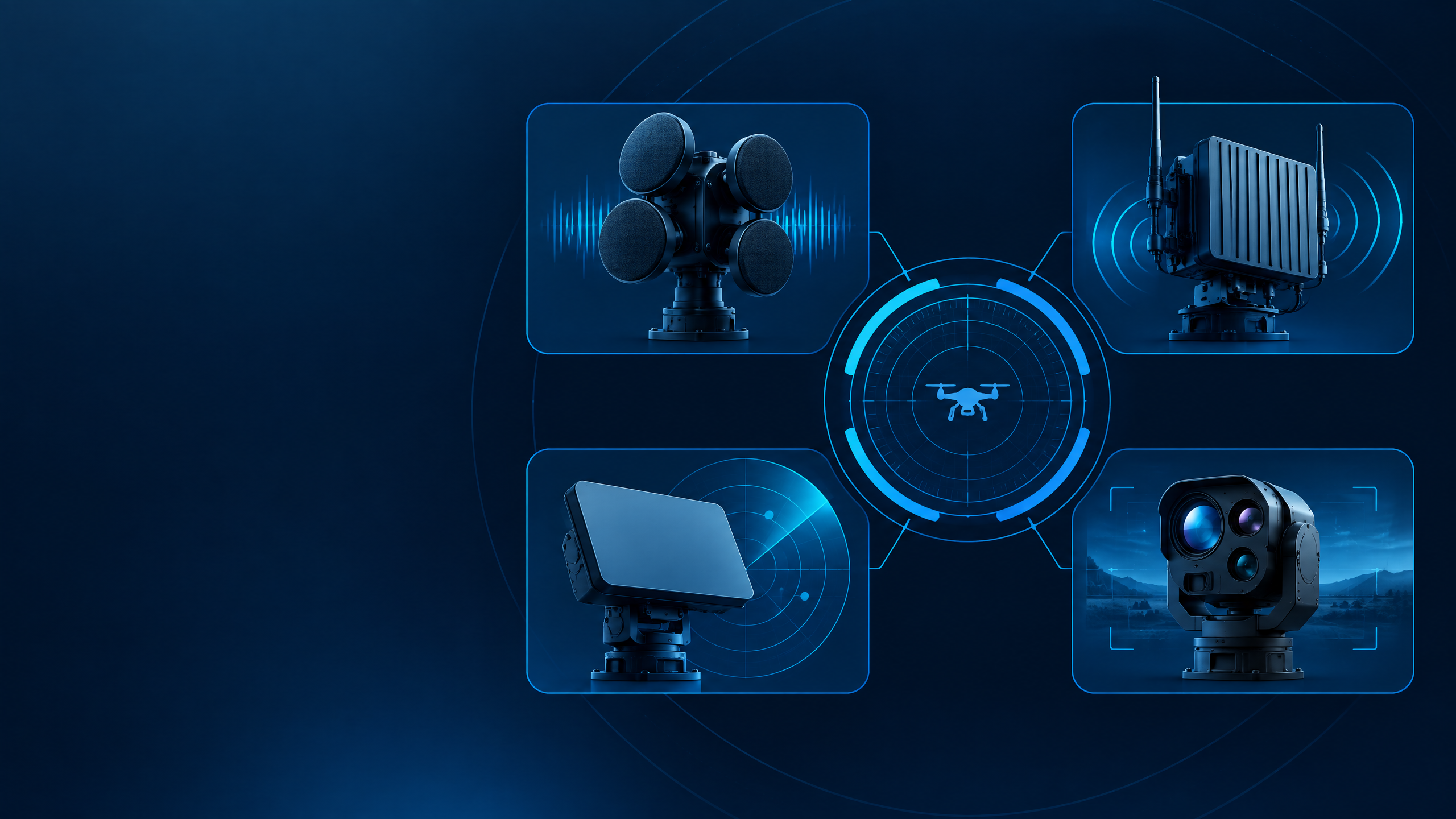
A compliance-first framework for comparing acoustic, optical, and RF sensing by purpose, uncertainty, governance, and site-specific validation—not by headline claims.
Choose acoustic sensing for an observable sound question
Acoustic sensing can add local context when rotor or propulsion sound is observable and the site can characterize its ordinary soundscape. Traffic, construction, weather, wildlife, building reflections, and equipment noise may change what the sensor hears. Requirements should therefore describe the environmental question, microphone health checks, privacy boundaries, timestamp quality, and how an uncertain sound event reaches review. An acoustic alert is an observation to assess, not proof of an aircraft, operator, or intent.
Use optical sensing where visual evidence is lawful and interpretable
Optical or EO/IR sensing may help an authorized reviewer examine visible movement and scene context, but interpretation depends on light, weather, occlusion, camera placement, image quality, and approved privacy zones. Integrators should specify masking, retention, role-based access, image provenance, and a human confirmation path. A model-generated label can prioritize a review queue; it should not be presented as verified identity or treated as permission to act.
Select RF when the monitoring purpose can be clearly bounded
RF sensing can contribute information about activity in a monitored radio environment, subject to local spectrum conditions, authorized collection, reference-data quality, and changing benign emitters. Define what the system records, what it cannot infer, and how signal observations are separated from identity or intent claims. Requirements should include provenance, time synchronization, confidence language, access control, and a documented path for human review. RF is an evidentiary input—not a verdict and not an authorization mechanism.
Evaluate the integration boundary, not only the sensor head
A sensor is fit for purpose only when its outputs can be governed through the surrounding C2 and API workflow. Ask how alerts are correlated, how disagreements remain visible, who can review them, how changes are logged, and what happens when a sensor or connection fails. Require least-privilege access, authenticated interfaces, audit records, time synchronization, correction and deletion procedures, and separation between detection, notification, and consequential action. Acceptance should test the complete evidence path on the actual site.
Where this framework applies
The framework is useful for airports and transport properties, energy and utility sites, ports, campuses, data centers, public venues, and other controlled environments that need a documented civil low-altitude alert-and-review process. It fits early requirements work, vendor comparison, architecture review, integration design, acceptance testing, and governance audits. It is not a substitute for local aviation, spectrum, privacy, safety, cybersecurity, or security requirements, and it should be adapted to the site's authorized responsibilities and existing C2 processes.
Start with a sensor decision sheet: state the lawful purpose, observable question, blind spots, corroborating source, human reviewer, retention rule, failure mode, and site validation test for each alert pathway. Then ask your integrator to demonstrate—not merely describe—how an uncertain observation is surfaced, challenged, documented, corrected, and closed.SonicVast provides this article for general civil security education. It is not legal advice, a compliance certification, a performance guarantee, an identification determination, or operational guidance. System owners and integrators remain responsible for authorization, lawful use, privacy, safety, cybersecurity, human review, data governance, and site-specific validation.