
SENSOR FUSION / FIELD GOVERNANCE
Sensor Fusion Strategies for Professional C-UAS Deployments
Professional C-UAS planning is less about collecting the largest possible stream of signals than about making each observation understandable, comparable and reviewable. A civil site may have building reflections, intermittent noise, changing light, permitted aircraft activity and ordinary radio traffic at the same time. Sensor fusion should therefore be designed as an evidence workflow, not as an automatic verdict. Acoustic, RF and optical inputs can add context to one another, but a sensor observation alone is not proof of identity, intent or authorization. Authorized people should review the evidence in line with site procedures before an event is classified, escalated or retained as a mission record. A sound deployment begins with a site assessment. The team should map observation zones, likely obstructions, lighting transitions, equipment rooms, neighboring activities, privacy boundaries and the people who are authorized to access records. It should also define what the system is expected to document, what it must not infer, and which decisions remain human responsibilities. This makes procurement, integration and later maintenance measurable without promising outcomes that the environment cannot guarantee.
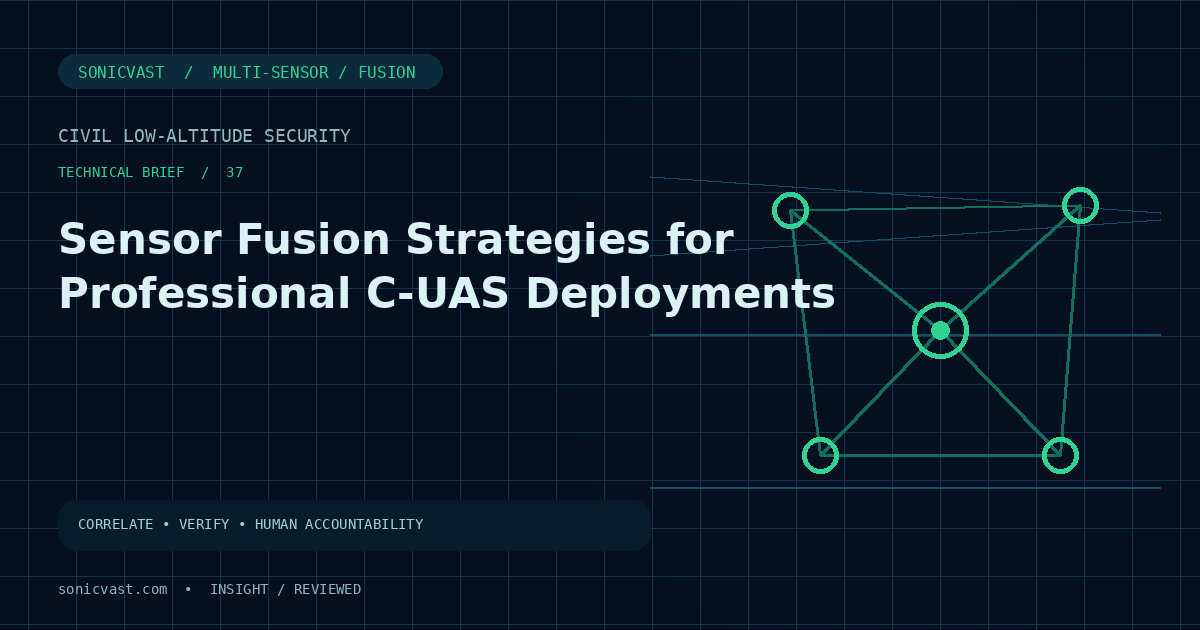
A compliance-first framework for joining acoustic, RF and optical observations into accountable civil low-altitude safety decisions.
Start with a common evidence picture
Each sensing modality describes a different part of an event. Acoustic data can add a time-linked environmental cue; RF observation can indicate that a transmission was present; optical material can provide visual context when conditions permit. None of these descriptions should be silently converted into identity or intent. A useful fusion layer keeps the original observation, its timestamp, sensor source, operating condition and confidence note visible to the reviewer. The integration design should make time alignment and provenance explicit. Use a shared event reference rather than merging unrelated alerts because they appeared close together. Record when a sensor was unavailable, obstructed, recalibrated or affected by a known site condition. A reviewer can then distinguish corroboration from coincidence. Interfaces should show disagreement as well as agreement, with clear language for unknown, unconfirmed and not observed. This preserves an audit trail and reduces the temptation to treat a single composite label as fact.
Turn observations into authorized mission records
A professional program needs a record policy before it needs a dashboard. Define which observations may be retained, who may view them, how an event is annotated, and when material is corrected, exported or deleted. Separate routine telemetry from an incident record, and keep access logs so that later reviewers can see who changed a classification and why. Data minimization matters: capture what supports the site’s stated safety purpose, not an open-ended profile of people, vehicles or neighboring activity. Human review should be structured but not automated into an adverse decision. A reviewer can compare the fused event with the site schedule, authorized flight information, maintenance notes and other approved context, then document the basis for a disposition. The record should preserve uncertainty and competing explanations. If an alert cannot be resolved within the available evidence, the responsible outcome may be to mark it unresolved and follow the site’s established notification path rather than inventing certainty.
Procure an integration that can be maintained
Fusion quality depends on the work around the sensors. During site acceptance, test ordinary environmental variations, authorized activity, communications changes and planned maintenance conditions. Ask vendors how data is time-stamped, exported, corrected and secured; how interfaces exchange event metadata; which functions continue when one source is unavailable; and what training is provided for reviewers. Interoperability should be demonstrated with documented interfaces and controlled test records, not assumed from a product label. A maintenance plan should cover calibration checks, clock consistency, firmware review, storage health, access permissions and periodic reassessment after construction or operational changes. Procurement teams should also examine support boundaries, data ownership, retention settings and the process for investigating false or incomplete records. The strongest deployment is one that remains legible months after installation: its observations have context, its limitations are known, and its authorized users can explain how a conclusion was reached without claiming more than the evidence supports.
Use fusion to support judgment
Combine independent observations to improve the quality and traceability of review. Keep source data, uncertainty and reviewer notes together so a later decision can be understood without overstating what the sensors established.
Build a reviewable civil C-UAS evidence workflow with SonicVast.General information only; not legal, aviation, security or emergency-response advice.