
SONICVAST / INTEGRATION PRACTICE
Choosing Between Standalone and Integrated Drone Detection Systems
The right question is not which architecture looks more capable. It is which architecture lets a site recognize uncertainty, assign responsibility, protect data, and make a lawful decision that people can review later.
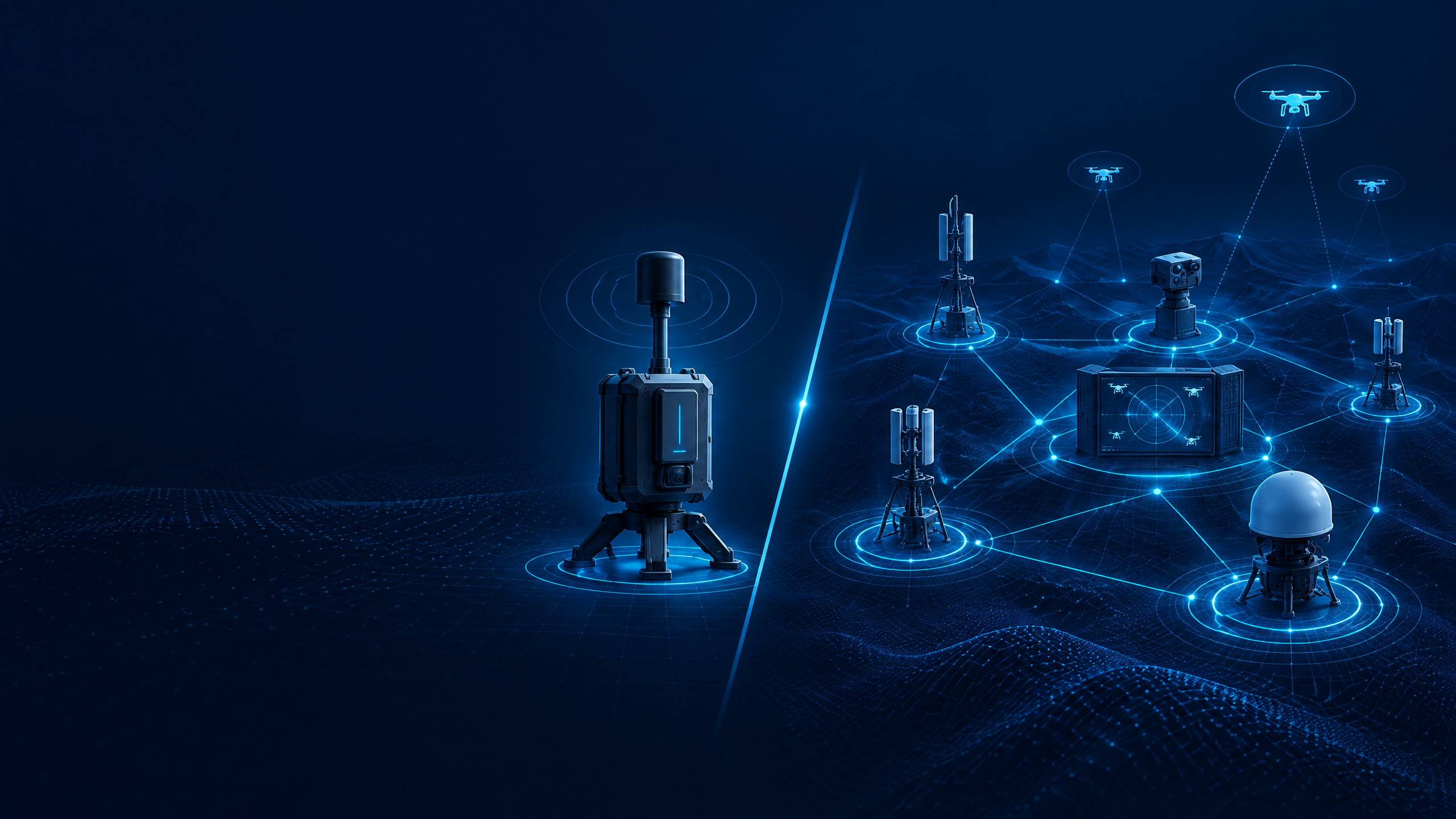
A compliance-first guide to deciding whether a standalone detector or an integrated workflow better fits a civil site, with uncertainty, human review, authorization, data governance, and validation treated as design requirements.
Start with a clear, contained responsibility
A standalone system can be appropriate when a site needs a focused observation and has a defined team to review it. Its smaller boundary may simplify ownership, access control, maintenance, and evidence handling. It can also leave important context outside the record. Before selection, document what the system observes, what it does not observe, who receives an alert, how a reviewer verifies it, and how the record is closed. A contained design is not automatically a complete one.
Integrate only where context has a job
An integrated design can connect detector observations with authorized site context such as access status, weather notes, camera review, or an incident record. The value is not the number of connected systems; it is whether each connection improves accountable review. Define API ownership, identity, permissions, data minimization, retention, change control, and failure handling before integration. A larger workflow can create larger privacy, availability, and accountability obligations.
Compare evidence, not product labels
Architecture decisions should compare the quality and governance of observations rather than assume that standalone or integrated means better. Consider acoustic, optical, and RF inputs in the actual site environment, including noise, obstructions, weather, privacy boundaries, and maintenance conditions. Preserve source, time, confidence, limitations, and reviewer notes. Disagreement between inputs is a reason to examine assumptions, not permission to force a single answer.
Make escalation and pause paths explicit
No architecture removes the need for trained human judgment. Define who may acknowledge, escalate, dismiss, or share an observation; what evidence each decision requires; and when automated handling must pause. Use role-based access, audit records, periodic review, and a documented route for false or ambiguous events. Site-specific validation should test ordinary conditions and failure modes with stakeholders before the workflow is relied upon for consequential decisions.
Applicability and validation
The framework applies to airports, utilities, campuses, logistics sites, and other controlled civil environments considering low-altitude awareness. Standalone may suit a bounded need with clear local ownership; integration may suit a site that can govern shared context and connected records. Neither choice can be made from a generic checklist. Validate locally against soundscapes, RF conditions, sightlines, architecture, weather, privacy expectations, staffing, maintenance, network resilience, and incident-governance procedures. Begin with a limited evaluation, agree acceptance criteria, and revisit the decision as the site changes.
Ask SonicVast to help structure a reviewable architecture brief: define the decision boundary, map authorized data, expose uncertainty, and validate ownership with the teams responsible for safety, privacy, and continuity.Disclosure: This is general educational material, not legal, regulatory, safety, security, or procurement advice. SonicVast makes no performance, coverage, attribution, superiority, or suitability claim. Seek qualified counsel and complete documented, site-specific validation before deployment or reliance on any decision workflow.