
INDUSTRY WATCH / PASSIVE SENSING
Thales and Visionary Machines describe a preliminary passive EO/IR counter-drone evaluation
Thales and Visionary Machines have announced preliminary work to combine Visionary Machines’ Pandion Sentinel passive detection, classification and ranging capabilities with Thales infrared camera hardware. Public reporting describes controlled trials intended to evaluate technical feasibility, interface requirements and indicative system-level performance, following a memorandum of understanding reported in July. This source-attributed record treats the collaboration as a planned technical evaluation. It does not establish completed trials, customer deployment, a production award, measured performance, a full counter-drone system or a suitable outcome for a civil facility.
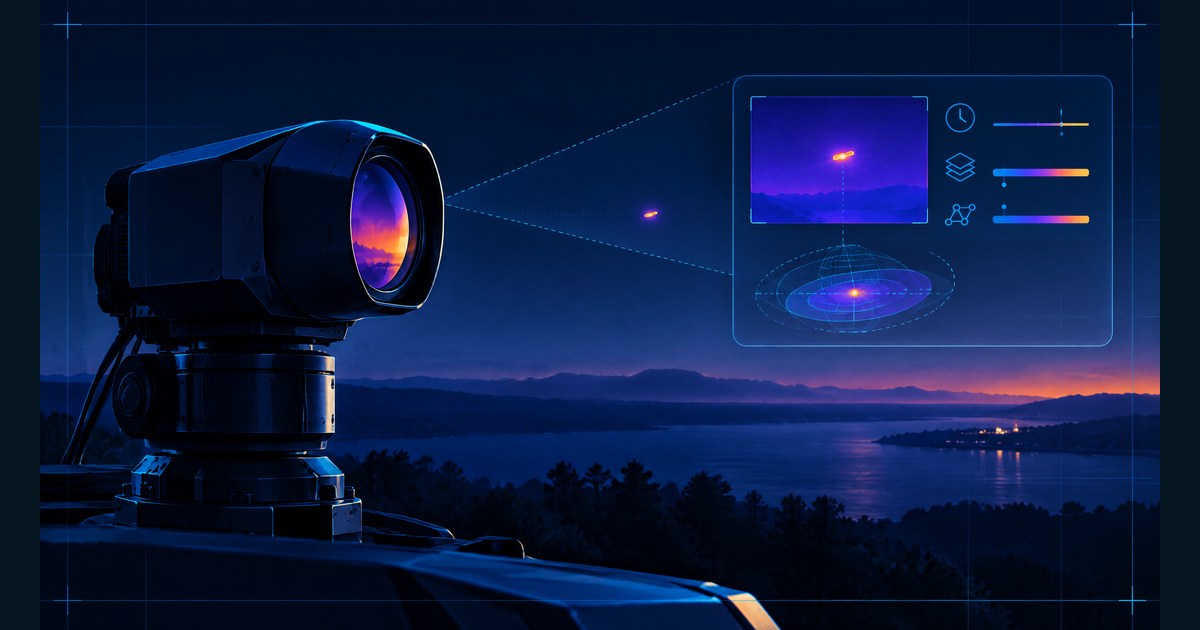
Thales and Visionary Machines say they are evaluating integration of passive detection software with infrared cameras; public material describes planned controlled trials, not a completed deployment or measured outcome.
The public material describes a feasibility-oriented combination of passive software and infrared hardware.
Company and trade material describe preliminary integration of Pandion Sentinel with Thales infrared camera systems. The stated aim is to assess technical feasibility, interface requirements and indicative system-level performance through controlled trials. This is a prospective evaluation of a passive EO/IR sensing approach, not a customer-deployed system or an independently established result.
The sources do not establish what the controlled trials will show or how a system would perform elsewhere.
No reviewed source establishes a completed trial, a performance dataset, a customer purchase, field deployment or an integrated defeat capability. Statements about passive or non-emitting sensing describe an approach, not a guarantee of detection, classification or ranging in all conditions. The record also avoids turning a technology partnership into an endorsement, a comparative claim or a civil-site recommendation.
Passive optical, acoustic and other sources can each add context while retaining distinct limits.
For civil low-altitude awareness, a passive EO/IR observation may be reviewed alongside permitted acoustic, RF, radar, airspace and site context. Correlation must preserve source provenance, time alignment, environmental conditions and disagreement rather than automatically becoming identity, authorisation or action. Site teams require legal, aviation, privacy, cybersecurity, safety and engineering review before any implementation conclusion.
Evaluate passive sensing through complementary, reviewable evidence
Retain source provenance, timing, environmental context, uncertainty, lawful authority and named human review when comparing passive optical, acoustic and other observations.
Discuss a civil, compliance-first passive and multi-sensor evidence-governance framework with SonicVast.Source note: Thales, Visionary Machines, Australian Defence Magazine and Unmanned Airspace material reviewed on 14 October 2026. Source names are shown for transparency; external links are not displayed. This record does not claim completed trials, performance, procurement, deployment, a full counter-drone capability, civil suitability or SonicVast involvement.