
TECHNOLOGY INSIGHT / PASSIVE ACOUSTIC
The Role of Microphone Arrays in Modern UAV Security Systems
As low-altitude airspace becomes busier, security teams need more than a single sensor view. Microphone arrays offer a complementary form of observation: they compare sound arriving at several synchronized microphones to estimate a bearing and to identify recurring acoustic patterns for assessment. This can help operators decide when a situation merits verification through other lawful sources. It is not a shortcut to certainty. Wind, buildings, traffic, vegetation, construction, and overlapping aircraft can distort or mask sound. A responsible system therefore presents acoustic results as indications with confidence and context, preserves a reviewable record, and keeps consequential decisions with authorized people.
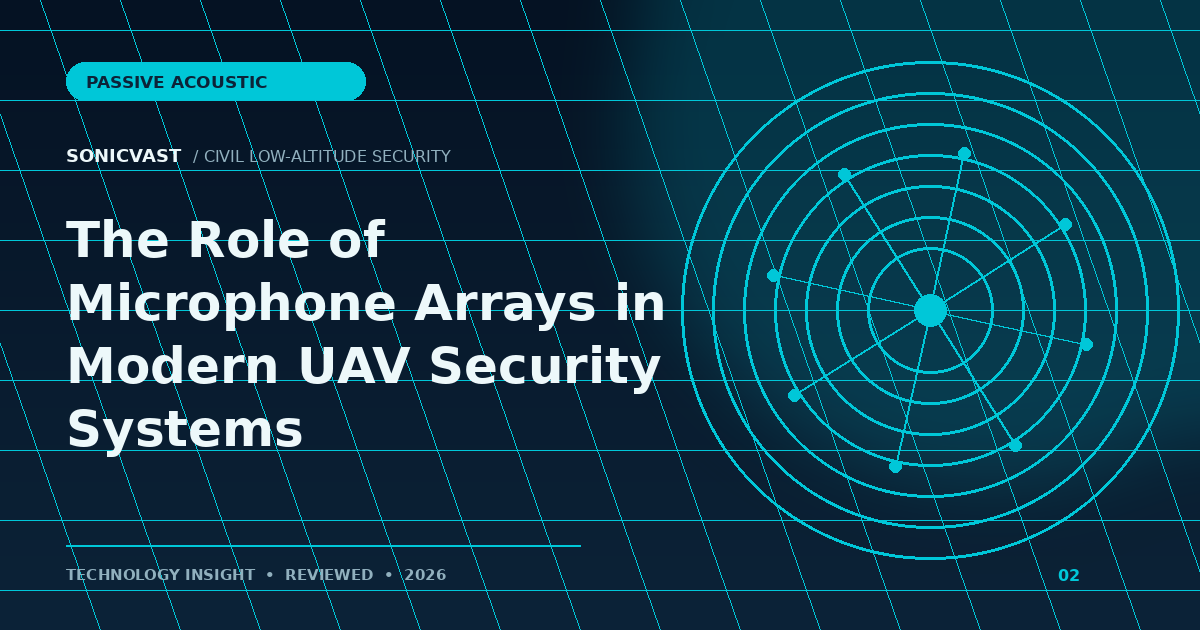
Microphone arrays can support civil UAV awareness by locating and characterizing sound patterns for human review. Their value depends on calibrated observation, environmental context, careful data handling, and authorization—not on treating audio as proof of identity or intent.
What an array adds to the sensor picture
One microphone records sound at one point; an array compares timing and intensity across multiple points. That spatial difference can support a directional estimate and help distinguish a persistent tonal pattern from a transient background event. The output is an observation, not an identity claim. A sound signature may be shared by different aircraft, changed by payload or maintenance, or confused with machinery, birds, or road noise. Good interfaces show the signal, time window, estimated direction, and confidence so reviewers can understand both the finding and its limits.
Why environment matters as much as hardware
Acoustic assessment is inseparable from place and conditions. Reflections from walls, tree cover, elevation changes, weather, and moving vehicles can create misleading paths or gaps in coverage. Calibration checks, known-noise baselines, and documented maintenance help teams recognize when a reading is degraded. Systems should record uncertainty and allow a reviewer to mark an observation as inconclusive. Corroboration with approved sources—such as visual observation or airspace information—should be treated as verification, not as an automatic escalation. Teams should also test ordinary edge cases before relying on an alert: a nearby fan, a passing bus, a flock of birds, or a temporary construction project may produce a familiar pattern. Review logs can capture what was heard, what was checked, and why confidence changed. This makes later assessment more transparent and helps improve local baselines without turning every unusual sound into a security event.
Design for privacy and accountable review
Microphones can capture more than aircraft sound, including voices and ordinary community activity. A civil deployment should define a narrow purpose, a lawful operating area, retention limits, access controls, and an audit trail before collection begins. Where feasible, processing should prioritize relevant acoustic features over unnecessary raw audio, with clear rules for deletion and authorized disclosure. Human reviewers need training on false positives, accessibility, local conditions, and bias in available datasets. Every alert should have a path to challenge, correction, and supervisory review. Governance should also specify who may see raw recordings, who may annotate an event, and who can approve a change to detection settings. Periodic reviews can ask whether the system remains necessary, whether it is producing disproportionate nuisance alerts, and whether affected people have a clear channel for questions or correction. These controls are part of system quality, not paperwork added after deployment.
Turn a signal into a measured decision
The practical role of an array is to improve awareness and prioritize verification, not to decide what an aircraft means or who controls it. A proportionate workflow can label an acoustic observation, compare it with permitted context, request human review, and document the authorization for any next step. If evidence remains ambiguous, the correct outcome may be continued monitoring or no action. Clear escalation thresholds, incident review, and periodic governance checks keep the system aligned with safety, civil rights, and the limits of the evidence.
Interpret observations with care
5 min read
Where it fits
Arrays can contribute to site awareness, event planning, infrastructure monitoring, and post-incident review when the purpose is defined in advance. Pair them with approved context, publish clear responsibilities, and record uncertainty. A disciplined “unable to determine” result is safer than overconfident classification.
Build acoustic awareness around evidence, authorization, and review—not assumptions.This article is educational and does not provide legal, regulatory, aviation, or privacy advice. Deployments should undergo an appropriate risk assessment, local compliance review, and documented authorization before use.