
ACOUSTIC SENSING / ENGINEERING AND PROCUREMENT
UAV Acoustic Detection System Outputs: What the Signal Can and Cannot Prove
A UAV acoustic detection system does not produce one universal answer called “drone detected.” It turns pressure fluctuations captured by microphones into a sequence of outputs. Those outputs may include an acoustic event, signal quality indicators, a bearing estimate, a changing track, and a model-based classification score. Each answers a different question. Understanding that chain helps a civil infrastructure team specify the right interface, test the right evidence, and avoid treating a probability or direction estimate as proof of an aircraft identity, authorization status, or intended action.
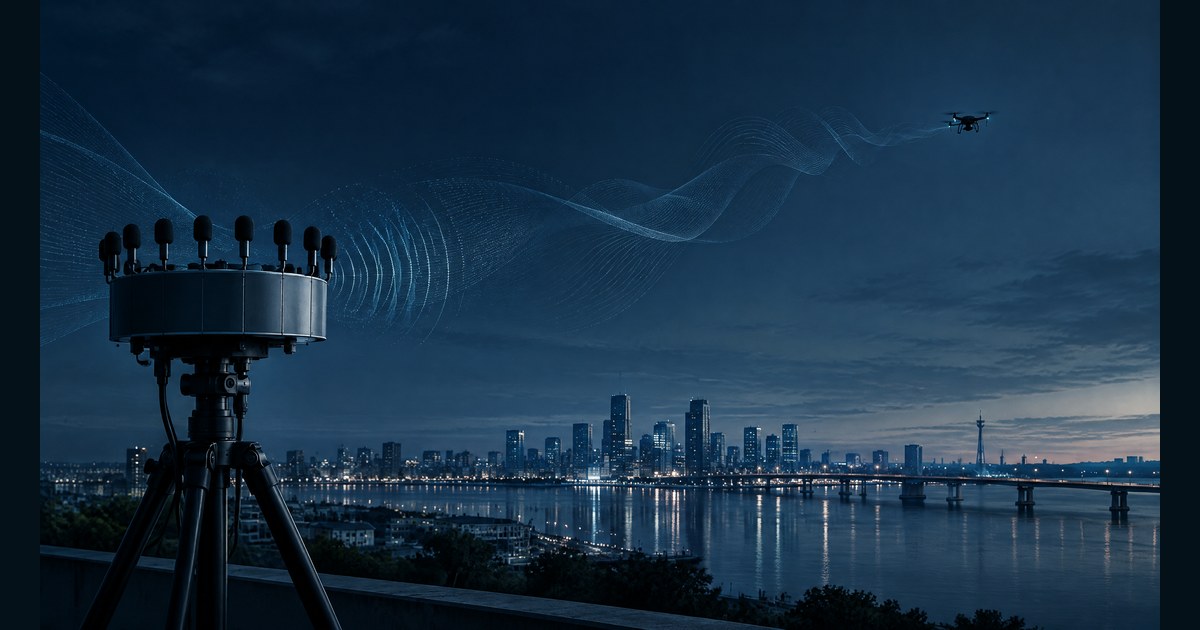
A procurement-oriented guide to reading acoustic detections, directional estimates, tracks and classification scores without confusing an observation with an identification.
Start with the output type, not the headline alert
The first review question is what the system actually observed. A useful output record should make the transition from audio to interpretation visible. It should not collapse raw evidence, signal processing and a human decision into one label.
An acoustic event is an observation of sound energy
At the lowest level, the system records a time window in which sound energy or a signal pattern differs from a local baseline. Depending on the design, the record may include timestamps, channel levels, a waveform or spectrogram, frequency-band measures and a quality or confidence indicator. This says that the microphones received an analyzable acoustic pattern. It does not by itself say that the source was an aircraft. Vehicles, machinery, birds, construction activity and wind can all create patterns that need review.
A feature is not the same as a classification
Signal features are measurements or transformations used to describe sound. Frequency peaks, harmonic structure, modulation, energy over time and Mel-frequency cepstral coefficients are examples used in acoustic research. A classifier uses selected features to compare an observation with a trained set of examples. The resulting class or score is therefore conditional on the training data, preprocessing and operating environment. It is better read as model-supported evidence than as an independently verified aircraft identity.
Separate direction, position and track
Directional outputs are valuable for review, but they are not interchangeable. A buyer should ask which geometric quantity is delivered and how the system represents uncertainty.
Bearing or direction of arrival
A microphone array can compare the timing and level relationships between channels to estimate the direction from which a sound reaches the array. The result may be an azimuth, an elevation estimate, a sector or a confidence interval. It is a directional cue relative to the sensor. Reflections, obstructions, array calibration, timing synchronization and background noise can affect the estimate, so a displayed line should not automatically be treated as a precise source location.
Position needs more than one geometric constraint
A single directional sensor generally supplies a line or sector rather than a complete three-dimensional position. Position can be estimated when the system combines multiple suitably synchronized sensors, motion over time, or another approved source of spatial information. That estimate depends on sensor geometry, clock alignment, propagation assumptions and association logic. Procurement documents should therefore distinguish “bearing available” from “position calculated” and request the coordinate reference, update behavior and uncertainty representation for each.
A track is an association over time
A track is not a second microphone measurement. It is a software representation that links successive observations into a moving object hypothesis. Track continuity can break when the sound is masked, the source changes direction, another sound is nearby, or the system loses sufficient signal quality. A track history should preserve when it was created, updated, degraded or dropped instead of displaying an uninterrupted path that hides gaps.
Read classification scores as conditional evidence
Classification is often the most misunderstood acoustic output. A label such as “multirotor” or a model name can be useful for organizing attention, but its meaning depends on how the model was trained and tested.
Training conditions shape what a score means
A 2024 study in Sensors recorded 17 UAVs in outdoor conditions and used acoustic analysis and MFCC-based discriminant analysis to investigate model differences. The experiment used controlled observations, including hovering at 8 m above the recording equipment, and documented different locations and weather conditions. That is useful evidence that acoustic differences can be studied; it is not a universal guarantee that the same model score will transfer to every site, altitude, flight mode, microphone arrangement or soundscape.
Distance changes the input before the model sees it
A 2024 Electronics study evaluated several machine-learning detectors at different distances. Its results showed that performance changed when models trained on short-distance recordings were tested farther away, while distance-diverse training data improved generalization. The practical lesson is not to copy a published range. It is to ask whether acceptance data represent the distances, orientations, background sounds and weather that matter at the proposed site.
Confidence is not probability of identity in the world
A displayed confidence value usually describes the model's relative support for a class under its defined scoring process. Unless calibration, validation data and decision thresholds are documented, it should not be interpreted as a literal probability that a particular aircraft is present. A responsible interface can show the candidate class, score, quality conditions, model version and “unknown” or “insufficient evidence” states rather than forcing every sound into a named category.
Treat the environment as part of the output
Acoustic outputs are inseparable from the conditions under which sound was captured. A system that reports only a label without the surrounding measurement context makes later review harder.
Wind, rain and reflections can change the evidence
UK government guidance for environmental sound measurements requires reporting weather at the microphone location, including wind speed and direction, and calls for microphone windshields. It also warns about wind-induced noise, reflections and other interfering sources. For UAV acoustic work, the same principle is a practical data-governance requirement: log weather and site conditions with each test or event so a weak or unusual output can be interpreted rather than merely accepted or rejected.
Signal-to-noise ratio is a decision context
A quiet laboratory recording and an industrial perimeter are not equivalent inputs. Machinery, roads, vegetation, structures and changing wind can mask or imitate parts of an aircraft signature. The system should expose quality indicators such as usable channels, saturation or clipping, estimated background level, interference flags and time-window validity where available. These indicators help an operator understand whether a classification failure reflects the target, the environment or the measurement chain.
A local baseline is more useful than a universal promise
The relevant baseline is the soundscape at the proposed site during the hours and operating states that matter. A civil buyer can ask for background recordings, representative non-target examples, weather logs and repeat tests across meaningful conditions. This creates an evidence set for the actual location instead of treating a laboratory dataset or a single demonstration as a site-wide performance claim.
Specify an evidence chain that people can audit
The most useful acoustic output is not necessarily the most visually impressive one. It is the one that lets qualified reviewers understand what happened, what was inferred and what remains unknown.
Ask for a layered event record
A practical record can include the event timestamp, sensor identity, channel health, audio or derived evidence retained under the site's privacy policy, detected frequency or feature information, bearing or sector, track state, candidate class and model version. It should also record quality flags, environmental observations and any correlation with other approved sensors. The exact fields depend on the integration, but the separation of raw or near-raw evidence from derived decisions should remain clear.
Define unknown and review states before acceptance
A system should have a documented response when the sound is too weak, ambiguous, out of distribution or inconsistent across sensors. Useful states may include detected sound, possible UAV acoustic signature, unclassified source, insufficient quality and track lost. These are not failures of wording; they prevent the interface from converting uncertainty into false precision.
Test outputs against the decision they are meant to support
Acceptance should evaluate the output used by the civil workflow. If the requirement is an early directional cue, test bearing stability and latency. If it is classification support, test known targets together with non-target sounds and unknown examples. If it is a track for later correlation, test continuity and gap reporting. Do not accept a single accuracy number without its dataset, threshold, distance, weather, false-alarm definition and measurement procedure.
Turn the output vocabulary into procurement questions
For a project discussion, ask the integrator to define each output, its units, update rate, uncertainty or confidence representation, quality flags, retained evidence, model version and unknown state. Then request a site-relevant test plan covering distance, weather, background sounds, reflections, non-target sources and approved cross-sensor correlation. SonicVast project teams can confirm applicable acoustic sensing, integration and documentation options against the actual site and interface requirements.
Discuss your projectAcoustic sensing observes sound and cannot detect a literally silent target. Research results from particular sensors, datasets and test conditions do not establish universal range, accuracy or classification performance. Detection, direction, position, track, classification and authorization remain different outputs and decisions.