
ACOUSTIC SENSING / ENGINEERING AND PROCUREMENT
Acoustic Counter UAV System: Separate Observation From Authorization and Countermeasure Decisions
An acoustic counter UAV system can be useful at the first stage of a low-altitude security workflow: it can register sound patterns and raise a candidate observation for review. It cannot, by itself, prove who operates an aircraft, whether the flight is authorized, what the pilot intends, or whether a countermeasure is lawful. The practical procurement question is therefore not simply whether a sensor detects a drone. It is whether the complete workflow preserves a clear boundary between an observation and a decision to act.
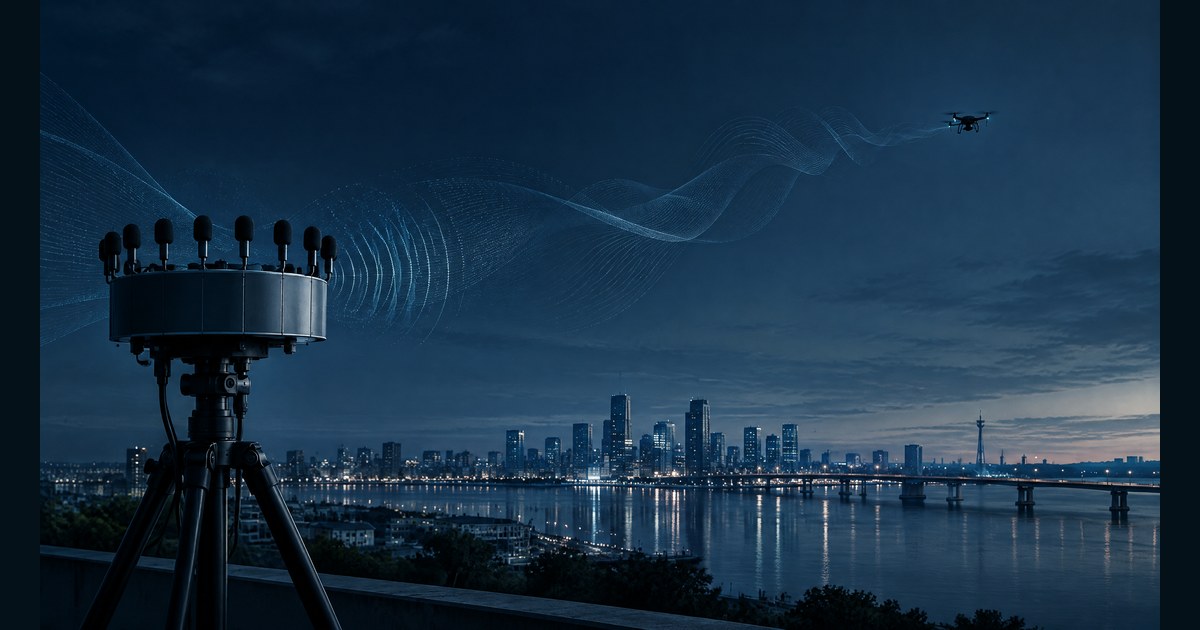
A civil buyer's guide to keeping acoustic alerts, flight authorization, threat assessment, and countermeasure authority in separate decision stages.
What an acoustic alert actually represents
A microphone array receives environmental sound. Signal processing may identify features associated with rotating propellers, motors, or frame vibration, while multiple microphones can provide directional or localization context. Those outputs are useful evidence, but they remain evidence. The U.S. Federal Aviation Administration (FAA) describes acoustic sensors as one possible detection source and states that detection systems do not determine intent or the level of threat posed by a UAS.
Separate bearing, track, class, and identity
A bearing is not a confirmed position. A position estimate is not a track history. A classification such as possible multirotor is not a unique aircraft identity, and an identity is not proof of permission. A procurement specification should name each output separately and state the evidence behind it. This prevents a dashboard label such as drone detected from being read as unauthorized aircraft confirmed.
Treat the sound environment as part of the result
Wind, traffic, machinery, birds, reflections, microphone placement, and changing flight conditions can affect the received signal. Research in Acta Acustica describes time-difference-of-arrival localization and machine-learning classification as useful approaches, while also identifying environmental noise, multipath propagation, limited range, and model generalization as continuing challenges. A civil acceptance plan should therefore test the local soundscape and preserve uncertainty rather than import a laboratory result as a universal field guarantee.
Observation is not authorization status
The next question after an acoustic alert is not automatically whether to counter the aircraft. It is whether the candidate event can be compared with the site's approved activity and the relevant airspace information. That comparison may involve an operator schedule, a site permit, a known inspection mission, Remote ID where applicable, visual confirmation, or information from an authorized coordination channel. Each item answers a different question and none should be treated as a substitute for the others.
Use Remote ID as one correlation source
The FAA explains that Remote ID broadcasts identification and location information that can be received by other parties, and that compliant configurations differ. It also recognizes authorization paths for some operations that do not follow the ordinary Remote ID arrangement. Remote ID can therefore help correlate an observation with a registered or declared source when the signal is present and applicable. Its presence does not make an acoustic alert unnecessary, and its absence does not by itself establish malicious intent or authorize a response.
Make the authorization record explicit
For procurement, ask where authorization status is recorded, who can amend it, how time and location limits are represented, and what happens when an approved mission changes. A useful interface should show the difference between no matching authorization found, authorization information unavailable, and authorization explicitly rejected. These are operationally different states and should not collapse into one alarm category.
Threat assessment needs a separate accountable step
An acoustic observation may support an investigation, but it does not establish intent or threat level. The FAA's airport guidance makes this distinction directly: detection systems prompt further investigation, while detection itself cannot determine intent or the level of threat posed by a UAS. A civil workflow should assign that assessment to a named role using approved procedures and available evidence.
Define the handoff, not an automatic conclusion
The system should record when an alert was created, what the acoustic layer observed, what corroborating sources were available, who reviewed the event, and which rule governed the next step. If confidence is low or sources disagree, the result should remain an unresolved observation with an escalation path. This is more defensible than converting an uncertain classification into a binary hostile or safe label.
Protect safety and privacy during review
A civil site should define retention, access, and audit rules for audio and related event records. The 2020 interagency advisory from the U.S. Department of Justice, FAA, Department of Homeland Security, and Federal Communications Commission warns that detection and mitigation technologies can implicate aviation safety, communications, privacy, civil liberties, and civil rights. The review process should be designed with those impacts in view, not added after installation.
Countermeasure authority is a different procurement question
A detection layer and a mitigation layer should be specified, purchased, and governed as different capabilities. The FAA distinguishes detection systems from mitigation systems, which can include disrupting, disabling, destroying, taking control of, or providing alternate flight instructions to a UAS. The fact that a supplier offers both functions, or that an interface displays a response button, does not establish that a civil operator may use the function.
Start with the jurisdiction and designated authority
The applicable authority depends on the country, site, airspace, and function being considered. In the United States, the DOJ advisory says Congress had granted limited authority to four federal departments for UAS detection and mitigation activities at the time of publication, and it cautions that federal agencies do not approve private or non-federal use of commercial products. CISA likewise advises critical-infrastructure owners to know who has authority to take action and to implement legally approved technology. Buyers elsewhere need the equivalent review from their own aviation, communications, public-safety, and legal authorities.
Keep safety effects in the decision record
The FAA notes that operational use of detection and mitigation systems can provoke responses that disrupt airport operations or introduce safety and efficiency impacts. A countermeasure decision should therefore document authority, trigger conditions, affected airspace, coordination requirements, safety review, and a route back to normal operations. This article does not prescribe a countermeasure or an engagement procedure; it identifies the governance information that must exist before any such capability is considered.
A buyer's acceptance checklist for the separation
The strongest civil procurement specification makes every transition visible. It asks the supplier to demonstrate what the acoustic layer produces, what another source can corroborate, what the operator sees when authorization data are incomplete, and which actions are technically unavailable unless separately approved. It also tests the record that remains after the event.
Questions for the acoustic layer
Request definitions for detection, direction, localization, classification, confidence, track continuity, timestamping, and data retention. Ask how the system handles wind, machinery, birds, reflections, missing channels, and sensor faults. Require local test evidence and a clear statement of what the supplier has not validated. Do not accept a single range, accuracy, or detection-rate number without its environment, target, method, and confidence context.
Questions for the decision workflow
Ask who can acknowledge an alert, who can mark a flight as authorized, who can request external assistance, and who can approve any legally permitted mitigation. Confirm that permissions are role-based, that changes are logged, and that an operator cannot accidentally treat a classification as an authorization result. Finally, require an exportable event record so the site can review whether observation, authorization, assessment, and response stayed in their proper sequence.
Specify the handoffs before specifying the response
Before comparing acoustic counter-UAV products, draw the site's decision path from alert to review, authorization check, accountable assessment, and documented escalation. Then ask each supplier to map its sensor outputs and interfaces to that path. SonicVast project discussions can be framed around acoustic sensing, integration boundaries, and written confirmation of the functions and support terms required for the specific civil application.
Discuss your projectThis is general civil procurement guidance, not legal advice or authorization to deploy detection or mitigation equipment. Aviation, spectrum, privacy, safety, and counter-UAS rules vary by jurisdiction and site. Confirm applicable requirements with qualified local counsel and competent authorities before deployment or response decisions.