
ACOUSTIC SENSING / ENGINEERING AND PROCUREMENT
How to Write an Evidence-Based Acoustic Drone Detection Solution Proposal
An acoustic drone detection solution should be proposed as a set of verifiable capabilities for a defined site, not as a universal answer to every low-altitude security problem. The strongest proposal connects the customer's operational question to an observable acoustic output, states what the sensor cannot establish, and identifies the tests and interfaces needed before a purchasing decision. This approach is consistent with CISA's advice to establish capability requirements from the threat, facility, airspace, and organizational context before choosing site-appropriate detection technology.
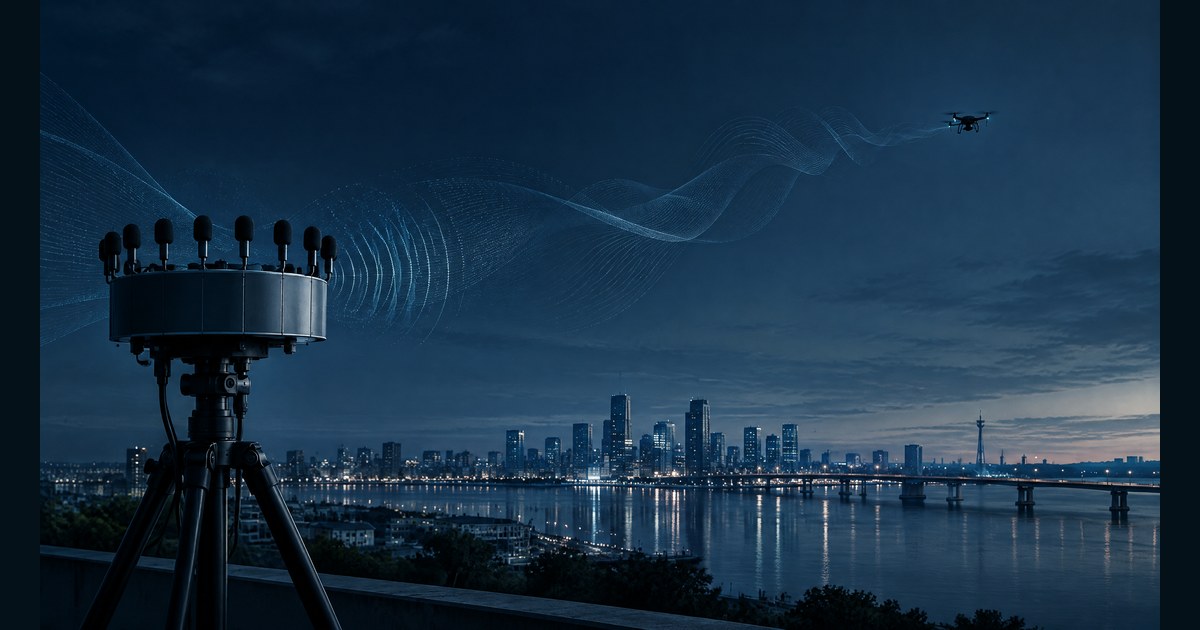
A practical framework for turning a customer problem into a bounded acoustic sensing proposal, with explicit outputs, evidence, integration assumptions, and qualification questions.
Start with the decision the customer needs to make
A proposal becomes evidence-based when it begins with a decision rather than a product description. Ask what the operator must know, how quickly that information matters, who reviews it, and what approved process follows an indication. A request for perimeter awareness, for example, is different from a request for an identified aircraft track or an investigation record.
Translate the problem into an observable output
Write the required output in terms that can be tested. Possible outputs include an acoustic event indication, a confidence score, a bearing estimate, a time-stamped event record, or an alert forwarded to an existing monitoring platform. Do not combine these into the word detection. A bearing is not a position, a classification is not an identity, and an alert is not proof of intent. The FAA explains that UAS detection systems can support alerts and further investigation but cannot determine intent or the level of threat posed by a UAS.
Separate must-have questions from later possibilities
A buyer may need an early warning cue today while considering multi-sensor correlation in a later phase. Put the immediate requirement, optional enhancement, and out-of-scope function in separate lines. This prevents a future integration idea from being read as a committed present capability. It also gives a systems integrator a clearer basis for designing interfaces and acceptance evidence.
Bound the acoustic sensing claim
Acoustic sensing listens to sound that reaches the sensing arrangement. It can add environmental context without relying on an observable control transmission, but it is still affected by the acoustic scene, the target's sound, array geometry, installation, and processing. A proposal should describe the conditions under which the output is expected and the conditions that require qualification.
State what the sensor observes and what it does not prove
Use language such as candidate acoustic event, estimated direction, or classified sound pattern when that is what the evidence supports. Do not state that an acoustic indication proves a unique aircraft identity, operator, authorisation status, or threat intent. A quiet target, a masked sound source, or an unfamiliar operating condition may not produce the same observable evidence. Passive reception also does not by itself prove that every component of a wider system emits no energy or that an installation has hazardous-area approval.
Describe the environment as a qualification variable
Record the background conditions that can influence an evaluation: road and rail noise, rotating equipment, ventilation, construction, wind, rain, reflective structures, birds, and authorised aircraft activity. Avoid a single universal range or accuracy statement unless it is tied to a defined test condition. The UK Department for Transport's maritime guidance similarly stresses that counter-drone options have strengths and weaknesses and should be assessed for a proportionate net benefit in the relevant organisation.
Turn the proposal into a requirement-to-evidence chain
A credible proposal lets a reviewer trace each important claim to a requirement and an evidence method. NIST's verification and validation guidance describes traceability between system requirements and software requirements, together with analysis, review, demonstration, and testing of development outputs. The same discipline is useful when an acoustic sensing module is part of a larger civil security system.
Use a compact evidence register
For each proposed capability, record five fields: the customer requirement, the measured or observed output, the test condition, the acceptance method, and the unresolved limitation. For example, a requirement for event forwarding should identify the interface, timestamp behaviour, message fields, simulated event source, and evidence to be delivered. A requirement for directional context should identify the reference geometry, test path or source location, environmental notes, and how error is reported.
Keep vendor evidence and site evidence distinct
A laboratory demonstration can show that a function exists. It does not establish performance at a refinery boundary, airport apron, port, data centre, or other customer's site. Label manufacturer documentation, independent test material, site pilot observations, and final acceptance records separately. This distinction helps procurement teams avoid treating a general product statement as a guaranteed site outcome.
Choose delivery scope without hiding the integration work
The proposal should make clear whether the buyer is considering a sensor component, a packaged acoustic subsystem, or a broader integrated awareness service. CISA recommends integrating detection technology into existing security plans and using a layered approach. That does not mean every project needs the same architecture; it means the integration boundary should be deliberate and documented.
Sensor-only delivery can be the right first step
A sensor-only scope may suit an OEM, research team, or integrator that already owns the user interface, event management, data storage, and operational procedures. The proposal should then define the physical and software interfaces, timing expectations, configuration responsibilities, environmental assumptions, and test data needed for the receiving system. SDK, API, protocol, warranty, and release terms should remain items for written project confirmation unless they have been verified for the specific offering.
Integrated delivery requires a wider acceptance boundary
An integrated proposal may include acoustic inputs, event processing, operator display, approved correlation with other sensors, logging, and handover. Each added layer introduces another dependency. Confirm data ownership, clock synchronisation, network behaviour, alarm routing, cybersecurity review, maintenance access, and the human decision path. Do not describe integration with radar, RF, cameras, Remote ID, or a command platform as complete merely because a connector or concept exists.
Write acceptance criteria that can survive review
The closing part of the proposal should explain how the parties will decide whether the defined scope is met. A useful acceptance plan does not promise a universal detection rate. It specifies scenarios, observable outputs, environmental notes, data retention, exception handling, and the evidence package that will be reviewed.
Use representative scenarios, not only ideal demonstrations
Illustrative example, not a SonicVast specification or customer result: a port operator could define separate scenarios for an authorised flight, a non-target mechanical noise event, a candidate aircraft at a documented test location, and a loss of network connectivity. The evaluation would compare recorded outputs with the agreed ground truth and note weather, background activity, sensor configuration, and operator action. The purpose is not to manufacture a headline number; it is to reveal whether the proposed output supports the stated decision.
Make change and uncertainty visible
Record assumptions that could change the result, such as a new fan bank, building work, altered mounting, firmware revision, microphone replacement, or a changed alert workflow. Report uncertainty in the same vocabulary used in the requirement. If the requirement is directional context, do not substitute a classification score. If the requirement is an event log, do not substitute a live dashboard screenshot.
Ask for a traceable proposal before asking for a headline range
Request a requirement-to-evidence schedule covering the target scenario, acoustic output, environmental assumptions, integration scope, test method, acceptance record, and unresolved limitations. Then confirm which items SonicVast can discuss for the actual site, configuration, and partner role. That sequence turns a general enquiry into a bounded project conversation.
Discuss your projectAcoustic observation is site- and condition-dependent. It does not by itself establish aircraft identity, authorisation, intent, universal coverage, or an automatic response authority. Product interfaces, performance, certification, availability, warranty, and service terms require written confirmation for the specific project.