
ACOUSTIC SENSING / ENGINEERING AND PROCUREMENT
Acoustic Drone Identification System: Link Sound With Authorized Identity Evidence
An acoustic drone identification system should be treated as an evidence connector, not a machine that proves who operates an aircraft. Microphone arrays can produce an observation such as a bearing, a time window, or a candidate class. A separate authorized source, such as Remote ID or a site flight log, may provide an identifier or mission record. The procurement question is whether the system can preserve and compare those records clearly enough for an accountable reviewer to make a civil operational decision.
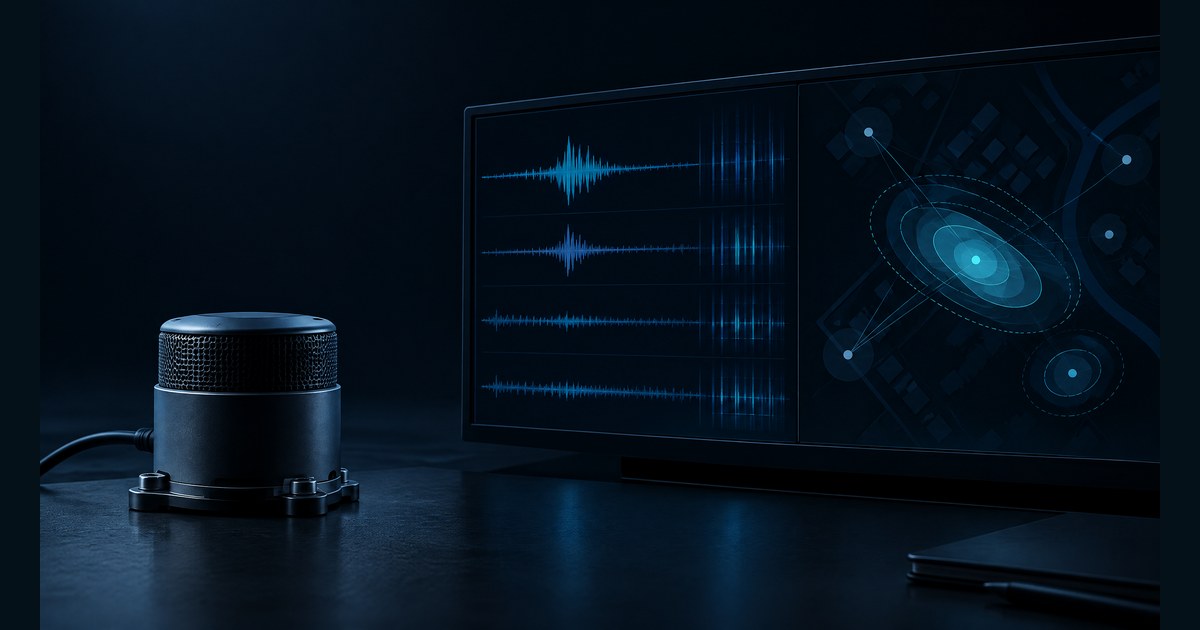
An acoustic observation can indicate that a drone-like sound is present. Identity and authorization require separate, access-controlled evidence. This guide shows buyers how to connect those evidence streams without turning a classifier into an identity authority.
Separate the acoustic observation from the identity claim
Sound and identity answer different questions. Acoustic processing works from received environmental sound. It may help a team decide that a drone-like event deserves review, but a sound pattern alone does not establish a serial number, operator, registration, permission, or aircraft model.
What the acoustic layer can contribute
A project may record the time of an event, an estimated direction, an approximate location derived from multiple observations, signal quality, and a classification result with its confidence or unknown status. These fields describe what the sensing layer observed. They should remain traceable to the sensor, processing version, environmental conditions, and review time. They are not substitutes for an external identity record.
What it cannot establish by itself
A likely multirotor class does not prove a particular make or serial number. A bearing does not prove the operator’s position. A missing acoustic event does not prove that no aircraft was present. These boundaries matter when a site is deciding whether an approved mission explains an alert or whether the event needs escalation under its own policy.
Use authorized external evidence as a second record
External identity evidence should enter the workflow through a defined authority, not through an informal assumption that a nearby aircraft is the same target. The available evidence will depend on jurisdiction, operating category, data access, and the operator’s compliance.
Remote ID is a correlation input, not a universal answer
The FAA describes Remote ID as broadcast identification and location information that can help relevant authorities locate a control station. For a standard Remote ID drone, the FAA says the broadcast includes information about the drone and control station; a broadcast module instead uses the take-off location. The FAA also explains that registration and compliance requirements apply within its regulatory framework. A receiver may therefore provide a useful time-and-location candidate, but the system should still record whether a message was received, whether it was complete, and whether the user is authorized to access any linked registration information.
Authorization records answer a different question
A site flight schedule, permit reference, operator approval, or mission ticket can show that a planned operation was authorized under the site’s process. It does not prove that the aircraft detected acoustically was the approved aircraft. The record becomes useful only after comparing time, area, altitude policy, operator or mission identifier, and the quality of the independent observation.
Access control is part of the identity design
EASA’s public explanation of European Remote Identification distinguishes information that the public may detect from the database association available to enforcement authorities. That distinction is a practical design cue: expose only the fields a reviewer is permitted to see, preserve restricted identifiers behind role-based access, and log when a record was queried or attached to an event.
Design the correlation record before choosing an interface
A dashboard can display a convenient match while hiding the reasoning behind it. Buyers should define the minimum evidence record first, then ask suppliers how the interface, API, or export preserves it.
Minimum fields for an auditable comparison
For each acoustic event, retain a stable event ID, sensor or node identity, synchronized time, observation quality, location or bearing output, class result, confidence or unknown label, and processing or model version. For each external record, retain its source type, received time, identifier type, geographic and temporal fields, authorization status, access role, and a reference to the original record where policy permits. The correlation result should say matched, partially consistent, conflicting, or unresolved rather than forcing a yes-or-no identity.
Time and location should be compared with tolerances
A Remote ID position, a flight-plan coordinate, and an acoustic bearing are not identical measurements. Network delay, clock drift, sensor geometry, aircraft movement, and map accuracy can produce differences even during an authorized flight. The project team should document its comparison window and spatial tolerance as site-specific engineering choices, then test how often those choices create ambiguous or conflicting results.
Make the reviewer’s decision visible
Correlation is valuable when it reduces avoidable uncertainty without hiding remaining uncertainty. CISA’s UAS Detection Technology Guidance for Critical Infrastructure recommends a system-of-systems approach and says sensor fusion can help reduce detection errors and enhance operator decision making. That guidance also emphasizes limitations, false positives, compatibility, training, and the need to understand how comparison libraries support identification and classification.
Use bounded review states
A practical workflow can use states such as acoustic observation received, external record found, temporal match, spatially consistent, authorization confirmed, conflict detected, and human review required. These labels describe evidence status. They should not silently become labels such as friendly, hostile, or confirmed operator unless a separate lawful process and accountable authority define those terms.
Keep conflicts as first-class outcomes
If the acoustic track overlaps an authorized flight but the Remote ID record is absent, incomplete, or inconsistent, retain the conflict and its reason. Possible explanations include coverage limits, non-compliance, data latency, an unrelated aircraft, or an acoustic false alarm. The system should support follow-up review rather than deleting the event because one source appears convenient.
Procurement questions for an integrated acoustic workflow
The best evaluation is not a promise that two feeds will fuse automatically. It is a written demonstration that the buyer can understand, govern, and export the evidence chain.
Ask how identity evidence is obtained and protected
Request a data-flow description showing which source supplies each identity field, who is allowed to access it, how credentials are managed, and how long records are retained. Ask whether the system can operate when an external service is unavailable without presenting stale data as current. Confirm whether the integration is read-only, whether it can preserve the original message metadata, and what audit log is available.
Ask how the match is explained and tested
Request examples of a successful match, an incomplete Remote ID message, an authorized flight outside the acoustic event window, and an unknown or conflicting case. Ask what happens when clocks are unsynchronized, several aircraft are present, the acoustic classifier returns unknown, or the external record is delayed. CISA specifically advises buyers to examine known limitations, testing environments, false positives, interoperability, training, and library updates.
Ask for a civil acceptance record
Acceptance should test evidence handling as well as detection. Define who supplies the authorized flight scenarios, who may view identity data, how reviewers record a decision, and which exports will be retained for incident or maintenance review. Treat SDK, API, Remote ID connector, retention, cybersecurity, and service terms as written project requirements to confirm with the selected supplier.
Define the evidence contract before integrating feeds
For a pilot, write the event schema, permitted identity fields, time and location tolerances, access roles, conflict states, retention rules, and reviewer responsibilities before selecting a connector. Then test normal, incomplete, and conflicting cases with representative civil operations. SonicVast can discuss acoustic sensing, PCBA, SDK, and integration requirements as project-specific options requiring written confirmation.
Discuss your projectRemote ID rules, data access, operator authorization, and retention obligations vary by jurisdiction and project. Acoustic sensing does not establish a unique aircraft identity, flight permission, or automatic response authority. Confirm legal, privacy, aviation, cybersecurity, and system-integration requirements with qualified project and regulatory advisers.