
ACOUSTIC SENSING / ENGINEERING AND PROCUREMENT
Acoustic Drone Monitoring System: Design an Event Record People Can Review
An acoustic drone monitoring system is only as useful as the record left after an alert. If the record says merely “drone detected,” a later reviewer cannot tell what was heard, when it was heard, which sensor produced the indication, what other evidence was available, or who assessed it. A more understandable monitoring event record preserves the observation, its limits, and the human review that followed. The exact English keyword is acoustic drone monitoring system.
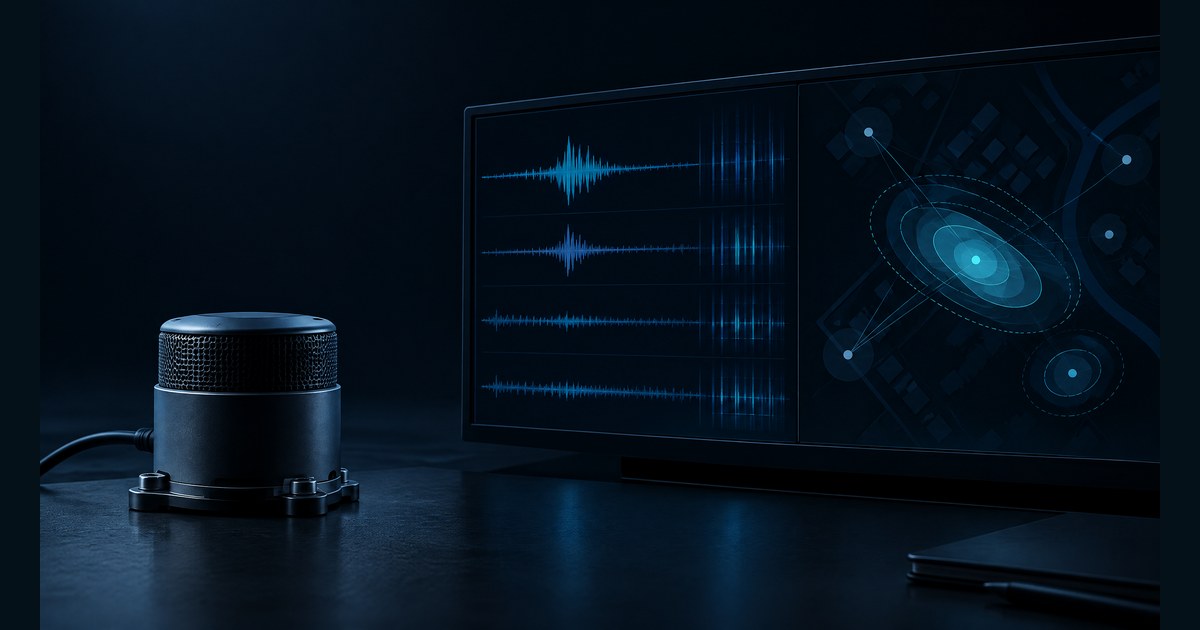
A practical, evidence-led guide to designing monitoring event records that operators, integrators, and infrastructure owners can understand and review without confusing an acoustic indication with aircraft identity, intent, or system health.
Start with an observation, not a conclusion
The first design decision is linguistic. A record should describe what the system observed before it describes what anyone believes it means. The Federal Aviation Administration notes that acoustic sensors may be used as UAS detection sources, alone or with other sensing technologies, and that detection systems do not determine intent or the level of threat posed by a UAS. That distinction should be visible in the record itself.
Use an event state that preserves uncertainty
Useful states might include indication, under review, correlated observation, cleared, and confirmed by an authorised reviewer. These are project-defined workflow labels, not universal regulatory categories. “Indication” says that a system produced an observable result. “Under review” says that a person or approved process is checking it. “Cleared” records a disposition without claiming that the original sensor was useless. A record should not silently convert a classifier label into a confirmed aircraft identity.
Separate detection from identity and intent
A microphone array can provide sound evidence and possibly directional context, depending on the system and site conditions. That does not by itself establish the aircraft model, operator, authorisation, intent, or legal status. A clear record therefore uses separate fields for acoustic indication, classification confidence if supplied, corroborating sources, identity assessment, and operational disposition. Blank or unknown values are more honest than a forced answer.
Give every event a stable timeline
A reviewer needs to reconstruct the sequence without guessing which clock or timestamp was used. NIST describes log management as a lifecycle that includes generating, transmitting, storing, accessing, and disposing of log data. For a monitoring event, that means the timestamp should be treated as evidence about the record, not as decorative dashboard text.
Capture more than one time
Consider recording the sensor-observation start time, observation end time, record-creation time, and review time. State the time zone or use a consistent machine-readable convention agreed for the project. If a gateway receives an event later than the sensor observed it, retain both times. This prevents a network delay from being mistaken for a delayed aircraft event.
Show sequence and change history
An event record should make it possible to see when a label changed from indication to under review, when a second source was attached, and when an authorised reviewer closed the case. Keep the original event content available rather than overwriting it with the latest status. A simple revision history can show who or what made each change, when it happened, and why.
Record the evidence trail without burying the reader
An understandable record is not a data dump. It presents a short operational summary first, then lets a qualified reviewer inspect the evidence behind it. Event logging is recognised by CISA and its partner agencies as a way to preserve visibility that supports the continued delivery of operations and the resilience of critical systems.
Put the review summary at the top
The first view can state the event identifier, current state, time window, affected site or zone label, reporting sensor or sensor group, and current disposition. Avoid a headline such as “hostile drone” unless an authorised process has established that conclusion and the record is explicitly about that decision. A better summary is “acoustic indication; review pending” or “indication correlated with approved flight record,” subject to the project's vocabulary.
Keep technical evidence linked to its source
The detail view can identify the sensor or node, software or configuration version, signal-quality indicators, directional result if available, related sensor observations, and any attached waveform or derived feature reference permitted by the project's privacy and security rules. Each item should have provenance. A reviewer should know whether a value came directly from a sensor, from an analytic service, or from a human entry.
Make human review an explicit part of the record
A record becomes understandable when it explains not only what the system produced, but also how the organisation interpreted it. The review step should not be hidden in a chat message or an operator's memory. It should be a controlled field in the event workflow.
Define the reviewer’s decision fields
A project may define fields such as review outcome, evidence considered, confidence or uncertainty note, related approved activity, escalation owner, and next review time. These fields should be adapted to the site's procedures. They are not a substitute for aviation, privacy, safety, or public-authority requirements. The important design principle is that a later reader can distinguish machine output from accountable human assessment.
Write a reason for closure
Closure should answer a small question: why is this event no longer awaiting review? Examples include an environmental sound explanation, correlation with an approved operation, insufficient evidence for further classification, or transfer to a named incident process. “Closed” alone is not an explanation. Neither is an unexplained colour on a map.
Design the record for handover and integration
Monitoring records often move between a sensor interface, a site platform, an incident-management tool, and a later review archive. NIST's lifecycle framing is useful here: generation and transmission matter as much as storage. A record that looks clear in one interface can become ambiguous when exported if field meanings and identifiers are not preserved.
Use a small, documented event schema
At minimum, document the meaning and format of the event identifier, timestamps, source identifier, location reference, event state, evidence references, confidence or uncertainty fields, reviewer identity, disposition, and revision history. Define whether a field is measured, inferred, selected from a list, or entered by a person. This makes an SDK or API discussion more concrete without assuming that any particular interface is already available.
Test a record outside the original dashboard
During integration acceptance, export sample records and ask a second reviewer who did not watch the live alert to explain what happened. Check whether the reviewer can identify the observation time, source, evidence, uncertainty, state changes, and final disposition. If the answer depends on undocumented vendor terminology or a screen that cannot be retained, the record design needs work.
Ask for a sample event record before selecting the integration scope
Ask each project participant to provide a redacted sample showing the complete event lifecycle: initial indication, timestamps, source evidence, related observations, review action, disposition, and revision history. Then ask whether the same record remains understandable after export to the intended site or incident platform. Confirm in writing which fields, attachments, time conventions, and access controls are supported for the actual project.
Discuss your projectAcoustic sensing observes sound and may provide an indication or directional context; it does not by itself prove a unique aircraft identity, flight authorisation, intent, or response authority. Record fields, access rules, and retention periods require site-specific legal, privacy, safety, and procurement review.