
ACOUSTIC SENSING / ENGINEERING AND PROCUREMENT
Acoustic Drone Tracking System: Documenting Track Gaps, Merges and Confidence Changes
An acoustic drone tracking system does more than place detections on a map. It must also explain how separate observations became one track, why a track was temporarily predicted without a fresh detection, and when a later observation was treated as a continuation rather than a new track. For civil infrastructure buyers, that history is often more useful than a single headline count. A defensible record makes uncertainty visible instead of turning a changing estimate into a permanent identity.
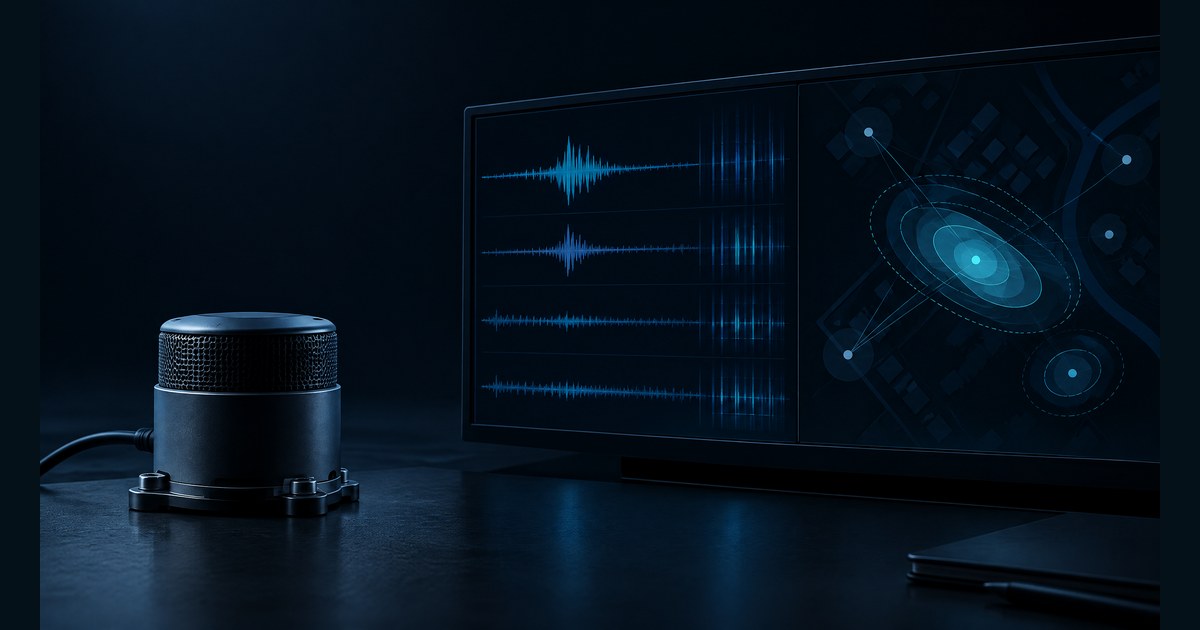
A procurement and review guide for documenting what happens to an acoustic track when detections disappear, overlap, reconnect or lose confidence.
A track is a managed estimate, not a continuous sound recording
A detection is an observation at a particular update. A track is a time-linked estimate assembled from observations and a tracking model. MathWorks describes multi-object tracking as obtaining detections, associating them across updates, and managing tracks. That distinction matters for acoustic sensing because sound can be intermittent, masked by machinery or altered by propagation conditions.
Separate the observation from the track state
A useful event record should distinguish at least four things: the raw or processed acoustic observation, the time and sensor that produced it, the estimated track state, and the status of the track. The state may include a bearing or position estimate and its uncertainty. The status should say whether the track is tentative, confirmed, coasted after a miss, merged, split, or terminated. A displayed line that hides these distinctions can make a predicted segment look like a new measurement.
Do not treat an identifier as aircraft identity
A track ID is an identifier for the system's evolving estimate. It is not proof of a unique aircraft, operator, model or authorization. Acoustic sensing observes sound and may support directional or positional context, but it cannot by itself establish that a target is literally silent, identify a particular aircraft with certainty, or establish flight permission. Those questions require separate approved evidence and governance.
Documenting a track gap without hiding it
When a detection is not assigned to an existing track, a tracker may keep predicting the state for a period rather than deleting the track immediately. MathWorks calls this a coast: the track is predicted without correction. A gap should therefore be represented as a state transition, not silently filled with a confident-looking line.
Minimum fields for every gap
For each gap, record the last update time, the first missed update, the time of the next accepted observation, the number or duration of missed updates, and whether the system coasted or terminated the track. Also retain the uncertainty or quality indicator before the gap and after reconnection. The record should identify the cause category used by the project, such as weak signal, masking, sensor health issue, communications delay, association rejection or no candidate observation. A cause category is not a diagnosis unless the underlying evidence supports it, so unknown should remain an available value.
A reconnection is not automatically proof of continuity
When a later acoustic observation falls near a coasted prediction, the tracker may reconnect it to the earlier track. Reviewers should be able to see the association conditions: time separation, spatial or bearing residual, uncertainty, competing candidate tracks and any gating threshold. A short gap with one plausible candidate is different from a long gap in clutter with several plausible candidates. The system should preserve both the continuity decision and the alternatives that were rejected when those alternatives matter to review.
Record merges and splits as identity events
In multi-target tracking, association is the problem of deciding which new observations belong to which existing tracks. Close or crossing sound sources can make that decision ambiguous. A merge or split should therefore be a first-class event in the audit trail, not an invisible correction to the display.
What a merge record should explain
A merge record should preserve the parent track IDs, the time window, the observations considered, the rule or model that selected one continuing track, and what happened to the other track. It should state whether the result is one retained track, a temporary ambiguity, or a termination of one estimate. Do not describe a merge as two aircraft becoming one. It means that the tracker could no longer maintain two sufficiently distinct estimates under the current evidence or its configured logic.
What a split record should explain
A split record should link the new track IDs to the earlier track, show the first update at which separate observations were accepted, and preserve the confidence or quality state before and after the split. A split may reflect newly resolved observations, a changed association decision or a previously combined acoustic scene. Without the event history, a reader may incorrectly count one track before the split and two tracks afterward as three separate objects.
Confidence must have a defined meaning and a visible history
The word confidence is not self-explanatory. It may refer to a classifier score, an association likelihood, a track-existence score, a localization uncertainty or a user-interface category. These values should not be mixed. MathWorks documents score-based track logic in which a score can support confirmation and deletion, while its tracking examples also expose state such as whether a track is confirmed or coasted.
Log changes, not only the current label
For every material confidence change, retain the previous value or band, the new value or band, the timestamp, the event that caused the change, and the relevant input summary. Examples include a new assigned observation, a missed update, a conflicting candidate, a merge, a split, a sensor-quality warning or a model revision. If the product only exposes high, medium and low, procurement teams should ask for the thresholds and whether the labels are comparable across sites, firmware versions and sensor configurations.
Avoid false precision in operational review
A score of 0.82 is not automatically more meaningful than a score of 0.81. Reviewers need the score definition, calibration context and decision thresholds before comparing values. A track with a high classification score can still have weak position certainty, while a well-localized sound source can remain uncertain as to whether it is the same source observed earlier. Store these dimensions separately where the system supports them, and label unavailable dimensions rather than inferring them.
Turn the event history into an acceptance record
A buyer evaluating an acoustic drone tracking system should ask to inspect event-level evidence, not only a replay that draws smooth lines. The aim is to test whether the system communicates uncertainty in a way that a site operator, integrator and later reviewer can understand.
A practical review packet
Request a synchronized packet containing sensor timestamps, observation IDs, track IDs, status transitions, association decisions, gap durations, merge and split links, confidence history, configuration version and relevant health flags. Include the raw or retained evidence permitted by the site's privacy and retention policy. The packet should make it possible to reconstruct why a track began, why it persisted through a gap, why it changed confidence and why it ended.
Questions for a controlled demonstration
Ask the integrator to demonstrate one clean continuation, one missed-update gap, two nearby sources that create association ambiguity, and a track that should be terminated. The exact scenario should be defined by the project and should not be presented as a universal performance result. Review whether the interface distinguishes measured updates from coasted predictions, preserves old IDs after a merge or split, and exports the same history that it displays.
Specify the track audit trail before comparing demonstrations
Before comparing suppliers or integration options, define the event fields, status vocabulary, confidence semantics, export format and retention rules that the project requires. Ask SonicVast to confirm the applicable sensing, PCBA, SDK or integration scope in writing for the actual architecture; do not infer a particular tracking workflow from a general product description.
Discuss your projectTracking states, scores and event fields vary by implementation. Acoustic observations are affected by the environment, and a track does not by itself establish aircraft identity, authorization or response authority. Any acceptance thresholds should be set for the specific site and approved operating process.