
ACOUSTIC SENSING / ENGINEERING AND PROCUREMENT
Counter UAS System Integration: Preserve Evidence Provenance Across Sensors
In counter UAS system integration, a fused track is only as reviewable as the evidence behind it. A useful integration should let a buyer answer which sensor produced each observation, when the phenomenon occurred, when the system received the result, what processing changed it, and who approved the resulting alert. This provenance discipline is especially important when acoustic, RF, radar and optical inputs disagree or one source becomes unavailable.
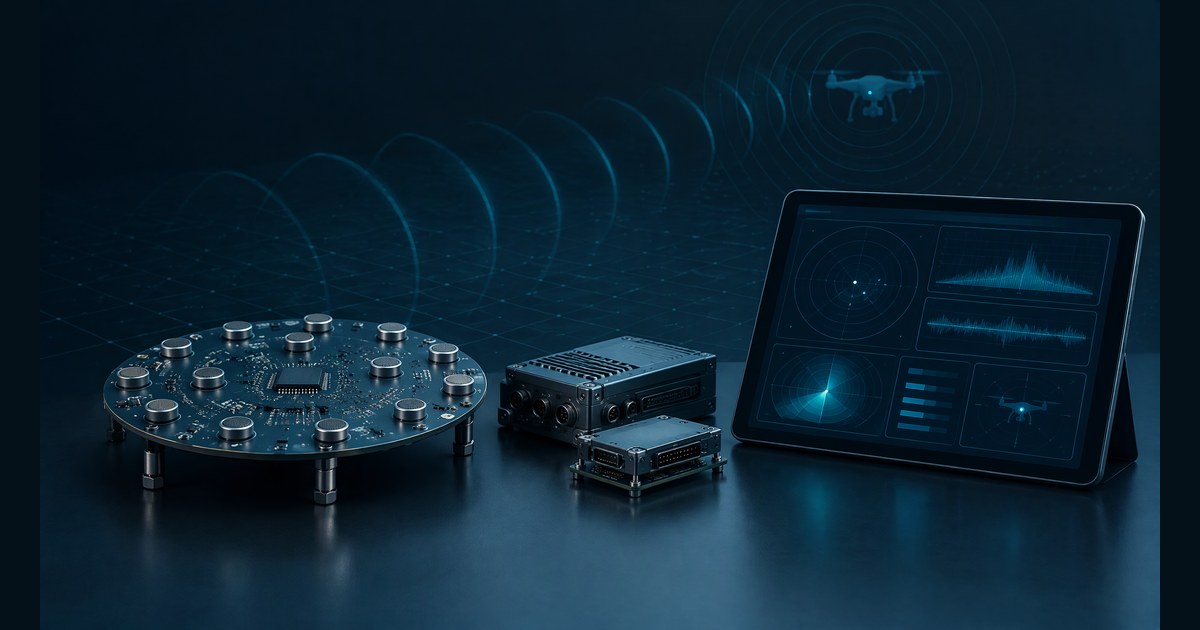
A procurement and engineering guide to keeping every multi-sensor observation traceable from collection through correlation, review and export.
Treat the fused track as a derived record, not the original evidence
A multi-sensor platform normally creates new records as it receives, normalises and associates observations. The final track is therefore a derived product. It should remain linked to the underlying observations instead of replacing them.
Separate observation, interpretation and decision
An acoustic node may report a candidate bearing and a sound feature. An RF subsystem may report relevant radio activity. Radar may report a plot, while an optical system may provide an image or video review. None of these outputs alone is automatically a unique aircraft identity or an authorised response. The integration should label the stages separately: raw or near-raw observation, sensor-level interpretation, correlated track, operator review and site decision. This prevents a confidence score or dashboard label from being mistaken for primary evidence.
Keep lineage when records are filtered or combined
A fusion engine may resample timestamps, remove duplicate reports, convert coordinates, suppress a known nuisance source or combine several observations into one track. Each operation should have a record of the input identifiers, software or rule version, processing time and output identifier. W3C PROV describes provenance through entities, activities and agents, including derivation and attribution. That model is a useful design reference even when a project uses its own data schema.
Make time and identity part of the evidence model
Sensors cannot be compared reliably if their clocks and identifiers are treated as incidental. Time alignment does not prove that two observations describe the same aircraft, but poor time records can make that question impossible to review.
Record phenomenon time separately from result time
The time a sound, radio signal, radar return or image was observed can differ from the time a device, gateway or fusion service produced its result. OGC SensorThings API distinguishes phenomenonTime and resultTime and links observations to a sensor and datastream. A project should preserve both concepts, plus time zone or UTC representation, clock source, synchronisation status and any known offset or uncertainty. IEEE 1588 describes Precision Time Protocol for synchronising clocks in networked distributed systems; whether a project uses PTP, another method or a documented local reference, the chosen method and health state should be visible in the record.
Use stable identifiers across gateways and software
A sensor identifier should survive transport, storage and reprocessing. Event identifiers, device identifiers, datastream identifiers and track identifiers should not be silently regenerated when a message crosses a gateway. If a system must transform an identifier, it should retain the predecessor and successor relationship. This allows an engineer to follow one observation from the edge device to the fused display and later export without relying on screenshots or memory.
Preserve raw context when a sensor is uncertain
Provenance is most valuable when data is incomplete. A degraded microphone array, intermittent network, RF silence, radar clutter or low-light image does not automatically mean that another sensor is wrong. The integration should expose the limitation rather than hide it inside a single score.
Attach health and quality state to each contribution
Useful fields include sensor health, calibration or configuration version, coverage state, network delay, missing-data flag, quality indicator and the reason an observation was rejected or down-weighted. These are not universal performance guarantees; they are documentary controls to be agreed in the project specification. A track built while one sensor was offline should say so, and a later replay should not make the original degraded condition disappear.
Do not convert absence into a negative finding
No RF observation is not proof that no aircraft is present. No acoustic observation can reflect distance, masking noise, wind or an aircraft whose sound is not captured. Likewise, an optical camera that produces no usable image may be affected by lighting or line of sight. A provenance-preserving interface distinguishes not observed, not available, not processed and observed negative. That distinction is more useful to reviewers than a forced yes-or-no status.
Build an auditable review record around the correlation engine
The integration layer should make it possible to reconstruct how a candidate track was formed without treating the fusion algorithm as an opaque authority. The review record can be compact, but it must contain enough context to test the conclusion.
Record why observations were associated
For each association, retain the rule or model version, time window, spatial relationship, sensor sources, relevant quality fields and any operator override. A buyer does not need every internal calculation on the main screen, but the underlying record should be exportable for engineering review. This is different from claiming that a correlation is correct. It simply makes the basis of the correlation inspectable.
Protect the record from silent alteration
NIST defines chain of custody as tracking evidence through collection, safeguarding and analysis, including who handled it, when it was collected or transferred and why. For a civil sensing project, that principle can become access control, append-only or versioned event storage, audit logs, integrity checks and documented export procedures. These controls do not turn a sensor observation into legal proof by themselves. They make later review more credible and reveal when a record has been changed, reprocessed or redacted.
Turn provenance into a procurement and acceptance requirement
A vendor-neutral statement of work should specify what evidence the integrator will retain, how long it will be retained, who can access it and how a buyer can replay a representative event. The requirement should cover the sensing layer and the software that transports, correlates and displays it.
Ask for a field-level data dictionary
Request the meaning, unit, source, precision and update behaviour of fields such as event ID, sensor ID, phenomenon time, result time, location reference, bearing, quality state, processing version and association status. Ask which fields are mandatory when a sensor is degraded. If the interface exposes only a final track and confidence value, ask how the original observations and transformation history can be retrieved. SDK, API and schema contents should be confirmed in writing for the actual project.
Test disagreement and replay, not only nominal detection
An acceptance exercise should include a known sequence of test observations or a clearly labelled illustrative dataset, with at least one delayed message, one unavailable sensor and one conflicting observation. The evaluator should check whether the system preserves original timestamps, identifies the affected source, records the association decision and reproduces the same review view from retained data. This tests evidence governance rather than claiming a universal detection rate.
Specify the provenance chain before selecting the fusion screen
Ask each integrator to map one representative event from acoustic, RF, radar or optical input through transport, processing, correlation, operator review and export. Compare the maps for timestamp semantics, stable identifiers, health states, transformation history, access controls and replay support. Then confirm the required interfaces and retention terms in the project documentation.
Discuss your projectProvenance controls support engineering review and accountable civil operations; they do not establish aircraft identity, flight permission, legal authority or a guaranteed detection result. Sensor, SDK, API, retention and security functions require written confirmation for the specific integration.