
ACOUSTIC SENSING / ENGINEERING AND PROCUREMENT
Industrial Acoustic Drone Detection System Validation After Maintenance Changes
An industrial acoustic drone detection system is validated against the sound environment in which it must operate. That environment is not fixed. A bearing replacement, a new silencer, a repaired compressor guard, a changed production rate, or temporary construction equipment can alter the background or the way sound travels. The right response is not to discard the system or label the change a false alarm. It is to connect the acoustic record to the maintenance record and determine whether the relevant observation conditions still match the approved validation case.
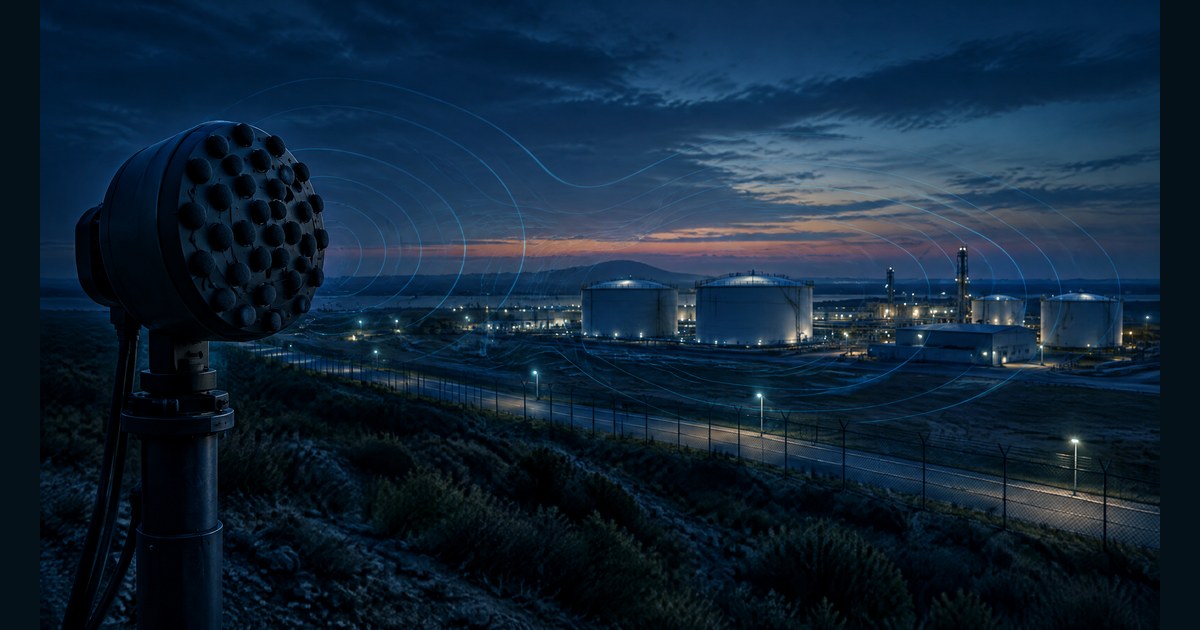
A maintenance job can alter the acoustic scene without creating a drone event. This guide shows industrial buyers and integrators how to identify maintenance changes that matter, preserve comparable evidence, and decide when acoustic validation should be repeated.
Why maintenance is part of acoustic validation
Acoustic validation asks whether an observed sound pattern is usable for the stated sensing purpose under documented conditions. Maintenance changes those conditions in two different ways: it may change the sound emitted by equipment, or it may change the path between a source and a microphone. A review that records only a detection result cannot tell these causes apart.
Separate the monitored machine from the sound scene
A repair can reduce a machine's noise, introduce a new tonal component during run-in, or change vibration that becomes airborne sound. At the same time, an acoustic enclosure, barrier, duct, roof panel, or fan replacement can change reflection, shielding, and directionality. These are not the same as a drone observation. They are changes to the conditions under which the observation is interpreted.
Use condition labels instead of one permanent baseline
A useful validation record labels the plant state: equipment identity, operating mode, load or throughput where relevant, nearby work, weather, and sensor status. ISO 20816 describes operational monitoring as measurements made during normal machine operation and distinguishes machine-produced vibration from vibration transmitted from outside. The same discipline is useful here: compare like operating states, and document when the state has changed rather than forcing every measurement into one undifferentiated baseline.
Maintenance changes that deserve an acoustic review
Not every work order requires a full revalidation. The practical question is whether the work could change the spectrum, level, intermittency, direction, or transmission path within the acoustic observation area. Buyers should ask the maintenance and integration teams to flag those changes before the next acceptance or performance review.
Rotating equipment, bearings, drives, and lubrication
Bearing replacement, alignment, belt tension, balancing, gearbox work, and lubrication can change mechanical vibration and airborne sound. OSHA identifies maintenance and lubrication as engineering measures that can reduce workplace noise, while NASA's predictive-testing guidance describes vibration and acoustic-emission techniques as condition-monitoring methods with their own limitations. A quieter or differently modulated pump is therefore a maintenance-state change, not evidence that an acoustic drone layer has gained or lost a universal capability.
Fans, silencers, enclosures, and barriers
Replacing a fan, adjusting an air-handling system, adding a silencer, repairing a guard, or moving an acoustic barrier can change both source noise and propagation. HSE engineering guidance lists damping, anti-vibration mounts, silencers, enclosures, screens, and periodic inspection as noise-control measures. These works should be recorded with their location and completion date because a sensor may hear a changed sound field even when no production asset is malfunctioning.
Process, construction, and temporary equipment changes
A production-rate change, altered start-up sequence, night shift, crane or generator hire, scaffolding, pressure washing, or road work can create intermittent sounds that were absent during the original validation. Such activity should be treated as an operating condition to be labelled and, where feasible, sampled separately. Do not silently merge temporary work into the permanent site record.
Build a maintenance-aware validation record
The objective is a traceable comparison, not a larger pile of recordings. For each validation run, keep enough context for a reviewer to understand what the microphones, analytics, and other approved evidence were actually observing.
Capture the change before interpreting the signal
Link the acoustic run to the work-order or change reference, affected asset, work type, start and completion time, operating mode, and whether equipment was in warm-up, steady operation, shutdown, or post-maintenance observation. Record sensor placement and health, environmental conditions that materially affect the measurement, and any known nearby activity. A short note such as “fan replaced” is less useful than “fan F-12 replaced; speed control changed; enclosure panel reinstalled; first steady-load run recorded.”
Compare recordings on matched conditions
Where possible, compare pre-change and post-change samples at a comparable operating state and with the same documented sensor configuration. ISO 3744 explains that sound-power determination uses sound-pressure measurements around a source and depends on a defined measurement environment, including reflecting surfaces and corrections. That principle cautions against treating recordings made after a barrier, enclosure, or layout change as directly interchangeable without noting the changed environment.
Keep a human-review path for ambiguous changes
A change in sound level or spectrum can justify investigation, but it does not by itself establish a unique aircraft identity, position, flight authorisation status, or response authority. Escalation should preserve the recording, the maintenance context, and any independently approved corroborating evidence. The purpose is to make the conclusion reviewable and to prevent an equipment change from becoming an automatic security conclusion.
Decide whether to monitor, spot-check, or revalidate
Maintenance-aware validation does not mean repeating every test after every intervention. It means setting a written decision rule before the work occurs. The rule should be based on how much the work could affect the acoustic observation, not simply on the maintenance department's label for the job.
A spot-check may be enough for a low-impact change
A documented spot-check can be appropriate when the change is remote from the sensing path, the operating state is unchanged, and the pre- and post-work recordings remain comparable. The record should state who reviewed the comparison, what was checked, and why the original validation remains applicable.
Plan targeted retesting for a source or path change
Targeted retesting is more defensible when a major rotating asset, fan, enclosure, barrier, roof section, duct, or site layout has changed near the observation area. Retest the affected operating states and document the result as a new validation condition. Avoid presenting it as a universal range or accuracy claim; it is evidence for the specified site and conditions.
Reopen the validation plan when the use case changes
A change in operating hours, production schedule, sensor relocation, construction phase, or required alert workflow can be more significant than a single repaired component. In that situation, revisit the validation objectives and acceptance evidence rather than applying a narrow maintenance retest to a broader operational change.
Procurement questions for an industrial project
A buyer can make maintenance readiness part of the delivery scope without prescribing a particular algorithm or claiming a result in advance. The contract and commissioning plan should make the evidence responsibilities visible to the owner, maintenance team, integrator, and sensing supplier.
Questions about records and interfaces
Ask whether the project can associate an acoustic observation with an asset identifier, work-order reference, operating state, and review status. Confirm which fields are available through the proposed interface or export, and require written confirmation for any SDK, API, data-retention, or integration detail.
Questions about retest boundaries
Ask which maintenance categories trigger a spot-check, targeted retest, or full validation review; who approves the comparison conditions; and what evidence is retained. The answer should identify assumptions about sensor position, plant configuration, operating mode, and environmental conditions rather than promise a fixed result across all sites.
Questions about civil governance
Ask how an ambiguous acoustic indication is presented to an authorised reviewer, how approved flights and planned maintenance are recorded, and how the system avoids converting an acoustic cue into an automatic response. Acoustic reception does not establish that a target is present when it is silent, nor does it prove aircraft identity or legal status.
Add a maintenance-change gate to the validation plan
Before procurement or commissioning, define the work-order fields, condition labels, comparison method, and retest thresholds that the project will use. SonicVast project discussions can then focus on the required sensing and integration scope, while the owner retains responsibility for site evidence, maintenance coordination, and civil operating decisions.
Discuss your projectAcoustic observations are site- and condition-dependent. This article does not establish a guaranteed detection range, accuracy, certification, or automatic response authority. Any interface, retention, warranty, or service term requires written project confirmation.